


Table of content
Key Takeaways
- A dental bridge is a fixed restoration. It spans the gap left by one or more missing teeth, supported by the natural teeth on either side, and is cemented in place.
- A bridge is priced per unit, not per gap. Each unit is billed at the crown price for the material chosen; see the Elite Dental Vietnam cosmetic dentistry price list for current figures.
- A bridge replaces the crown of a tooth, not the root. Ridge resorption therefore continues beneath the pontic. An Implant is the option that addresses that mechanism directly.
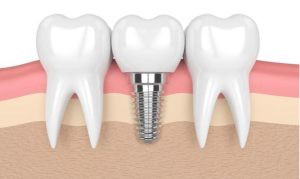
- A dental bridge replaces the crown of a tooth, not the root, so the bone beneath the pontic will continue to resorb.Because the bone beneath the pontic is no longer stimulated by a natural tooth root, alveolar ridge resorption continues. In contrast, a dental implant is an artificial tooth root placed into the jawbone to replace the missing natural root, thereby providing functional stimulation to the surrounding bone and helping preserve the bone.
- Candidacy is the deciding factor. The choice between a bridge, an Implant, and a partial denture depends on the neighboring teeth, the bone, and the patient’s budget account.
- Elite Dental Vietnam holds AACI accreditation with a score of 95.33/100, the first AACI-accredited dental system in Vietnam (issued September 2025).
1. What is a dental bridge and how does it work?
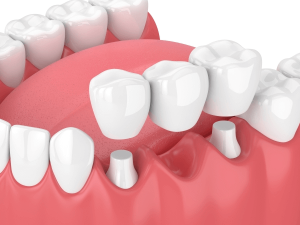
A dental bridge is a fixed prosthesis that replaces one or more missing teeth. The replacement tooth, called a pontic, is joined to crowns cemented onto the prepared teeth on each side of the gap. Those supporting teeth are called abutments,
Bridges come in two broad material families. All-ceramic bridges are built entirely from tooth-colored material and are the usual choice where appearance matters. Metal-ceramic bridges use a metal framework covered with ceramic, and remain practical in some posterior situations.
Restorations at Elite Dental Vietnam are designed and milled using CAD/CAM workflows, with shade and shape personalized to the patient’s existing teeth. In the visible zone, Smile Design planning is used to agree the final look before fabrication.
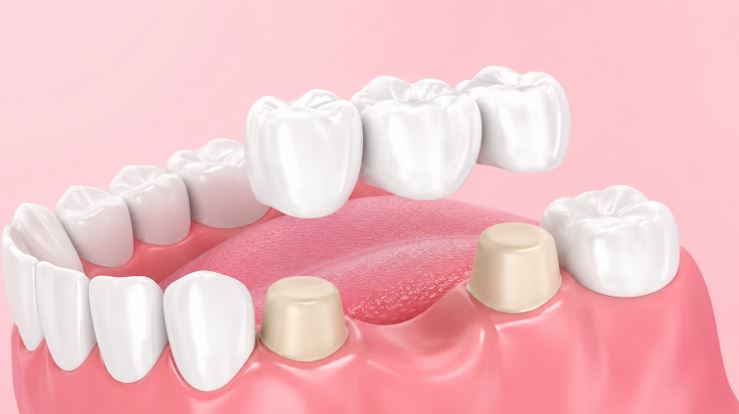
A dental bridge permanently fills the gap left by one or more missing teeth
2. What types of dental bridges are used in 2026?
Four designs cover most cases seen in Ho Chi Minh City today. The right one depends on how many teeth are missing, where the gap sits, and what the neighboring teeth can carry. The designs do not carry the same track record, so the durability column below is part of the discussion, not a footnote to it.
| Bridge type | How it is supported | Typically considered when | Longevity and durability notes |
| Traditional bridge | Crowns on the natural teeth on both sides of the gap | The most common design; both neighboring teeth are sound enough to serve as abutments | The most extensively documented tooth-supported design, with survival of approximately 94% at five years and 89% at ten years [2] |
| Cantilever bridge | A single/ a couple of natural teeth on one side | Just one suitable abutment is available; requires careful planning of force distribution | The load is carried on one side only. Cantilever designs are reported with lower survival, and with loosening of the retainer more often, than conventional bridges in the same systematic review series [2] |
| Maryland bridge | A pontic bonded by wings to the back surfaces of adjacent teeth | A conservative option for a front tooth where the neighbors are healthy and largely untouched | Preserves the most tooth structure, but the bonded wings can come loose. Resin-bonded designs are reported with lower survival than conventional bridges , and debonding is the usual reason for re-treatment |
| Implant-supported bridge | Implants placed in the jawbone as abutments | The patient prefers not to prepare healthy neighbors or the edentulous span is too long. | Does not depend on natural abutment teeth. Its longevity is comparable to that of a natural tooth. |
The pattern is consistent: the designs that remove less tooth structure, or that rest on a single abutment, ask more of the bond or the abutment and are reported with shorter service life. That trade-off is discussed openly at the consultation, because it is often the point on which the choice turns.
3. Who is a good candidate for a dental bridge?
A bridge suits a patient who wants a fixed replacement and has healthy, well-positioned teeth on both sides of the gap. It is also a common recommendation for patients who are not currently candidates for Implant surgery, or who prefer a shorter treatment path.
The design is reconsidered in a few situations. A second molar lost without a suitable abutment behind it cannot support a conventional bridge. Active periodontal disease or compromised abutment teeth are treated first, because the bridge relies on those teeth for support.
The trade-off worth understanding is tooth preparation, which is permanent. Where the abutment teeth already need crowns anyway, this matters less; where they are intact, it weighs more heavily.
4. How does a bridge compare with an Implant or a partial denture?
Each option answers a different clinical question.
| Dental bridge | Implant | Partial denture | |
| Fixed or removable | Fixed, cemented | Fixed | Removable |
| Neighboring teeth | Prepared and crowned | Left untouched | Used as clasp support |
| Replaces the root | No (restores the crown alone) | Yes (an artificial root is placed in the bone) | No |
| Effect on ridge bone | Resorption under the pontic continues | The Implant transmits chewing load into the bone, a factor associated with maintaining ridge volume | Resorption continues |
| Surgery required | No | Yes | No |
| Treatment time | Shorter (a series of appointments) | Longer (healing time between stages) | Shortest |
| Relative cost | Moderate | Higher | Lowest |
| Often considered when | Neighbors need crowns anyway; a fixed result is wanted quickly | Neighbors are healthy; the ridge is a priority in the plan | Several teeth are missing, or as an interim solution |
On the bone question, the mechanism is worth stating plainly. A natural tooth root transmits chewing forces into the alveolar bone, and that stimulation is associated with maintaining bone volume. A bridge restores the visible crown and the chewing surface, but does not put a root back into the socket, so the ridge under the pontic continues to remodel.
The timing matters for reading the numbers correctly. Published research on extraction sites reports roughly half of the ridge width lost within the first year, most of it in the first three months [3]. That change follows the extraction itself and happens whichever restoration is chosen, or none at all. A bridge does not add to it, but a bridge does not act on that mechanism either, and an Implant placed after the site has healed does not reverse the volume already lost in those early months. What is being compared is what happens from that point on.
This is why candidacy is assessed case by case rather than by rule, and systematic review evidence comparing the replacement options directly remains limited [4]. Where the abutment teeth already need crowns, a bridge treats two problems with one restoration. Where the neighbors are intact and the bone is good, an Implant leaves the neighboring enamel untouched and puts a root back into the site.
How is a dental bridge placed?
Treatment begins with a clinical examination and imaging to assess the abutment teeth, the periodontal tissues, and the shape of the ridge. Any decay, pulp involvement, or gum disease is treated before the bridge is designed.
The bridge is then completed over a short series of appointments. The abutment teeth are prepared, records are taken, and a temporary restoration is fitted during fabrication. The framework is tried in, the shade confirmed, and the finished bridge cemented. The number of visits and the schedule depend on the patient’s clinical condition and treatment plan, confirmed at the initial consultation.
Does getting a dental bridge hurt?
The preparation appointment is carried out under local anesthesia and is well-tolerated by most patients. Some sensitivity around the prepared teeth in the days that follow is normal, and post-operative discomfort is typically managed with standard analgesia.
Sensitivity that persists, or a bridge that feels high when biting, should be reviewed rather than tolerated. Both are usually straightforward to adjust.
How much does a dental bridge cost in Ho Chi Minh City?
A bridge is priced per unit. Each crown in the span counts as one unit: the two abutment crowns and each pontic. A three-unit bridge is therefore billed as three units of the chosen material.
For current 2026 pricing, see the Elite Dental Vietnam cosmetic dentistry price list.
The number of units is confirmed at the consultation, once the abutment teeth and the span have been assessed. For international patients, treatment costs in Vietnam are significantly lower than in the US or Australia. That difference is driven by local operating and laboratory costs, not by the materials or the protocols used.
How long does a dental bridge last, and how do you care for it?
Systematic reviews of tooth-supported fixed dental prostheses report survival of approximately 94% at five years and 89% at ten years [2]. Those figures describe conventional bridges. Longevity in any individual case depends on oral hygiene, the material chosen, the design used, the health of the abutment teeth, and the accuracy of the fit.
Day-to-day care is the largest variable a patient controls:
- Brush twice daily with a soft-bristled brush and fluoride toothpaste, focusing on the margin where the bridge meets the abutment teeth.
- Clean under the pontic daily with floss threaders or interdental brushes, because brushing alone cannot reach this area.
- Return to soft foods in the first days after cementation, then resume a balanced diet.
- Attend check-ups, typically every six months, so the margins and abutment teeth can be reviewed.
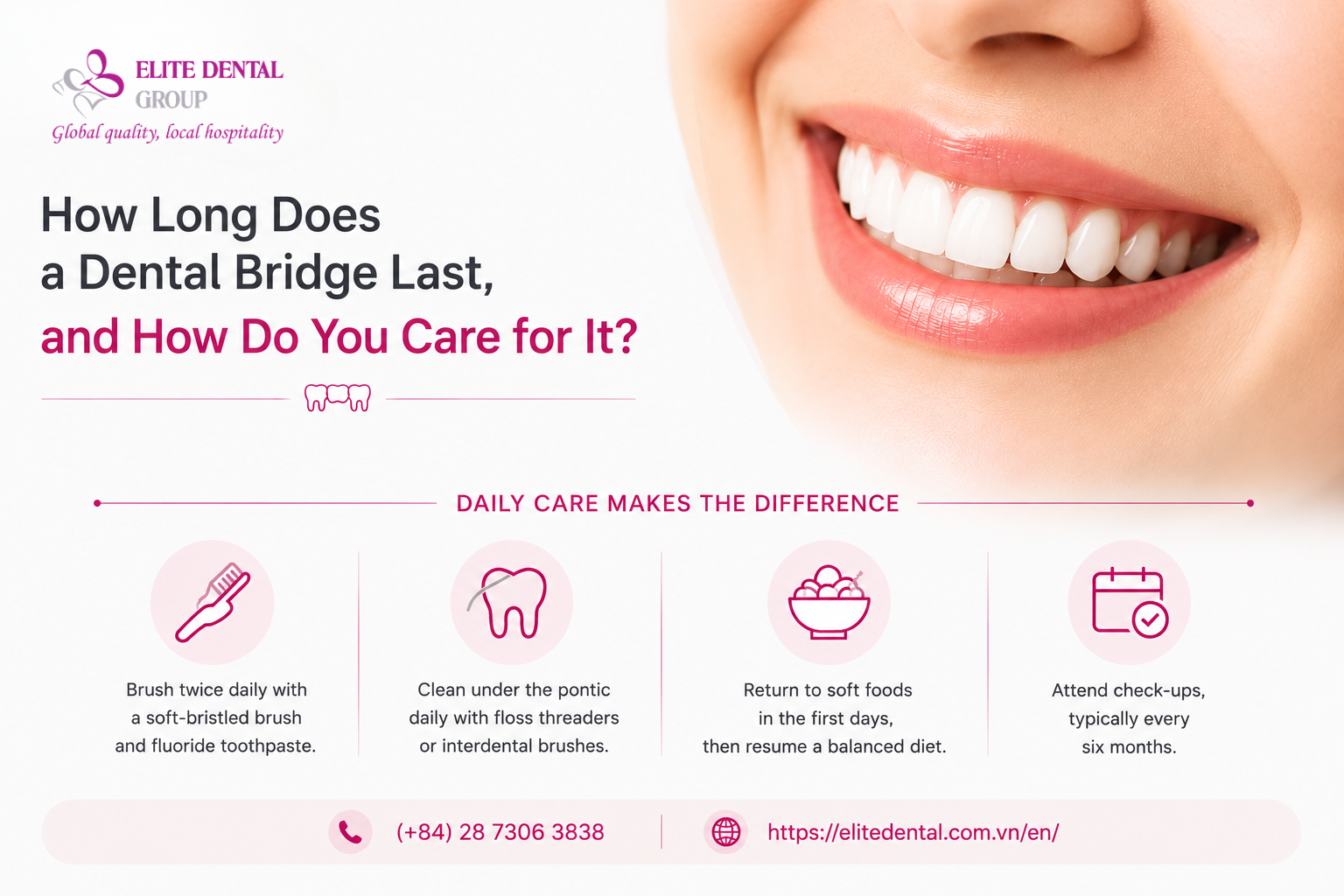 What is the typical lifespan of a dental bridge, and what’s the best way to maintain it?
Quality standards at Elite Dental Vietnam
Elite Dental Vietnam holds AACI (American Accreditation Commission International) accreditation with a score of 95.33/100 — the first AACI-accredited dental system in Vietnam (issued September 2025). AACI evaluates sterilization, material traceability, and patient safety.
For restorative work, this means the ceramics used in bridges and crowns are documented from a defined supply chain. The shade and shape agreed with the patient are recorded in the treatment file. Emax ceramics used in cosmetic cases at Elite Dental Vietnam are sourced from Europe. AACI assesses the quality-management and safety system, not the clinical outcome of an individual case.
Contact Elite Dental Vietnam at (+84) 28 7306 3838 for a consultation on dental bridges.
Conclusion
A dental bridge is a well-established, fixed way to replace missing teeth, restoring chewing function and appearance over a shorter treatment path than surgery. Two characteristics define it: the abutment teeth are prepared, and it restores a crown rather than a root. Those two points are what the candidacy discussion is about.
Where the neighboring teeth already need restoration, that trade-off often favors a bridge. Where they are intact and the bone is healthy, an Implant is worth weighing. The design also matters, because the four bridge types do not carry the same published service life. At Elite Dental Vietnam in HCMC, both options are assessed at the consultation, with the reasoning explained beforehand.
Frequently Asked Questions
Can I get a dental bridge if I have some bone loss in the area?
Yes, in most cases. A conventional bridge is supported by the abutment teeth rather than by the bone under the gap, so moderate ridge resorption does not by itself rule it out. Most of that resorption follows the extraction itself rather than the restoration. The dentist may adjust the pontic design to sit comfortably against the reshaped ridge.
Can a bridge be made if one of my neighboring teeth already has a large filling?
Yes, and this is a common and favorable situation. A tooth that already needs a crown makes a natural abutment, because the preparation it requires is the same one the bridge needs.
Can I choose an Implant later if I start with a bridge now?
Yes. Many patients begin with a bridge and move to an Implant at a later stage, often when the bridge reaches the end of its service life. The bone under the pontic is assessed at that point, and grafting is planned if needed.
Is a zirconia bridge suitable for back teeth?
Yes. Zirconia is well suited to posterior bridges, where chewing loads are highest, and it gives a tooth-colored result. The material for each case is agreed at the consultation, based on the position of the gap and the appearance the patient is aiming for.
Can international patients complete a bridge in one visit to Vietnam?
In most cases, yes. Bridge treatment does not require the healing interval that Implant surgery does, so it is often completed within a single trip to Ho Chi Minh City. The schedule depends on the clinical condition and treatment plan, confirmed at the initial consultation.
References
- American Dental Association (MouthHealthy). https://www.mouthhealthy.org/all-topics-a-z/bridges
- Tan K, Pjetursson BE, Lang NP, Chan ES. A systematic review of the survival and complication rates of fixed partial dentures (FPDs) after an observation period of at least 5 years. Part III: conventional FPDs. Clin Oral Implants Res. 2004;15(6):654-666. https://pubmed.ncbi.nlm.nih.gov/15533125/
- Schropp L, Wenzel A, Kostopoulos L, Karring T. Bone healing and soft tissue contour changes following single-tooth extraction: a clinical and radiographic 12-month prospective study. Int J Periodontics Restorative Dent. 2003;23(4):313-323. https://pubmed.ncbi.nlm.nih.gov/12956475/
- Abt E, Carr AB, Worthington HV. Interventions for replacing missing teeth: partially absent dentition. Cochrane Database of Systematic Reviews. 2012, Issue 2. Art. No.: CD003814. https://pubmed.ncbi.nlm.nih.gov/22336793/