

Table of content
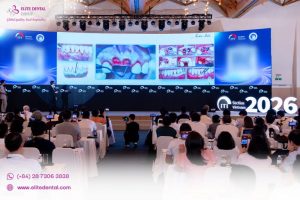
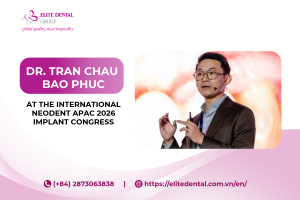
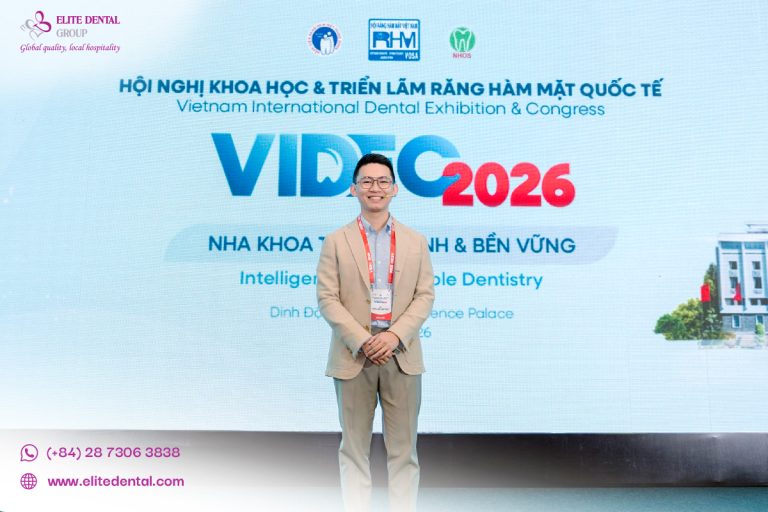
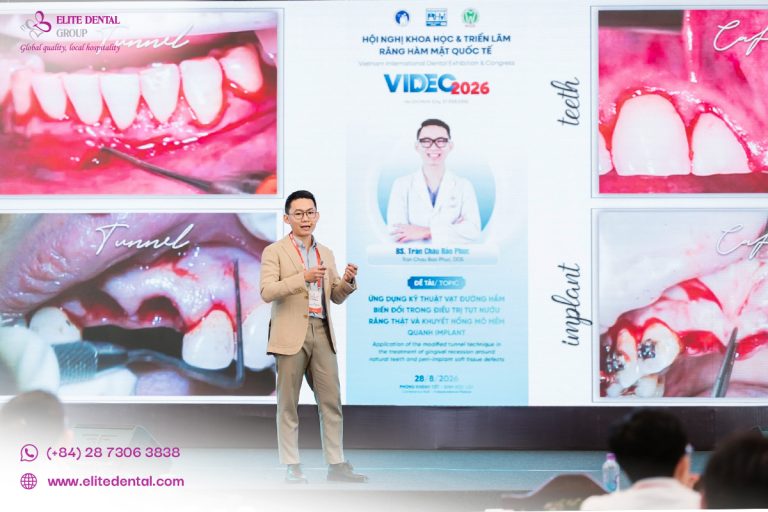
On August 28, 2026, Dr. Tran Chau Bao Phuc – Clinical Director of Elite Dental Metropole, specializing in Dental Implants – delivered a scientific presentation at the VIDEC 2026 International Dental Science Conference & Exhibition, on the topic “Application of the Modified Tunnel Flap Technique in the Treatment of Gingival Recession on Natural Teeth and Soft Tissue Defects Around Implants.” The presentation focused on applying the Modified VISTA technique in clinical situations that require soft tissue reconstruction, aiming to improve gingival form and aesthetic outcomes.
Gingival recession and soft tissue defects: challenges in dental treatment
Gingival recession is a condition in which the gingival margin shifts toward the root of the tooth, exposing part of the root surface. This can make teeth more sensitive, affect the aesthetics of the smile, and make oral hygiene more difficult.
For patients who already have dental implants, a deficiency or change in the form of the soft tissue around the restoration can also affect the gingival contour and the natural look of the teeth.
In some cases, especially in the incisor region, soft tissue reconstruction becomes complex because of the anatomical features, the thickness of the gingiva, and the extent of loss of supporting tissue.
This is the issue Dr. Tran Chau Bao Phuc shared at the Periodontology – Dental Implantology scientific session of VIDEC 2026, held at the Independence Palace in Ho Chi Minh City.
With the theme “Smart and Sustainable Dentistry,” VIDEC 2026 is an international scientific forum that brings together experts and dentists from many fields of dentistry to exchange knowledge and research and to apply professional advances in treatment practice.
Applying the Modified VISTA technique in soft tissue reconstruction
In his presentation, Dr. Tran Chau Bao Phuc introduced the Modified Tunnel Flap technique (Modified VISTA), a soft tissue plastic surgery method based on the principle of tunnel access.
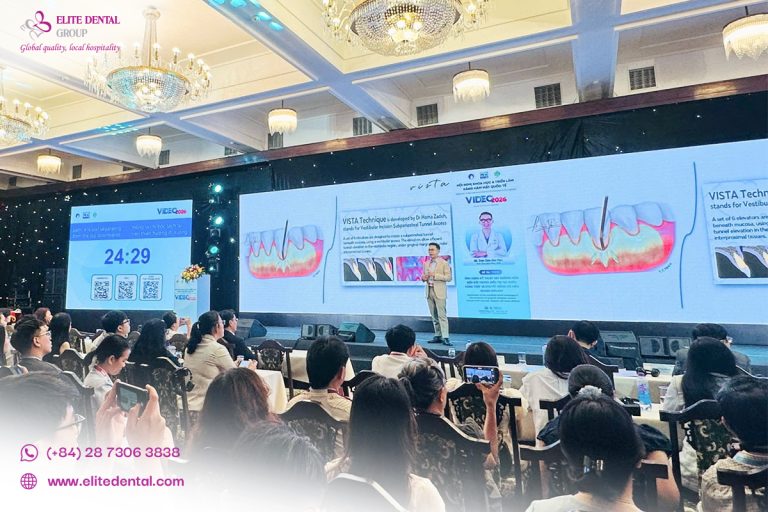
The VISTA technique (Vestibular Incision Subperiosteal Tunnel Access) uses an incision in the vestibular mucosa to create access beneath the tissue, supporting the dissection, mobilization, and repositioning of gingival tissue in indicated cases.
Compared with some traditional flap methods, the tunnel approach aims to limit direct incisions in the interdental papilla area, helping to preserve tissue structure and support regeneration of the gingival contour.
According to the abstract published at the conference, Dr. Phuc’s presentation focused on applying Modified VISTA with a minimal vertical mucosal incision, in order to improve access and flap control during surgery.
Through illustrative clinical cases, he presented the application of the technique in two groups of situations:
- Gingival recession on natural teeth: Particularly in cases with interproximal attachment loss classified as Cairo RT2 and RT3. This group of conditions presents certain challenges for root coverage and requires careful assessment of periodontal tissue conditions and treatment prognosis.
- Soft tissue defects around implants: Cases with tissue deficiency or changes in gingival contour, including loss of the papilla around implants, which affect the aesthetics of the restored area.
The choice of technique and the ability to achieve root coverage depend on the severity of the recession, the condition of the periodontal tissue, anatomical features, and accompanying risk factors. Modified VISTA is not indicated for every case of gingival recession.
Prioritizing the preservation of natural tissue and choosing the right technique
Beyond its ability to support tissue regeneration, one important principle in soft tissue surgery is controlling the extent of intervention and preserving healthy tissue structures.
In the incisor region in particular, gingival tissue reconstruction should aim for harmony in thickness, shape, and gingival contour with the adjacent teeth.
For gingival recession after orthodontic treatment, the dentist needs to assess the cause, the degree of attachment loss, and the condition of the supporting tissue before deciding on a treatment approach. The potential for regeneration and root coverage depends on the clinical characteristics of each case.
This is also the treatment approach Dr. Tran Chau Bao Phuc emphasizes in clinical practice: choosing methods based on scientific evidence, carefully assessing tissue conditions, and considering an appropriate level of intervention, so as to preserve natural structures as much as possible.
With in-depth training in dental implants, bone grafting, and soft tissue reconstruction surgical techniques, he continues to research and keep up with professional advances in order to broaden treatment options for complex clinical situations.
In this, the application of suitable surgical methods rests on a comprehensive assessment of the patient’s condition, aiming for harmony between periodontal tissue health, aesthetics, and the ability to maintain results over the long term.
Sharing clinical experience at an international dental forum
His presentation at VIDEC 2026 continues Dr. Tran Chau Bao Phuc’s participation in the academic exchange programs of the dental community.
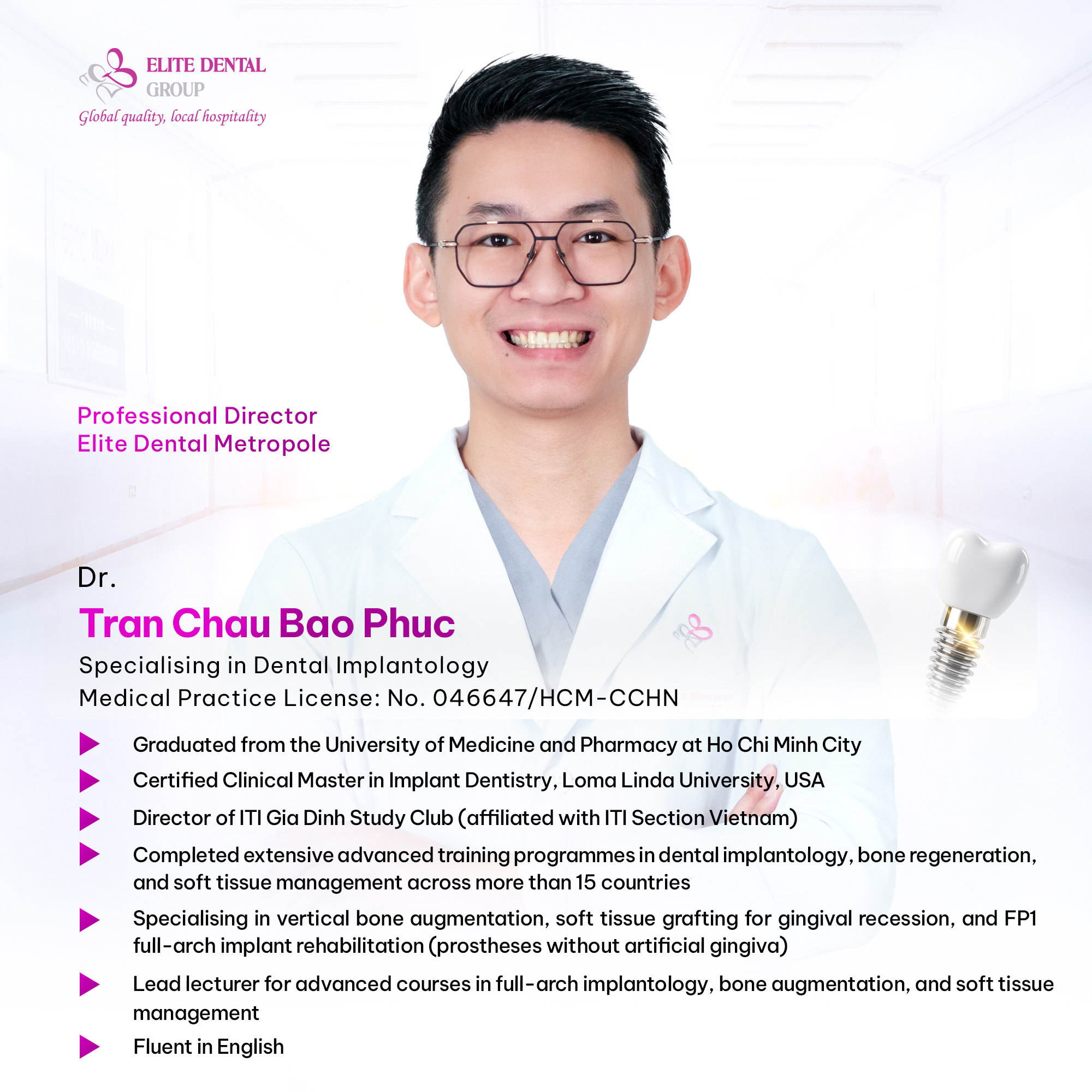
In addition to his roles as Clinical Director of Elite Dental Metropole, President of the ITI Study Club Gia Dinh, and lecturer at THL Academy, he actively takes part in training programs, conferences, and professional exchanges, and directly teaches and mentors trainee dentists in Vietnam and abroad.
These activities give him opportunities to share clinical practice experience, update scientific knowledge, and learn about new treatment methods in dental implantology.
At Elite Dental, the choice of treatment option is built on a combination of scientific evidence, professional experience, and each patient’s actual condition.
Within this, soft tissue reconstruction techniques are considered when indicated, in order to address gingival tissue problems, preserve natural structures, and work toward a treatment outcome that balances oral health, function, and long-term aesthetics.
This is also consistent with Elite Dental’s guiding principle of “Maximum Preservation – Minimally Invasive,” which emphasizes effectiveness, safety, and the patient’s long-term interests in every treatment decision.
Learn more about Dr. Tran Chau Bao Phuc and advanced dental services at Elite Dental.