

Table of content
- Key Takeaways
- 1. The Four Checks
- 2. Check the Dentist
- 3. Check the Facility: What Accreditation Covers
- 4. Check the Materials and How Treatment Is Planned
- 5. Check the Records You Will Take Home
- 6. Check the Aftercare, and Know What to Do If Something Needs Attention
- 7. Warning Signs When Choosing Any Clinic
- 8. Questions to Ask Any Clinic Before You Book
- 9. Looking Beyond What a Clinic Says About Itself
- 10. What Insurance May and May Not Cover
- Frequently Asked Questions
- Next Steps
- References
If you are wondering whether dental work in Vietnam is safe, you are asking exactly the right question. Treatment far from home is a decision made with hope and caution at the same time: hope for the smile you want, and caution because you will be trusting people you have never met. That caution is not a sign that you are being difficult. It is good judgment, and it is the best protection you have.
Whether dental work at a particular clinic is safe is something you can check rather than assume. Before you book flights, look for the accrediting body’s name, the certificate’s score, year and branch coverage, the treating dentist’s name and training, the implant brand and lot number, and a clear explanation of how aftercare works once you are home.
The reassuring part is that none of this requires medical expertise. It requires a handful of well-chosen questions and the habit of asking for the answers in writing. A clinic that is confident in its standards will usually be glad to provide them, and the way a clinic responds to your questions is itself useful information.
Key Takeaways
Check four things: the dentist, the facility, the materials and the records. These are the same checks you would make at home, applied to a clinic abroad.
Accreditation is useful only when it can be verified. Look for the accrediting body, a score, the year of issue and whether the certificate covers the branch where you will be treated.
Ask for names and documents in writing. The treating dentist, the implant brand and lot number and the warranty terms should all be on paper before you travel.
Plan for the time after you fly home. Documentation, remote follow-up and a named contact are what make aftercare workable at a distance.
1. The Four Checks
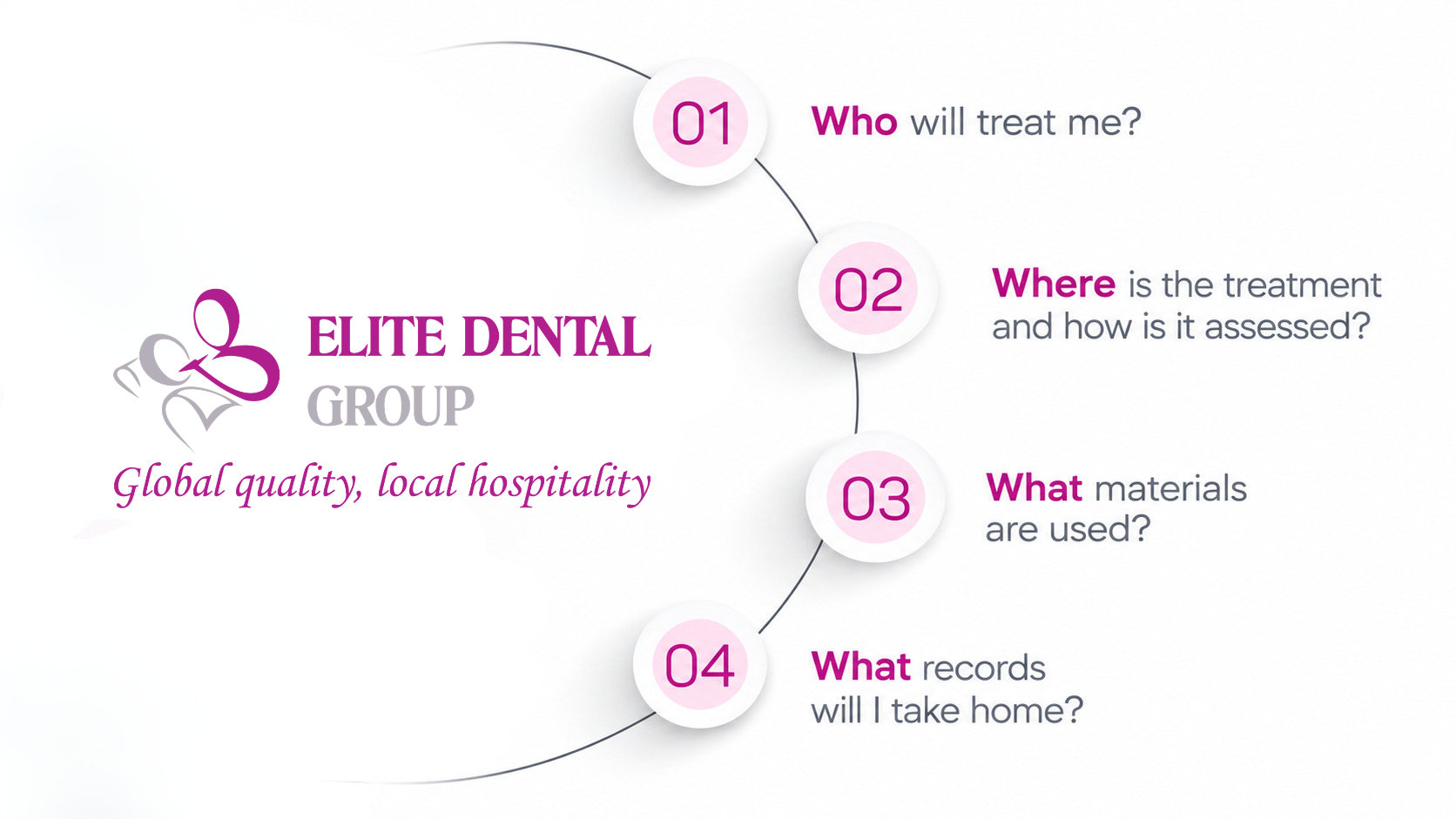
At home, you rarely think about how you know your dentist is qualified, your instruments are sterile and your implants are genuine, because the system around you quietly does that work. Overseas, you do some of that work yourself, and the good news is that it comes down to four questions:
- Who will treat me, and with what training?
- Where will the treatment take place, and how is that facility independently assessed?
- What materials will be used, and can they be traced?
- What records will I take home, and who will look after me afterwards?
Know every detail and trust every step of your dental journey
2. Check the Dentist
At home, patients usually check the practitioner on an official register: AHPRA in Australia, the General Dental Council in the UK and the state dental board in the US. The same logic applies to a clinic overseas, but you will often need to ask the clinic for the information. Request the treating dentist’s name, qualifications, specialty and experience with your type of treatment, and check that the dentist’s practising licence is available to see.
Elite Dental publishes the practising licences of its doctors on its website, on each doctor’s profile page (see Our Doctors). When you read a profile, look for three things: where the dentist trained, what their specialty is, and whether their licence is shown. Then compare that with the name and professional background you are given for your own treating dentist, which Elite Dental provides in writing before you travel.

Elite Dental – Home to leading dental specialists, bringing together expertise, experience and excellence in world-class dentistry
Behind any single dentist is a team. Elite Dental’s team includes more than 30 specialist doctors trained in France, Italy, the US and Japan. Complex implant cases are led by Assoc. Prof. Dr Tran Hung Lam, DDS, PhD, Chief Medical Officer, and complex cases are discussed between specialists so that implant, gum and restorative needs are planned together. For a treatment that involves several disciplines, that kind of shared planning is worth asking about at any clinic.
3. Check the Facility: What Accreditation Covers
A qualified dentist works within a facility, and the facility matters just as much. This is where independent accreditation helps, because it lets someone other than the clinic itself assess how the clinic operates.
AACI (American Accreditation Commission International) is an independent US healthcare accreditation body with a dedicated set of standards for dental facilities. Version 2.1 comprises 52 standards across three domains: governance, clinical practice and infrastructure. The standards are built on ISO 9001:2015, WHO recommendations and US CMS/Medicare requirements. A facility goes through standardisation of its processes, evidence review, a preliminary assessment and a final assessment before it is scored.

AACI Asia–Pacific representative presents the AACI quality accreditation to representatives of Elite Dental’s three clinics.
In practical terms, the areas covered include instrument sterilisation control, patient identification, emergency response procedures and radiation safety during X-ray imaging, which matters for treatment planned from 3D scans. Records, clinical imaging and equipment management are also within the scope of the assessment. These are the quiet, behind-the-scenes routines that you cannot see as a patient but that shape how safe a treatment room is.
When any clinic mentions accreditation, look for four details: the name of the accrediting body, a verifiable score, the year of issue, and whether the certificate covers the specific branch where you will be treated.
Elite Dental is the first dental clinic in Vietnam to achieve AACI accreditation, with a score of 95.33/100 under Version 2.1 for dental facilities. The same standards framework is applied at all three branches in Ho Chi Minh City (Huynh Tinh Cua, Tu Xuong and Metropole). Implant surgery takes place in a 7-SOP sterile environment that meets AACI standards. You can read more on the Awards and Certifications page.
4. Check the Materials and How Treatment Is Planned
The next question is what will actually be placed in your mouth, and how the dentist decides where it goes. Ask which implant brand and model will be used, and ask for the lot number. This is not fussiness: the brand and lot number are what allow a dentist back home to identify your implant and source compatible components if they are ever needed. Straumann, Neodent/Hahn and the major Korean systems are internationally distributed brands, so a dentist back home can usually identify the system and source compatible components when the documentation is clear.
Elite Dental uses documented, traceable implant brands, with manufacturer documentation available on request. THL Academy, part of Elite Dental Group, is a recognised Straumann Center of Dental Education.
As a recognized Straumann Center of Dental Education, Elite Dental is committed to delivering world-class dental care and clinical excellence
Planning matters as much as materials. Treatment at Elite Dental begins with a 3D CBCT scan, which shows your jawbone and the position of nerves and sinuses in three dimensions. Implants are then placed using surgical guides, including a static guide and the DCarer dynamic navigation system, so that positioning follows the plan. Final restorations are made from digital impressions taken with a 3D Trios scanner and manufactured with CAD/CAM technology. Each of these steps leaves a digital record, which supports the documentation you take home.
5. Check the Records You Will Take Home
The last of the four checks looks ahead to the day you are back in your own kitchen. Before you fly home, ask for:
- Treatment notes
- X-rays and scans
- The implant brand and lot number, or the bridge material and laboratory
- The warranty terms
- A named contact for follow-up
These records are what allow a dentist in your home country to look after your teeth with a full picture, rather than guessing at what was done. Implant patients at Elite Dental also receive the Implant Passport, a documented and portable warranty record, with a named contact for follow-up. Elite Dental’s Document Assistance service helps with insurance, pension and treatment documentation, so the paperwork does not become a burden on top of the treatment itself.
6. Check the Aftercare, and Know What to Do If Something Needs Attention
Good aftercare is a shared effort. The months between two trips are part of treatment, so your own part matters: gentle brushing, soft food in the early weeks, no smoking or alcohol, medicines exactly as prescribed, and attending your reviews.
Clinic aftercare is the other half. At Elite Dental, aftercare is backed by AACI-accredited safety standards and includes:
- Full clinical documentation for your home dentist.
- Remote WhatsApp follow-up with your specialist.
- A manufacturer warranty on implants and restorations.
- Continuity of care with your home dentist.
- Priority scheduling if you return for a review visit.
If something does not feel right, the sequence is simple. Report anything unusual early, such as swelling that does not settle, a loose implant or bridge, or worsening pain. Contact your specialist through remote follow-up, and see your own dentist if it cannot wait. Your home dentist can then act with the documentation you brought with you. Knowing that sequence in advance is often what turns worry into a plan.
7. Warning Signs When Choosing Any Clinic
Checking is easier when you know what a gap looks like. These are signs worth pausing on, at any clinic in any country:
- No written, itemised treatment plan before you travel. Without one, you cannot compare quotes or hold anyone to what was agreed.
- No named treating dentist. You should know who is responsible for your care.
- A reluctance to name the implant brand or provide documentation. Traceability is the basis of long-term care.
- Accreditation claims that cannot be verified. Look for the body, score, year and branch covered.
- Pressure to commit before an examination and a 3D scan. A responsible plan is built on the scan, not before it.
For a longer list, see 8 Red Flags to Avoid When Getting Dental Work Abroad and How to Choose a Dental Clinic in Ho Chi Minh City: A 10-Point Checklist for International Patients.
8. Questions to Ask Any Clinic Before You Book
Put these to every clinic you are considering, and notice how clearly each one answers:
- Who will treat me, and where can I see their qualifications and licence?
- Which body accredits the clinic, with what score and in what year?
- Does the accreditation cover the branch where I will be treated?
- Which implant brand and model will be used, and can I have the lot number?
- Will my treatment plan be itemised and agreed in writing before I travel?
- What is charged separately from the quoted price?
- How many trips will I need, and how many days on each?
- What documents will I take home?
- How does follow-up work once I am back, and who is my named contact?
- What happens if the work needs attention after I return?
A good answer is specific, written and checkable: a name, a score, a document, a described process. A vague answer is not always a bad sign, but it is a reason to ask again.
9. Looking Beyond What a Clinic Says About Itself
Reviews and results are part of how people judge any clinic, and they are most useful when you read them for detail. Look for accounts that describe what was done, by whom and how the follow-up went, rather than only how the patient felt on the day. Ask to see results for cases like yours, and ask how long ago the treatment was completed.
Elite Dental publishes a Treatment Results Gallery and patient testimonials, so you can see real cases and read the experiences of patients who travelled before you.
10. What Insurance May and May Not Cover
Check with your insurer or health fund whether any part of treatment overseas is claimable, and do not assume cover. Standard travel insurance usually excludes complications from planned dental work, so check your policy and ask about specialist cover before you book.
Frequently Asked Questions
Is it safe to get dental implants in Vietnam? Safety depends on the clinic, so check the dentist, the facility, the materials and the records before you book. At Elite Dental, every treatment plan is itemised and agreed in writing before you depart, and surgery takes place under AACI-accredited standards.
How do I check a dentist’s qualifications from overseas? Ask for the dentist’s name, training, specialty and experience, and compare it with the clinic’s doctor profiles. At Elite Dental, the practising licences of its doctors are published on each doctor’s profile page, and the name and professional background of your treating dentist are provided in writing before you travel.
What does AACI accreditation mean? AACI is an independent US healthcare accreditation body. Its dental facility standards, Version 2.1, cover governance, clinical practice and infrastructure, including areas such as instrument sterilisation and patient identification. Elite Dental achieved a score of 95.33/100 and applies the framework at all three branches.
Does the accreditation cover every branch? Ask this of any clinic. At Elite Dental, the same standards framework is applied at all three branches in Ho Chi Minh City: Huynh Tinh Cua, Tu Xuong and Metropole.
What records should I take home? Treatment notes, X-rays and scans, the implant brand and lot number, the warranty terms and a named contact.
What if something goes wrong after I return? Contact your specialist through remote WhatsApp follow-up and see your own dentist, who receives your full clinical documentation. If you return for a review, you receive priority scheduling.
Where can I see real patient results? Elite Dental publishes a Treatment Results Gallery and patient testimonials.
Can I speak with a dentist before I travel? Yes. You can book a video consultation with our dentist and put your questions to them directly.
Next Steps
Trust is not something a clinic can ask you to give. It is something you build, one verified detail at a time, and you are allowed to take as long as you need. Start with what you can see for yourself: read the awards and certifications, meet the dentists on the Our Doctors page, look through the treatment results gallery and the stories of patients who travelled before you. Then bring your questions to a real person. Book a video consultation with our dentist and put every question from this guide to them, face to face, from the comfort of your own home. If you would rather start with a call, ring (+84) 28 7306 3838. The right clinic will welcome your questions, because the people who ask the most thoughtful ones are usually the people who go on to feel most at ease.
References
- American Accreditation Commission International (AACI). Accreditation Standards for Dental Facilities, Version 2.1.
- International Organization for Standardization. ISO 9001:2015, Quality management systems: Requirements. Geneva: ISO; 2015.
- Elite Dental Vietnam. All-on-4 dental implants: Australia vs Vietnam. https://elitedental.com.vn/en/all-on-4-dental-implants-australia-vs-vietnam-cost-quality-and-warranty.html
Please note: This article is intended for general information only and is not a substitute for professional medical advice. Every patient’s oral health is different, so the most suitable treatment can only be determined after an in-person consultation and a personalised assessment by a qualified dentist.