

Table of content
- Key Takeaways
- 1. How Long Should You Stay in Vietnam for Dental Treatment?
- 2. Before You Book Flights
- 3. Arriving in Ho Chi Minh City
- 4. Your First Days: What Happens at the Clinic
- 5. A Real First Trip: Michael Turner
- 7. Where to Stay
- 8. Weather, Money and Getting Around
- 9. Visas and Entry
- 10. Resting, Eating and Sightseeing Between Appointments
- 11. Budgeting the Whole Trip
- 12. The Months Between Two Trips
- 13. Coming Home With the Right Documents
- Frequently Asked Questions
- Next Steps
- References
Travelling abroad for dental treatment can feel like a leap of faith. There are flights to book, leave to arrange, a city you may never have seen and a procedure you very much want to go well. The reassuring truth is that most of that uncertainty can be turned into a plan before you ever board a plane, and a good plan lets you spend the trip on what matters: your treatment, your recovery and, if you feel like it, a little time to enjoy being somewhere new.
How long you need in Ho Chi Minh City depends on the treatment. Veneers and crowns can usually be completed in one stay of about 5 to 10 days. Implants need healing time, so single implants and full-arch treatment usually need two trips: about 5 to 7 days on the first, about 4 to 6 months of healing at home, then about 3 to 5 days on the second. This guide sets out the timeline by treatment, how to prepare, what to expect when you arrive, where to stay, how to handle money and weather, and an illustrative 10-day stay built on a real first trip.
It is written for the practical questions that keep people awake before a trip like this: how many days, how many trips, where to sleep, what to eat while you heal, and what to bring home. Take it one section at a time, and by the end you should be able to sketch your own trip on a single page.

A dental trip to Ho Chi Minh City can be planned in advance, from your treatment dates to your hotel
Key Takeaways
Your treatment sets the number of days. Implants, veneers and crowns follow different schedules, so confirm yours before you book flights.
Healing time cannot be shortened by staying longer. Implants need months to integrate with the jawbone, which happens at home between the two trips.
Choose accommodation by the branch you will attend. Ask which branch your appointments are at, then look for a hotel with an easy trip to that address.
Build in buffer days. Extra days around appointments allow for jet lag, rest and collecting your records before you fly home.
Rely on official sources for entry rules. Rules change, so check the official Vietnamese and home-government pages before you book.
1. How Long Should You Stay in Vietnam for Dental Treatment?
The honest answer starts with what you are having done. Veneers and crowns are usually completed within a single stay, while implants are shaped by biology: after an implant is placed it needs months to fuse with the jawbone, a process called osseointegration, and that healing happens in your body rather than in the clinic.
| Treatment | Trips | Time in Vietnam | Notes |
| All-on-4 / All-on-6 | Usually two | Trip 1: about 5 to 7 days. Trip 2: about 3 to 5 days | About 4 to 6 months of healing at home in between. Preparation such as extractions or bone grafting is usually done in the first trip. |
| Single implant | Usually two | Trip 1: about 5 to 7 days. Trip 2: about 3 to 5 days | The same two-trip structure as full-arch treatment. The final crown is fitted after healing. |
| Dental bridge | One stay | About 5 to 10 days | Includes a bite review before you fly home. |
| Porcelain veneers | One stay | Usually about 5 to 10 days | Planned digitally before any tooth is touched. |
| Zirconia crowns | One stay | Usually about 5 to 10 days | Fitted after a digital impression. |
These timings are typical, not fixed. Your team confirms the exact schedule in your treatment plan, because the number of days depends on how many teeth are being treated and what preparation they need. To see what a real first trip looks like, read All-on-4 in Vietnam: Michael Turner’s Two-Trip Plan.
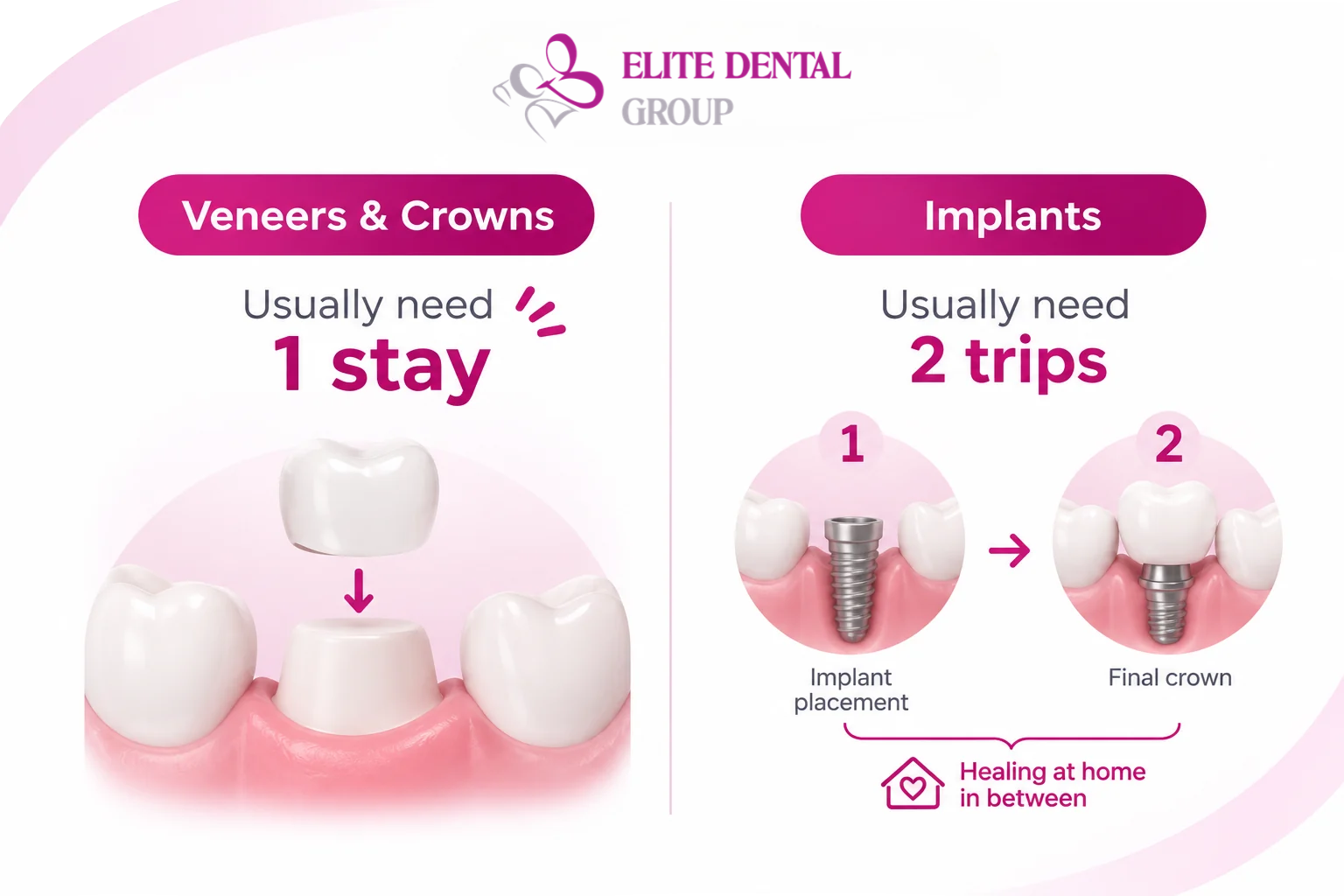
Veneers and crowns usually need one stay, while implants usually need two trips with healing at home in between.
2. Before You Book Flights
The weeks before you travel are where most of the stress can be removed. Work through this list in order:
- Send your existing X-rays or CBCT to Elite Dental for a preliminary assessment, along with your general health information. The specialist team can then outline a provisional plan before you travel.
- Ask for your treatment plan in writing, itemised, with the treating dentist’s name and professional background. The final plan is confirmed after an in-person examination and a 3D scan.
- Confirm which branch you will attend, and which days it is open. Elite Dental’s working days are Monday to Saturday, 08:00 to 19:00, so plan your arrival so that your first appointment falls on a working day.
- Plan your leave for the whole stay, with a day or two of margin on either side.
- For implants, agree a rough date for the second trip so you can book leave and flights well ahead.
- Check your visa and passport against the official sources (see section 9).
- Check your insurance. Standard travel insurance usually excludes complications from planned dental work, so check your policy and ask about specialist cover. Our guide Travel Insurance, Medicare and Overseas Dental Work: What Australians Should Know is a good place to start.
- Tell your own dentist about your plans, and share your records with the team in Vietnam before you travel.
- Ask your coordinator about airport pickup and hotel assistance, which Elite Dental provides at no charge for eligible cases.
3. Arriving in Ho Chi Minh City
Most international visitors arrive at Tan Son Nhat International Airport, which is about eight kilometres from the city centre. Depending on traffic, the journey into town can take 50 minutes or more. If you have arranged airport pickup through Elite Dental’s English-speaking coordinator, you will be met and taken to your hotel. If you travel independently, Vietnam Tourism notes that Vinasun and Mai Linh taxis are available at the airport taxi bay, that ride-hailing apps such as Grab, Be and Xanh SM work well in the city (you will need a Vietnamese SIM card for them), and that ATMs and currency exchange are available at the airport.
Time zones are gentler than you might fear if you are coming from Australia or New Zealand. Vietnam is on UTC+7, which is about 3 to 4 hours behind eastern Australia and about 5 to 6 hours behind New Zealand, depending on daylight saving. From the UK or the US the gap is larger, so allow a quiet first day to recover before your first appointment.
4. Your First Days: What Happens at the Clinic
After you have rested, your first appointment is a detailed consultation and a 3D CBCT scan, which shows your jawbone and the position of nerves and sinuses so that your plan can be confirmed. Where preparation is needed, such as extractions, removal of old implants or bone grafting, it is usually done in the first trip, before or alongside implant placement. For full-arch treatment, a fixed temporary restoration may be provided to maintain your appearance during healing, with timing based on your clinical condition and treatment plan.
Veneers and crowns follow their own digital workflow within the same stay, beginning with digital smile design, which previews the shape of the new smile before any tooth is touched, and 3D intraoral scanning, which replaces traditional impressions.
5. A Real First Trip: Michael Turner
Michael’s first trip ran from 21 to 25 April 2026. His record lists appointments on three of the five days.
| Date | Stage | What was done |
| 21 April | Preparation and surgery | Old restorations and previous implants removed, bone grafting, Straumann All-on-4 implants placed |
| 23 April | Review | A 45-minute follow-up to check healing and comfort |
| 25 April | Crowns | Three zirconia crowns fitted |
The days in between were left free, which is exactly what makes a trip like this manageable: appointments that matter, and room around them to rest.
6. A Sample 10-Day Stay (Illustrative)
The layout below follows the pattern of Michael’s first trip, set out here for a full-arch (All-on-4) case. Surgery takes place with an immediate temporary restoration, the review and fixed temporary restoration follow about two to three days later, and further treatment comes about four days after surgery, with arrival, rest and buffer days around it. It is an example only. The timing of each step is determined by your clinical condition and treatment plan, and your dentist confirms your own schedule.
| Day | Plan |
|---|---|
| 1 | Arrive. Airport pickup and hotel arrangements through Elite Dental’s English-speaking coordinator. Rest and recover from the journey. Plan your arrival so that your first appointment falls on a working day (Monday to Saturday). |
| 2 | Examination and planning. A detailed consultation and a 3D CBCT scan to assess your jawbone and identify key anatomical landmarks. Your treatment plan is confirmed in writing before any procedure begins. |
| 3 | Surgery day. Any preparation your case needs, such as extractions, removal of old implants or bone grafting, followed by implant placement. An immediate temporary restoration is placed so that you do not leave without teeth. |
| 4 | Rest. Soft food, gentle brushing, no smoking or alcohol, and medicines exactly as prescribed. Light activity only. |
| 5 | Review and fixed temporary restoration. About two to three days after surgery, your team checks your healing and comfort and fits the fixed temporary restoration. In Michael’s case, the review was a 45-minute follow-up. |
| 6 | Rest. Keep to soft food and gentle hygiene. |
| 7 | Further treatment as planned. For example, crowns on other teeth. In Michael’s case, a fibre post and three zirconia crowns were fitted four days after surgery. |
| 8–9 | Buffer days. Rest, or light sightseeing if your dentist agrees. These days also give you margin if anything in the schedule moves. |
| 10 | Collect your records and fly home. Ask for your itemised plan and invoice, treatment notes, X-rays and scans, implant details, warranty terms and a named contact. Remote WhatsApp follow-up with your specialist continues once you are home. |
After this first trip, you return home for about 4 to 6 months while the implants integrate with the jawbone. The second trip, usually about 3 to 5 days, is for the review and the final bridge.
If your plan is veneers or crowns, the same logic applies in a shorter or similar window. Veneers and crowns can usually be completed in one stay of about 5 to 10 days: consultation and digital design first, then 3D scanning, preparation and fitting, with buffer days for a final check before you leave.
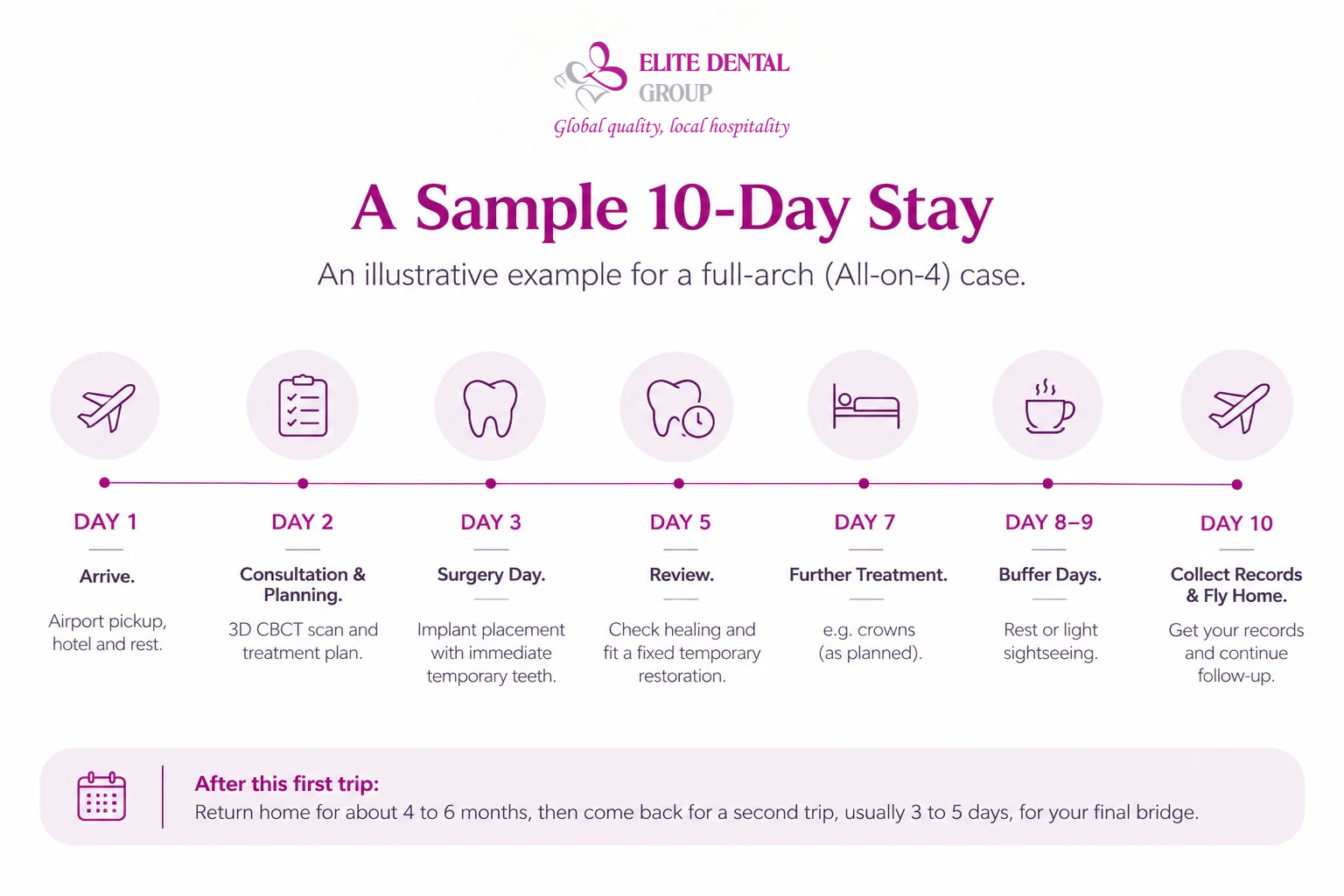
An illustrative 10-day stay based on a real first trip. Your dentist confirms your own schedule.
7. Where to Stay
Choosing where to sleep is easier once you know where you will spend your days.
- Start with the branch. Elite Dental’s Implant & Prosthodontic centre is at 51A Tú Xương, its Cosmetic & Orthodontic centre is at 75 Huỳnh Tịnh Của, and Elite Dental Metropole is at B0108 Galleria, D6 Street, An Khánh, Thủ Đức. Your coordinator confirms which one your appointments are at.
- Think about the journey to appointments. After surgery, a short, easy trip back to your room matters more than a central location.
- Plan for a quiet room. You will want to rest between appointments.
- Ask for help. Elite Dental’s English-speaking coordinator assists with hotel arrangements and airport pickup, provided at no charge for eligible cases.
Options your coordinator can suggest include M Village, which has several locations, including M Village Tu Xuong. Ask which location is most convenient for the branch you will attend. For a sense of scale, Vietnam Tourism lists reference prices of around 700,000 VND per night for a mid-range hotel, though actual costs vary by location, season and provider.
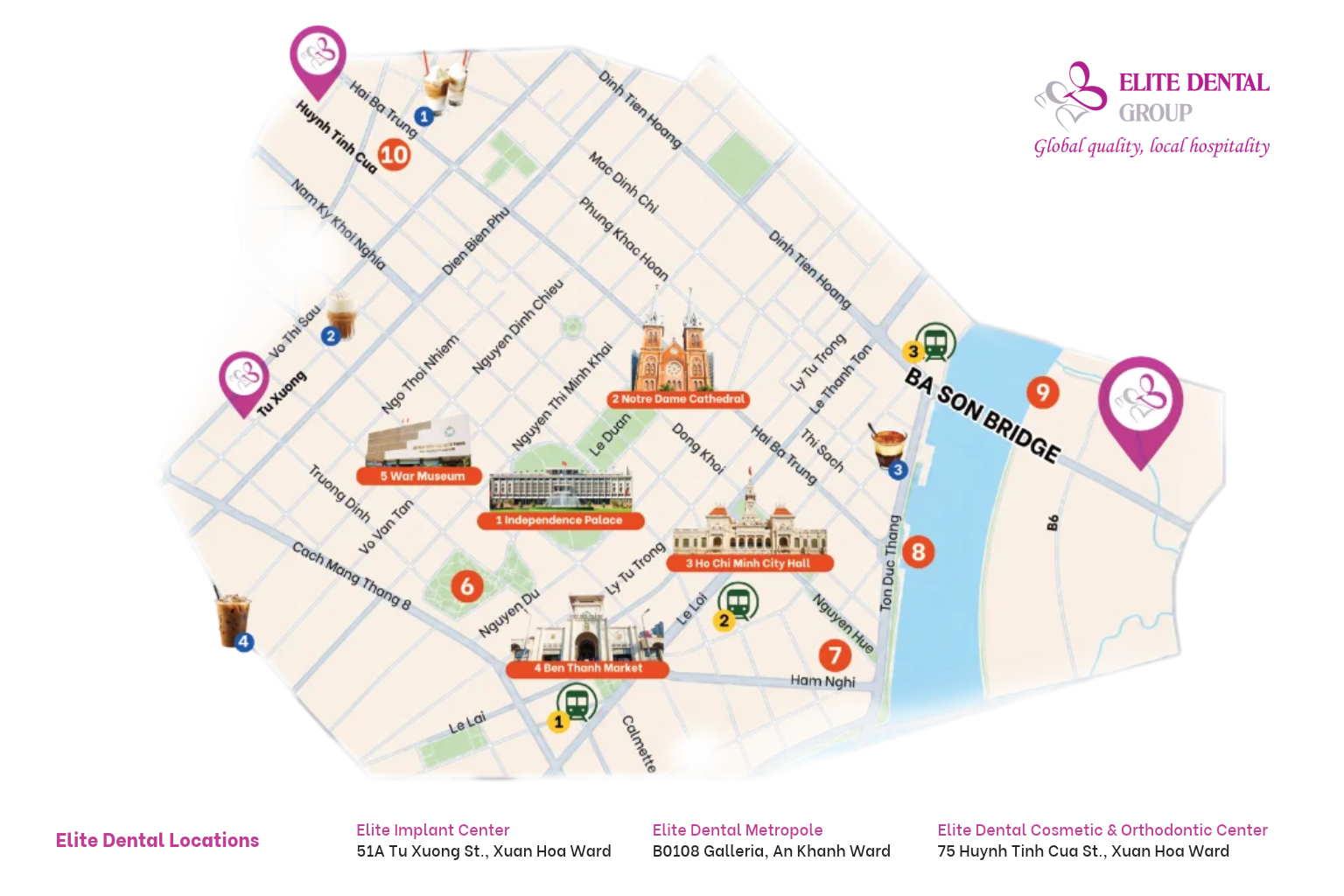
Ask your coordinator which branch your appointments are at, then choose your hotel around it
8. Weather, Money and Getting Around
Weather. Ho Chi Minh City is hot all year, with temperatures normally around 30 degrees. From December to April the skies are clear and sunny, while from May to November the wet season brings a dependable afternoon downpour that usually lasts a few hours. Plan appointments and outings around the heat and rain, and keep a light layer and an umbrella handy in the wet season.
Money. The currency is the Vietnamese dồng (VND). Cards are widely accepted by hotels, restaurants, shops and spas, while cash is used for small purchases and street vendors. ATMs are found just outside the arrival gates at major airports and throughout the city.
Getting around. Metered taxis, ride-hailing apps and your coordinator’s arrangements are the simplest options. After surgery, avoid long walks and crowded journeys, and choose a door-to-door ride.
9. Visas and Entry
Entry rules change, so check them before you book. Vietnam’s official e-visa portal is evisa.gov.vn, and Vietnam Tourism publishes an official visa requirements guide. Also read your own government’s travel advice: Smartraveller (Australia), SafeTravel (New Zealand) or the UK Foreign Office advice.
10. Resting, Eating and Sightseeing Between Appointments
Most patients can fit light sightseeing around appointments, but surgery days and the days after call for rest. Eat soft food for the first one to two weeks after implant surgery, avoid smoking and alcohol, and take medicines as prescribed. Many Vietnamese dishes are soft or soupy, and your dentist can tell you what suits your stage of healing. Ask before booking tours, long walks or anything physically demanding, and let the buffer days in your plan do their job.
11. Budgeting the Whole Trip
For a two-trip plan, allow for two return flights and roughly 8 to 12 days of accommodation across both trips, then compare the total with your quote at home. Add local transport, meals, insurance and time away from work. Elite Dental’s Document Assistance service helps with insurance, pension and treatment documentation. To compare costs in more detail, see Dental Implant Packages in Vietnam for Australians and New Zealanders.
12. The Months Between Two Trips
For implants, the months at home are part of the treatment. The implants integrate with the bone while you return to work and normal life. Your job is to protect them and stay in touch: follow your aftercare instructions, attend any review your plan includes, see your own dentist for routine care, and report anything unusual early. Elite Dental supports you with remote WhatsApp follow-up with your specialist and full clinical documentation for your home dentist. Choose the date of the second trip so the implants have enough time, and agree it with your team before you leave.
13. Coming Home With the Right Documents
Before you leave Vietnam, ask for your itemised plan and invoice, treatment notes and consent forms, X-rays and scans as digital files, the implant brand, model and lot number or the restoration material and laboratory, the warranty terms and a named contact. Implant patients also receive the Implant Passport, a documented and portable warranty record. These are what let your own dentist look after your teeth with a full picture.
Frequently Asked Questions
How many days do I need in Vietnam for veneers, crowns or implants? Veneers and crowns can usually be completed in one stay of about 5 to 10 days. Implants need healing time, so single implants and full-arch treatment usually need two trips: about 5 to 7 days on the first and about 3 to 5 days on the second, with about 4 to 6 months of healing at home in between. Your treatment plan confirms the schedule.
Can I do sightseeing between appointments? Usually, with care. Plan light activity around appointments, rest on surgery days and follow your aftercare instructions.
Where should I stay near the clinic? Ask which branch your appointments are at and choose a hotel with an easy trip to that address. Elite Dental’s coordinator helps with hotel arrangements and can suggest options such as M Village.
Do I need a visa? It depends on your passport and the length of stay. Check Vietnam’s official e-visa portal and your own government’s travel advice.
What is the weather like? Hot all year, around 30 degrees. December to April is clear and sunny, and May to November brings afternoon downpours.
Can I plan my treatment before I travel? Yes. Elite Dental offers a free online consultation, and you can send your most recent X-ray or CBCT for a preliminary assessment.
What days is the clinic open? Elite Dental’s working days are Monday to Saturday, 08:00 to 19:00.
What if I need to come back for a review? You receive priority scheduling if you return for a review visit, and remote follow-up continues in between.
Next Steps
A dental trip is more than appointments on a calendar. It is a few days of your life set aside to look after something that matters, and it can be calm, well organised and even a little restorative. Begin by looking at how others have done it: read Michael Turner’s two-trip journey to see what a first trip really looks like day by day, and keep our guides on travel insurance and Medicare and trip planning for New Zealanders beside you as you plan. Then let the Elite Dental team take some of the weight: ask us to draft your treatment timeline before you book flights, so your leave, your flights and your healing time all fit together from the start. If you would like to talk it through, call (+84) 28 7306 3838. Your smile journey does not begin on the day you land in Ho Chi Minh City. It begins with the first message you send.
References
- Elite Dental Vietnam. How many trips does All-on-4 in Vietnam need? https://elitedental.com.vn/en/how-many-trips-does-all-on-4-in-vietnam-need-a-real-two-trip-case.html
- Elite Dental Vietnam. Dental work in Vietnam for New Zealanders: cost comparison and trip planning. https://elitedental.com.vn/en/dental-work-in-vietnam-for-new-zealanders-cost-comparison-and-trip-planning.html
- Vietnam National Authority of Tourism. A traveller’s guide to Vietnam’s airports. https://vietnam.travel/things-to-do/travellers-guide-vietnams-airports/
- Vietnam National Authority of Tourism. Weather and climate in Vietnam. https://vietnam.travel/things-to-do/weather-and-climate-vietnam/
- Vietnam National Authority of Tourism. Currency and payments in Vietnam. https://vietnam.travel/things-to-do/currency-and-payments-vietnam/
- Vietnam National Authority of Tourism. Vietnam visa requirements. https://vietnam.travel/plan-your-trip/visa-requirements/
- Vietnam Immigration Department. Electronic visa portal. https://evisa.gov.vn
Please note: This article is intended for general information only and is not a substitute for professional medical advice, or for travel, financial or insurance advice. Treatment timelines vary from person to person, so the most suitable plan can only be determined after an in-person consultation and a personalised assessment by a qualified dentist.