

Table of content
- Key Takeaways
- 1. What Porcelain Veneers Involve
- 2. Vietnam vs Australia vs Bali at a Glance
- 3. Materials: Why “Porcelain” Is Not One Thing
- 4. Number of Visits and Time Away From Home
- 5. What to Check Before You Book
- 6. Does the Saving Hold Up?
- 7. Veneers at Elite Dental Vietnam
- Frequently Asked Questions
- References
Porcelain veneers are an elective treatment, so most Australians compare destinations before they commit. Price is usually the starting point, but it is rarely the best way to choose. Two quotes for the same number of veneers can differ in the ceramic used, the amount of tooth removed, how many appointments are involved and what happens if something needs adjusting after you fly home.
This guide compares porcelain veneers in Vietnam, Australia and Bali on the points that affect the result: materials, number of visits, time away from home and the checks to make before you book. It also explains how veneers are done at Elite Dental Vietnam.
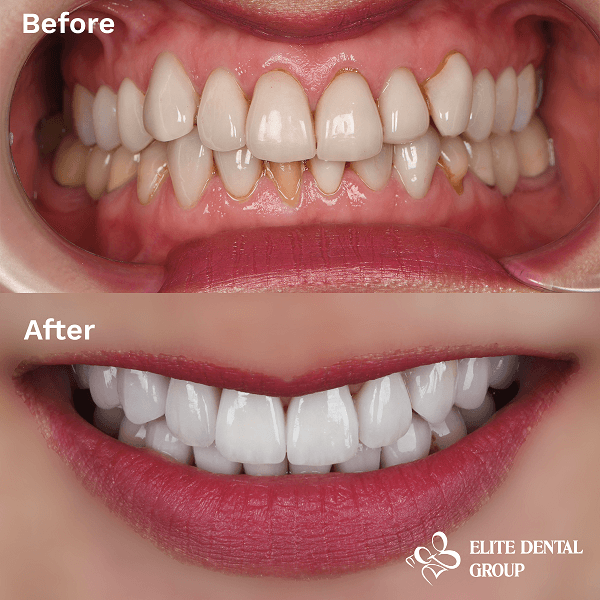
A stunning smile transformation using high-quality porcelain veneers
Key Takeaways
Veneers are a thin-shell treatment, but they are planned carefully. A veneer is bonded to the front of the tooth after a thin layer of enamel, about 0.3 to 0.5 mm, is prepared. The result depends on the dentist’s planning and the ceramic used, not only on the price.
Price gaps are real, but they are only part of the picture. Published Australian guides commonly quote porcelain veneers at about A$1,200 to A$2,500 per tooth. Bali clinics often advertise from roughly A$300 to A$600 per tooth. Elite Dental Vietnam’s veneers start from 9,000,000 VND per tooth (about A$520).
Visits and time away differ. At Elite Dental, veneers usually take 2 to 3 appointments of 1 to 2 hours each, plus a review in the days after bonding, and can typically be completed in a single 5 to 10 day stay.
Ask about the material by name. “Porcelain” covers several ceramics. Ask which one will be used, who makes it and where.
Check what happens after you leave. A review appointment before your flight, written warranty terms and a named contact matter as much as the veneers themselves.
1. What Porcelain Veneers Involve
Porcelain veneers are thin ceramic shells bonded to the front surface of the teeth. They are used to improve colour, shape and spacing. Typical cases include teeth that are stained and do not respond to whitening (for example, tetracycline or fluoride staining), small gaps between the front teeth, uneven tooth sizes, and teeth that are chipped or cracked without involving the nerve.
The dentist prepares each tooth by removing a thin layer, about 0.3 to 0.5 mm, and the veneer is then bonded in place. Compared with a full crown, which removes much more of the natural tooth and can sometimes require root canal treatment, veneers are less invasive. This fits Elite Dental’s approach of “minimal intervention, maximum preservation.”
Two points are worth knowing before you compare quotes:
- Preparing the tooth is not reversible. Enamel that has been removed does not grow back, so the planning stage matters.
- Veneers are not suitable for every tooth. On X-rays, the dentist can see whether a tooth has had root canal treatment. If it has, a veneer is not the right option and a crown is needed instead. Teeth with more extensive damage may also need a different solution.
For a full overview of the treatment, see our guide to Dental Veneers: Advantages, Procedure, Cost & Outcome.
2. Vietnam vs Australia vs Bali at a Glance
| Vietnam (Elite Dental) | Australia | Bali | |
| Porcelain veneer price per tooth | 9,000,000 to 12,000,000 VND (about US$350 to US$460, or A$520 to A$690) | Commonly about A$1,200 to A$2,500 in published guides; some premium clinics charge more | Often advertised from roughly A$300 to A$600 |
| Material | Emax ceramic, imported directly from Europe | Varies by clinic and laboratory; ask for the ceramic by name | Varies by clinic; ask for the ceramic by name and where it is made |
| Appointments | 2 to 3 appointments of 1 to 2 hours, plus a review 1 to 3 days after bonding | Usually more than one appointment, with temporary veneers in between | Confirm the schedule in writing |
| Time away from home | Typically a single 5 to 10 day stay | Not applicable | Confirm that the stay includes a review before you fly |
| Follow-up after you return home | Ask for written warranty terms and a named contact | Direct access to your own dentist | Ask for written warranty terms and a named contact |
Vietnam prices are indicative, based on exchange rates of US$1 ≈ 26,000 VND and US$1 ≈ A$1.50, and are confirmed at consultation. Australian and Bali figures come from published clinic and industry guides, vary widely by clinic and are for reference only.
3. Materials: Why “Porcelain” Is Not One Thing
Veneers are usually made from ceramic, but the type of ceramic affects strength, appearance and how long the veneer lasts. Composite veneers, built up directly on the tooth from resin, are a lower-cost alternative that can be completed in one appointment, but they generally do not last as long as porcelain.
At Elite Dental, porcelain veneers are made from Emax ceramic imported directly from Europe. Emax is a high-quality ceramic available in a range of shades, so the colour can be matched to your natural teeth, and it is known for its strength.
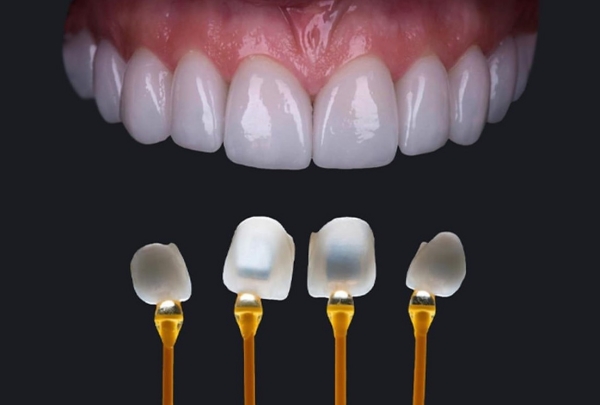
Where a back tooth needs more coverage than a veneer can give, the dentist may recommend a full-ceramic zirconia crown instead. Zirconia is known for its high strength. To see how porcelain and zirconia differ and how digital restorations are made, read Porcelain vs Zirconia and the Digital Restoration Process.
Whichever destination you choose, ask each clinic to confirm in writing:
- The name and brand of the ceramic, not just “porcelain”.
- Whether the veneers are made by the clinic’s own laboratory or an outside one, and where.
- Whether the quote is for porcelain or composite veneers.
- Whether the price covers temporary veneers.
If two quotes use different materials, the cheaper one is not directly comparable to the other.
4. Number of Visits and Time Away From Home
How many appointments you need affects how long you stay and how much you spend on travel.
At Elite Dental Vietnam, veneers usually take 2 to 3 appointments with the dentist, each lasting 1 to 2 hours. The process follows five steps:
- Examination, X-rays and photographs. The dentist assesses the colour and shape of your teeth and checks whether any have had root canal treatment.
- Treatment planning. The dentist drafts a plan and discusses it with you, including the shade and shape that suit your face.
- Tooth preparation and temporary teeth. The teeth are prepared and temporary teeth are fitted while the veneers are made.
- When the veneers are ready, the dentist bonds them to the teeth.
- Review and bite adjustment. You return 1 to 3 days later so the dentist can check the fit and adjust your bite if needed. This step helps avoid a rough or uncomfortable bite and reduces the risk of damage to the ceramic.
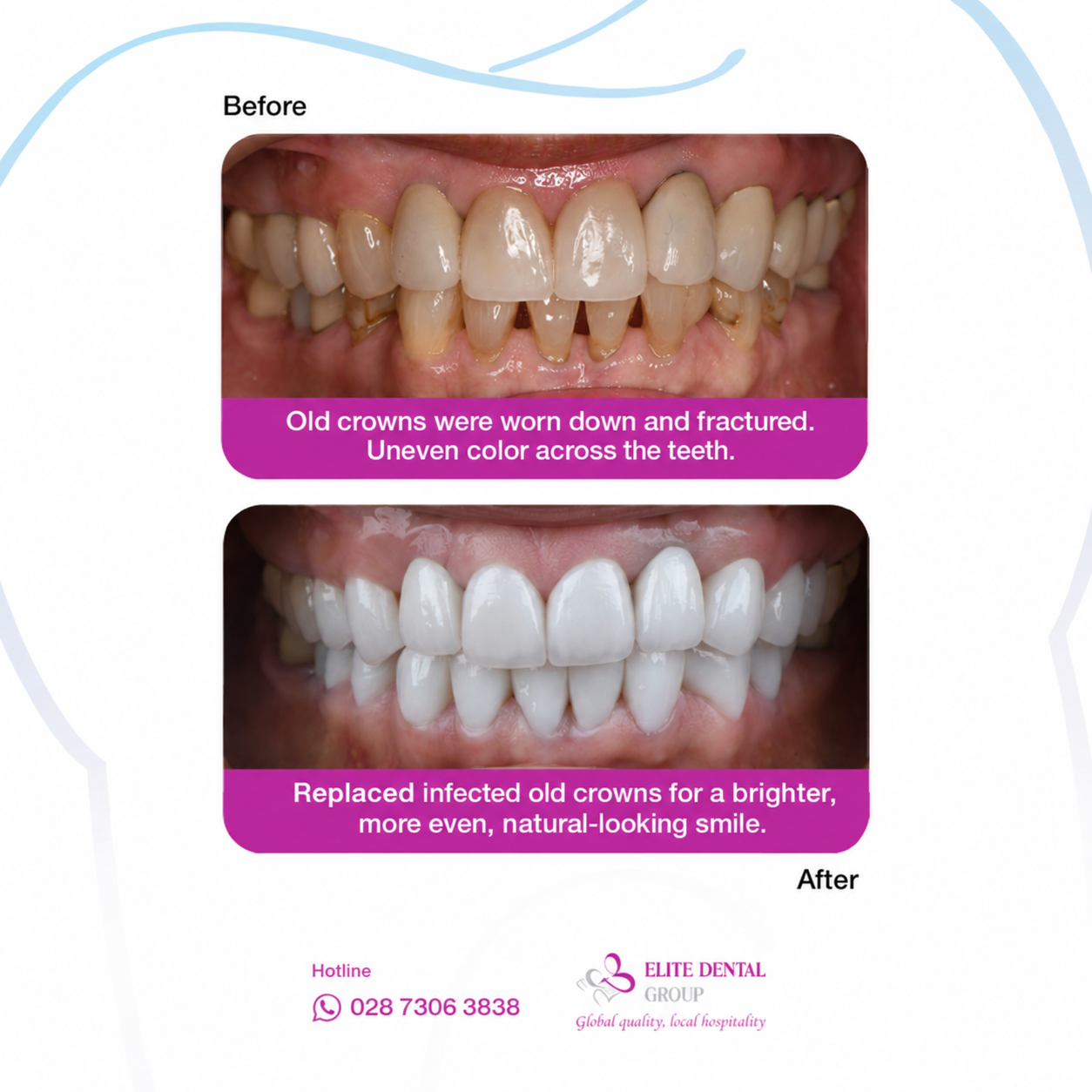
Complete porcelain restorations: A brand-new, radiant smile.
This schedule typically fits into a single 5 to 10 day stay. The exact timing depends on your teeth and the number of veneers, and is confirmed in your treatment plan.
In Australia, veneers are usually not a single-visit treatment. Most patients attend more than one appointment, with temporary veneers between preparation and fitting.
In Bali or any other overseas destination, ask exactly how many days the plan needs and whether the schedule leaves time for a review and adjustment before your flight. A review at the end is what allows small bite or fit problems to be fixed while you are still there.
5. What to Check Before You Book
Use this checklist with any clinic, in any country:
- The treating dentist. Ask for the dentist’s name, training and experience with veneers before you travel.
- The amount of tooth preparation planned. Ask how much enamel will be removed and why. A conservative approach protects your natural teeth.
- Whether your teeth are suitable. Teeth that have had root canal treatment generally need crowns rather than veneers.
- A preview of the result. Ask how the shade and shape will be agreed with you before treatment begins.
- The material and laboratory. Ask for the ceramic by name and where the veneers are made.
- What the quote includes. Check whether it covers the examination, X-rays, temporary teeth, the veneers themselves and review appointments.
- The review before you fly. Confirm that the stay includes a check of your bite after bonding.
- Written warranty and aftercare. Ask for the warranty terms in writing, a named contact for follow-up and what happens if a veneer chips or comes loose after you return home.
- Ask for a copy of the certificate, and check the body that issued it, the score, the year and whether it covers the branch where you will be treated.
6. Does the Saving Hold Up?
Here is a simple example for six veneers, comparing treatment fees only. Travel costs are added on top.
| Elite Dental Vietnam | Australia (published guides) | |
| Per tooth | 9,000,000 to 12,000,000 VND (A$520 to A$690) | About A$1,200 to A$2,500 |
| Six veneers | About A$3,100 to A$4,150 | About A$7,200 to A$15,000 |
To compare fairly, add one return flight and accommodation for a 5 to 10 day stay to the Vietnam total, then compare it with your own Australian quote for the same number of veneers and the same material. The saving usually grows with the number of veneers, because travel costs stay roughly the same.
7. Veneers at Elite Dental Vietnam
Elite Dental is an international premium dental system in Ho Chi Minh City, with three branches (Huynh Tinh Cua, Tu Xuong and Metropole). It is the first dental clinic in Vietnam to receive AACI (American Accreditation Commission International) accreditation, with a score of 95.33/100.
Minimal intervention, maximum preservation. Elite Dental follows this philosophy together with evidence-based dentistry, and combines it with modern technology to support diagnosis and treatment. Each option is built on the data and condition of the individual patient, with the aim of keeping as much natural tooth structure as possible. For veneers, this means ultra-thin shells of only 0.3 to 0.5 mm, and a plan that prepares as little enamel as the case allows. The name and professional background of your treating dentist are provided to you in writing before you travel, and every treatment plan is itemised and agreed in writing before you depart.
For veneers, patients are treated by specialist dentists in aesthetic restorations, who plan the case and calculate the amount of tooth preparation so that as much natural tooth as possible is kept. Elite Dental uses digital imaging and 3D scanning to take impressions without the discomfort of traditional moulds, and Emax ceramic imported from Europe for the veneers.
The team includes more than 30 specialists trained in France, Italy, the US and Japan. English-speaking staff support patients travelling from overseas through consultation, treatment and follow-up.
Case example: a full smile restoration in three appointments
Ms. Tami came to Elite Dental with old porcelain crowns that were stained and fractured. She had time for only three appointments, so the team planned each step in advance, from smile design to final fitting.
The case was treated by Dr. Bui Manh Hung, a restorative and aesthetic specialist. After a 3D scan and a Cone Beam CT, he found that most of her natural teeth were still strong and could be preserved without heavy preparation. The plan combined 9 veneers on the front teeth with 10 full-ceramic zirconia crowns on the back teeth, 19 units in total, to balance appearance with chewing function.
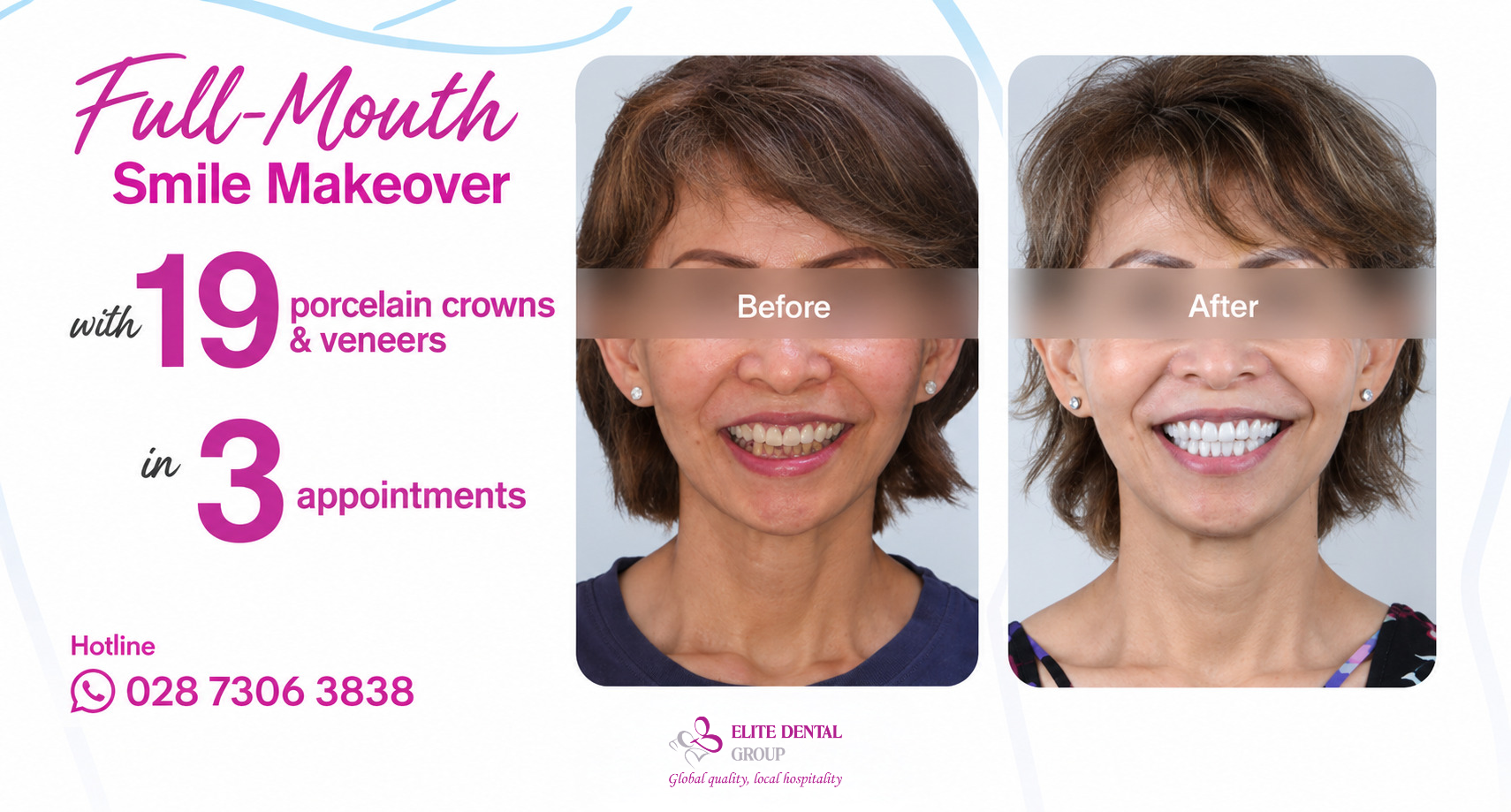 Ms. Tami’s remarkable smile transformation in just three visits to Elite Dental
- Appointment 1: examination and planning. Panoramic X-ray, Cone Beam CT and a 3D digital scan assessed her teeth, bite and gums. The dentist designed the smile with Digital Smile Design (DSD) software so she could preview the result, and agreed the shade and shape with her.
- Appointment 2: preparation and temporary teeth. The surfaces of the teeth for veneers were prepared and the teeth for crowns were lightly reshaped. Ms. Tami tried temporary teeth to check how they looked with her lips and face, and the shade was adjusted to her preference.
- Appointment 3: final fitting. All 19 units were fitted, and the dentist checked her bite, the fit at the gum line and how comfortable chewing felt.
She described the result in her own words: she had not expected such a result in three appointments, her teeth looked natural rather than artificial, and she felt very comfortable smiling. Results vary from person to person, and the plan for each patient is confirmed after examination.
For a personalised veneer plan, call (+84) 28 7306 3838 or send us a photo of your smile through our contact form.
Frequently Asked Questions
How much do porcelain veneers cost in Vietnam compared with Australia? At Elite Dental Vietnam, porcelain veneers cost from 9,000,000 to 12,000,000 VND per tooth (about A$520 to A$690), depending on your case. Published Australian guides commonly quote about A$1,200 to A$2,500 per tooth. The final price is confirmed after an examination.
How many visits do veneers need? At Elite Dental, veneers usually need 2 to 3 appointments of 1 to 2 hours, plus a review 1 to 3 days after bonding. This typically fits into a single 5 to 10 day stay.
What material are veneers made from at Elite Dental? Elite Dental uses Emax ceramic imported directly from Europe. It comes in a range of shades and is known for its strength.
Can I have veneers if I have had root canal treatment? Teeth that have had root canal treatment cannot usually be treated with veneers, and a crown is needed instead. The dentist can confirm this from your X-rays.
Do I need to have veneers on all my teeth? No. The number of veneers depends on your goals and the condition of your teeth. Discuss what you would like with the dentist, who can recommend a suitable plan.
What should I do after getting veneers? Avoid dark-coloured food and drinks and smoking, which can stain the teeth. Avoid hard or sticky foods and do not use your teeth to open bottles or packaging. Brush twice a day with a soft brush, use floss or a water flosser, and attend your review appointments.
References
- Elite Dental Vietnam. Porcelain veneers: process, materials and price information. https://elitedental.com.vn
- Smile Solutions. How much do porcelain veneers cost in Melbourne? 2026 pricing guide. https://directory.smilesolutions.com.au/porcelain-veneers-cost-melbourne-2026-smile-solutions-pricing/
- Veneers in Bali: what Australians should know before booking. https://www.top4.com.au/pressrelease/detail/veneers-in-bali-what-australians-should-know-before-booking
- American Accreditation Commission International (AACI). Accreditation Standards for Dental Facilities, Version 2.1.
Please note: This article is intended for general information only and is not a substitute for professional medical advice. Every patient’s oral health is different, so the most suitable treatment can only be determined after an in-person consultation and a personalized assessment by a qualified dentist.