

Table of content
- Contents
- 1. Patient Safety: The Core of Modern Dentistry
- 2. How Does AACI Approach Patient Safety?
- 3. Infection Control: Sterilization to Standard
- 4. Patient Identification: Right Person, Right Treatment Plan
- 5. Risk Management: Identify, Record, Respond
- 6. Radiation Safety in Diagnostic Imaging
- 7. Scope of Practice and Clinician Competence: A Foundation of Safety
- 8. Three Branches, One Safety Standard, Maintained Through Annual Independent Review
- 9. About AACI Accreditation at Elite Dental
- Frequently Asked Questions
- Conclusion
- References
When choosing dental care in Vietnam, patients often look beyond clinical expertise and technology to understand how a clinic manages safety in everyday practice. Independent accreditation such as AACI provides a practical benchmark by evaluating areas such as infection control, sterilization, patient assessment, clinical procedures, and emergency preparedness.
At Elite Dental, these principles are integrated into daily operations to help identify, reduce, and monitor potential risks throughout the patient journey. Looking at these standards in practice also provides a clearer picture of how Elite Dental approaches patient safety, from everyday protocols to ongoing quality control.
1. Patient Safety: The Core of Modern Dentistry
Many dental procedures take place in an environment with a risk of infection, and some are long-lasting and difficult to reverse. Patient safety is therefore a precondition for every treatment to achieve a lasting result, not an optional extra.
Safety here has several layers: safety during procedures, infection control, radiation safety during imaging, and protection of patient information. Each layer needs a clear procedure that does not depend on individual habit or personal experience. Patients can read our article What Is AACI? for background on the standard.
2. How Does AACI Approach Patient Safety?
AACI (American Accreditation Commission International) is an independent U.S. healthcare accreditation body with a dedicated standard for dental facilities. Its latest edition, Version 2.1, comprises 52 standards across three domains: governance, clinical practice, and infrastructure. The standards are built on ISO 9001:2015, WHO recommendations and U.S. CMS/Medicare requirements.
A dental facility must go beyond stating its commitment. It goes through a structured assessment covering process standardization, evidence review, a pre-assessment, and a final evaluation, and receives a score.
Representative areas covered by the standards include:
- Infection control: instrument sterilization control and sterilization system management.
- Risk management: emergency response protocols within the clinic.
- Radiation safety: safe practice in X-ray imaging.
- Records and equipment: management of dental records, clinical photographs, and equipment.
3. Infection Control: Sterilization to Standard
Infection control is one of the clearest pillars of patient safety in dentistry. A compliant sterilization process runs through consecutive steps: collecting and cleaning instruments after use, packaging, sterilizing at the correct temperature and time, storing under sterile conditions, and tracing each set so that every instrument reaching a patient is safe.
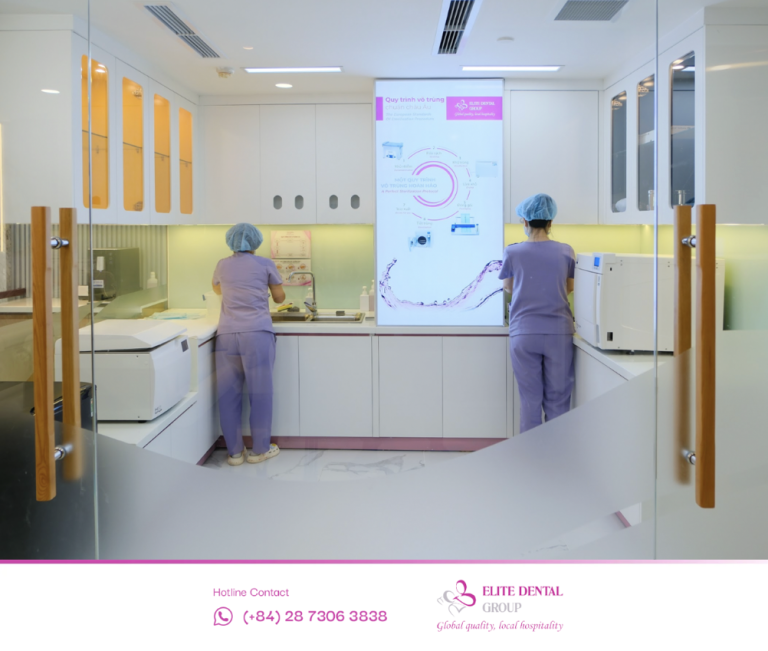
Under the AACI standards, infection control is one of the clearest pillars of patient safety in dentistry
Beyond instruments, infection control also covers surface disinfection after each case, use of single-use supplies where appropriate, and hand hygiene procedures. According to CDC guidance on infection control in dentistry, consistent compliance with procedures matters as much as having modern equipment.
4. Patient Identification: Right Person, Right Treatment Plan
A seemingly small error, such as confusing patient records or the tooth to be treated, can have consequences that are hard to reverse in dentistry. Patient identification is therefore a safety step AACI requires to be carried out systematically, without relying on any individual staff member’s memory. The general principle is to verify identity using at least two independent identifiers before each procedure and to check them against the agreed treatment plan.
 Patient identity should be verified with at least two independent identifiers, so that each patient receives the treatment planned for them
In practice, this means confirming information before imaging, before anesthesia and before starting the procedure, and clearly recording the tooth and procedure type in the patient’s file. This reduces mix-ups between patients with similar records, so each person receives only the treatment intended for them.
5. Risk Management: Identify, Record, Respond
Risk management under AACI is a proactive process. It means identifying risky situations early, recording them systematically, analyzing root causes and adjusting procedures to reduce the chance of recurrence. It goes hand in hand with emergency response capability: a team that is trained and has a response plan ready for unexpected situations during treatment.
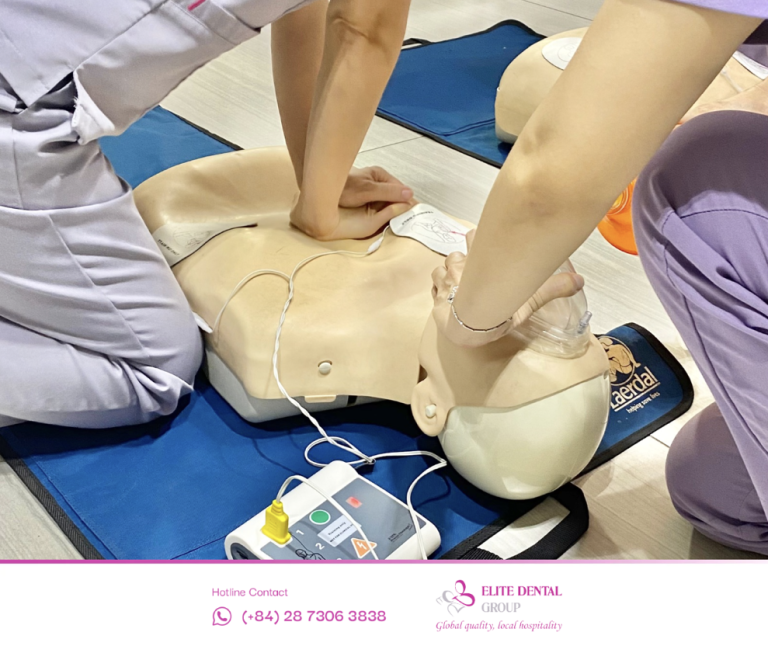
Every staff member at every patient touchpoint is equipped with emergency response skills, ready to handle unexpected situations during treatment
At Elite Dental, this approach is tied to a patient-centered quality management system. Patient data is collected, managed and stored consistently to support follow-up across multiple visits and between branches. Treatment indications and costs are presented transparently so that patients understand and consent. Continuous review, recording and improvement is what a system operating to AACI standards needs to sustain over time.
6. Radiation Safety in Diagnostic Imaging
X-rays and CT scans in dentistry provide essential information for diagnosis and treatment planning, but they also involve a radiation dose that must be controlled. The principle of radiation safety is to obtain images clear enough for an accurate diagnosis while keeping the dose reasonably low, with particular care for children and pregnant women.
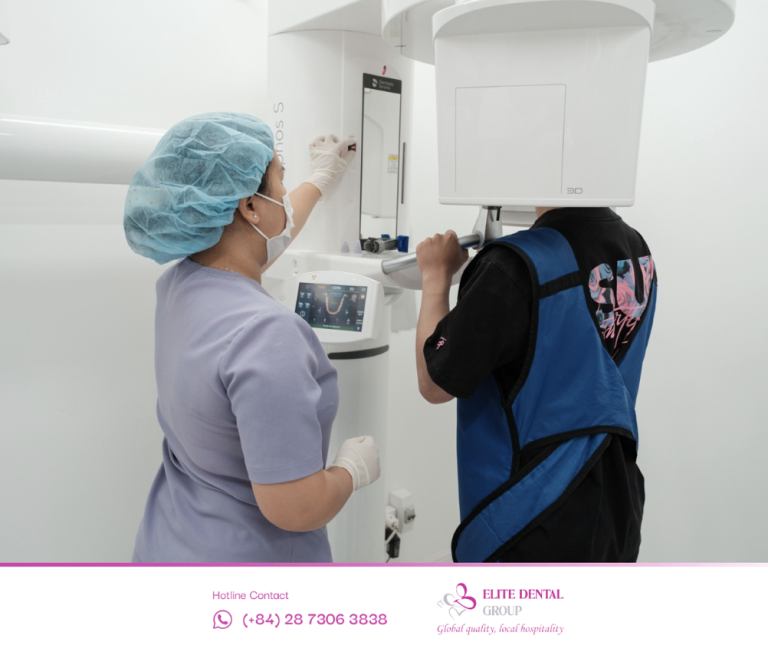
Radiation safety principles ensure that images remain clear enough for diagnosis while keeping the dose reasonably low
In practice, this means taking images only when truly necessary, choosing the imaging type that suits the diagnostic goal, using equipment that is calibrated regularly, and applying shielding where appropriate. Quality control of imaging equipment and operating procedures both protects patients and keeps diagnostic results reliable.
7. Scope of Practice and Clinician Competence: A Foundation of Safety
Safety comes not only from equipment and procedures, but also from the right clinician performing the right part of the work for their competence. Under the AACI framework, each dentist has a Scope of Practice profile based on their qualifications, certificates and experience.
This mechanism ensures complex cases are assigned to clinicians with sufficient competence, and that specialties can consult one another when needed to reach the most accurate treatment plan. For patients, it means the person performing the treatment is determined by actual professional capability, not arbitrary assignment. How Elite Dental organizes clinical competence is explained in detail in our article on scope of practice at Elite Dental.
One benefit of assigning dentists according to their own specialty is that complex cases go to clinicians with sufficient competence.
8. Three Branches, One Safety Standard, Maintained Through Annual Independent Review
An important feature of AACI accreditation at Elite Dental is that the assessment covers all three branches consistently: Huynh Tinh Cua, Tu Xuong and Metropole (Thu Thiem). The same set of safety procedures (infection control, patient identification, risk management) is standardized and applied uniformly at every location, so each patient receives the same quality standard regardless of which branch they visit.
AACI accreditation is valid for one year, and the facility must undergo periodic reassessment to maintain it. This means safety standards are not achieved once and left behind, but must become routine daily operations. For patients, a current accreditation reflects that the facility is still maintaining the processes that were audited year after year, confirmed by an independent third party.
9. About AACI Accreditation at Elite Dental
Elite Dental is the first dental system in Vietnam to achieve international AACI (American Accreditation Commission International) accreditation, with a score of 95.33/100 under standards version 2.1 for dental facilities. This is the highest score in the region as of 2026. AACI recognition from an independent third party confirms the quality that Elite Dental has maintained rigorously over many years.
The accreditation is valid for one year and is reviewed and reassessed on a cycle. It was awarded on 8 September 2025 and officially announced on 20 October 2025, and applies consistently across all three branches: Huynh Tinh Cua, Tu Xuong and Metropole (Thu Thiem).
Consultation hotline: (+84) 28 7306 3838. Website: elitedental.com.vn
Frequently Asked Questions
How can I tell whether a dental clinic is safe?
Patients can observe sterilization and hygiene practices, ask how the clinic controls infection, and find out whether the clinic is accredited by an independent quality standard. A dentistry-specific accreditation such as AACI is an objective reference point.
What steps does dental sterilization include?
A basic sterilization process includes cleaning instruments after use, packaging, sterilizing, sterile storage and tracing. Consistent compliance with every step is what determines the level of safety.
How does AACI control safety?
AACI places safety requirements within its clinical standards and turns them into procedures that can be checked: infection control, patient identification, risk management and emergency response capability. A facility must prove compliance to obtain and keep accreditation, which raises dental patient safety to a verifiable level.
Conclusion
Patient safety in dentistry results from standardized procedures, appropriately assigned professional competence and a transparent management culture. The AACI standards turn these elements into specific requirements that can be checked. At Elite Dental, safety procedures are applied consistently across all three branches as of 2026. Patients who would like in-depth advice can book an appointment through the hotline at (+84) 28 7306 3838.
References
- American Accreditation Commission International (AACI). Official information on the healthcare quality accreditation standards.
- U.S. Centers for Disease Control and Prevention (CDC). Guidelines for Infection Control in Dental Health-Care Settings.
- World Health Organization (WHO). Patient Safety materials.
Please note: This article is intended for general information only and is not a substitute for professional medical advice. Every patient’s oral health is different, so the most suitable treatment can only be determined after an in-person consultation and a personalized assessment by a qualified dentis