

Table of content
- 1. Why are dental implants in Vietnam more affordable than in the US or Australia?
- 2. How much does a dental implant in Vietnam cost in 2026?
- 3. What makes an implant dentist in Ho Chi Minh City qualified to treat international patients?
- 4. What does implant treatment at Elite Dental Vietnam involve?
- 5. What should I consider before deciding on a dental implant?
Key Takeaways
- Pricing is fixed by implant system, not by nationality. What you pay depends on the implant system chosen, not where you are from. For current 2026 Implant pricing across all tiers, see the Elite Dental Vietnam Implant price list: https://elitedental.com.vn/en/pricelist/dental-implant-pricelist
- The cost gap is explained by operating costs, not by cheaper implant components. Clinical salaries, facility rent, and administrative overhead in Ho Chi Minh City set the price base, while implant systems are bought on the same global market.
- Accreditation is the check that matters. Elite Dental Vietnam holds AACI accreditation with a score of 95.33/100 — the first AACI-accredited dental system in Vietnam (issued September 2025).
- Operator experience is widely regarded as a major factor in implant outcomes. Implant cases at Elite Dental Vietnam are planned with CBCT as part of the planning workflow and treated under internationally recognized implant protocols.
- International patients should budget two trips with a 4–6 month gap. The exact length and schedule depend on the patient’s clinical condition and treatment plan, confirmed at the initial consultation.
1. Why are dental implants in Vietnam more affordable than in the US or Australia?
The reason is operating cost, not clinical shortcuts. Clinical salaries, facility rent, and administrative overhead in Ho Chi Minh City sit well below those in Sydney, Melbourne, or California. The implant systems themselves are bought on the same global market, at the same catalogue.
This distinction matters for international patients. A Straumann implant placed in HCMC is the same Straumann implant placed in Brisbane. What changes is the cost base of the practice around it. Vietnam also lacks the insurance-billing layer that adds administrative cost to dental care in many Western markets.
The remaining variables are within your control when you choose where to go:
| Cost factor | What it changes | What to verify before you fly |
| Implant system | The single largest line item | Ask for the brand and reference: Straumann, Neodent, Hahn, MegaGen, Dentium |
| Bone condition | May add grafting or a sinus lift | Ask whether a 3D CBCT was reviewed before quoting |
| Restoration type | Crown material and design | Ask what is included in the quoted figure |
| Accreditation & sterilization | Infection control, records, safety | Ask for a third-party accreditation, not a self-declared standard |
| Follow-up after you fly home | Serviceability abroad | Ask whether the implant brand is distributed in your country |
Why Vietnam, and why Ho Chi Minh City specifically
Ho Chi Minh City is the practical entry point for dental tourism in Vietnam. It has direct flights from Australia and New Zealand, a large English-speaking service sector, and a concentration of implant-focused practices. Patients from Australia, New Zealand, the US, Ukraine, and Russia can reasonably combine a treatment trip with travel. For expats already living and working in Vietnam, care sits in the same city as home.
Elite Dental Vietnam has treated international patients and overseas Vietnamese for over a decade, alongside expats resident in HCMC. English-speaking dentists and trained interpreters handle the clinical conversation directly, and the patient care team can advise on transport, accommodation, and scheduling around your travel dates.
2. How much does a dental implant in Vietnam cost in 2026?
Implant pricing at Elite Dental Vietnam is set by the implant system chosen and, for full-arch work, is quoted per jaw; every figure includes the implant and the restoration on it. For current 2026 Implant pricing across all tiers, see the Elite Dental Vietnam Implant price list: https://elitedental.com.vn/en/pricelist/dental-implant-pricelist
Implant fees in Ho Chi Minh City sit significantly lower than in the US or Australia, and the difference reflects operating costs rather than the implant systems used.
Bone grafting or a sinus lift, where clinically indicated, is quoted separately after imaging. Elite Dental Vietnam quotes the full treatment plan in writing, so you approve the plan and its cost before surgery. Additional procedures found necessary during treatment are quoted and approved separately.
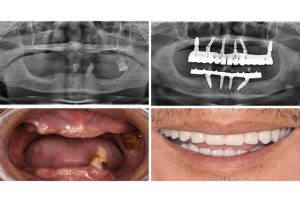
Full-arch treatment sits at the upper end of that range, and it has a published evidence base worth knowing before you commit. A clinical case series published in the international journal JDIR (Journal of Dental Implant Research) reported a 98.94% cumulative implant survival rate up to 3 years of loading. The definitive prosthesis survival rate in the same series was 100% at 3 years.
The series covered 94 Straumann BLT implants placed in 20 periodontally compromised patients, followed from April 2016 to April 2019, with one implant failing in the 0–3 month interval. It used the ProArch concept, the Straumann full-arch protocol that underpins All-on-4 and All-on-6 treatment. (Assoc. Prof. Tran Hung Lam is the lead author of this study.) Published survival figures describe a study cohort, not a prediction for an individual case, and your own plan is confirmed after imaging and clinical assessment.
3. What makes an implant dentist in Ho Chi Minh City qualified to treat international patients?
Implant placement is not simply inserting a post into the jawbone. It requires reading the bone architecture, choosing the placement axis, accounting for adjacent structures, and factoring in the patient’s general health. Operator experience is widely regarded as a major factor in implant outcomes.
Three things are worth checking in any implant practice in Vietnam:
- A dental degree is the baseline. A formal implant qualification, and continuing certification, is what indicates competence to diagnose and place.
- Case volume. Years of practice across simple and complex presentations build the judgment needed when a case does not follow the textbook.
- Case selection. A qualified dentist declines cases that should be declined (active infection at the site, pregnancy, uncontrolled systemic conditions) and says so at consultation rather than after payment.
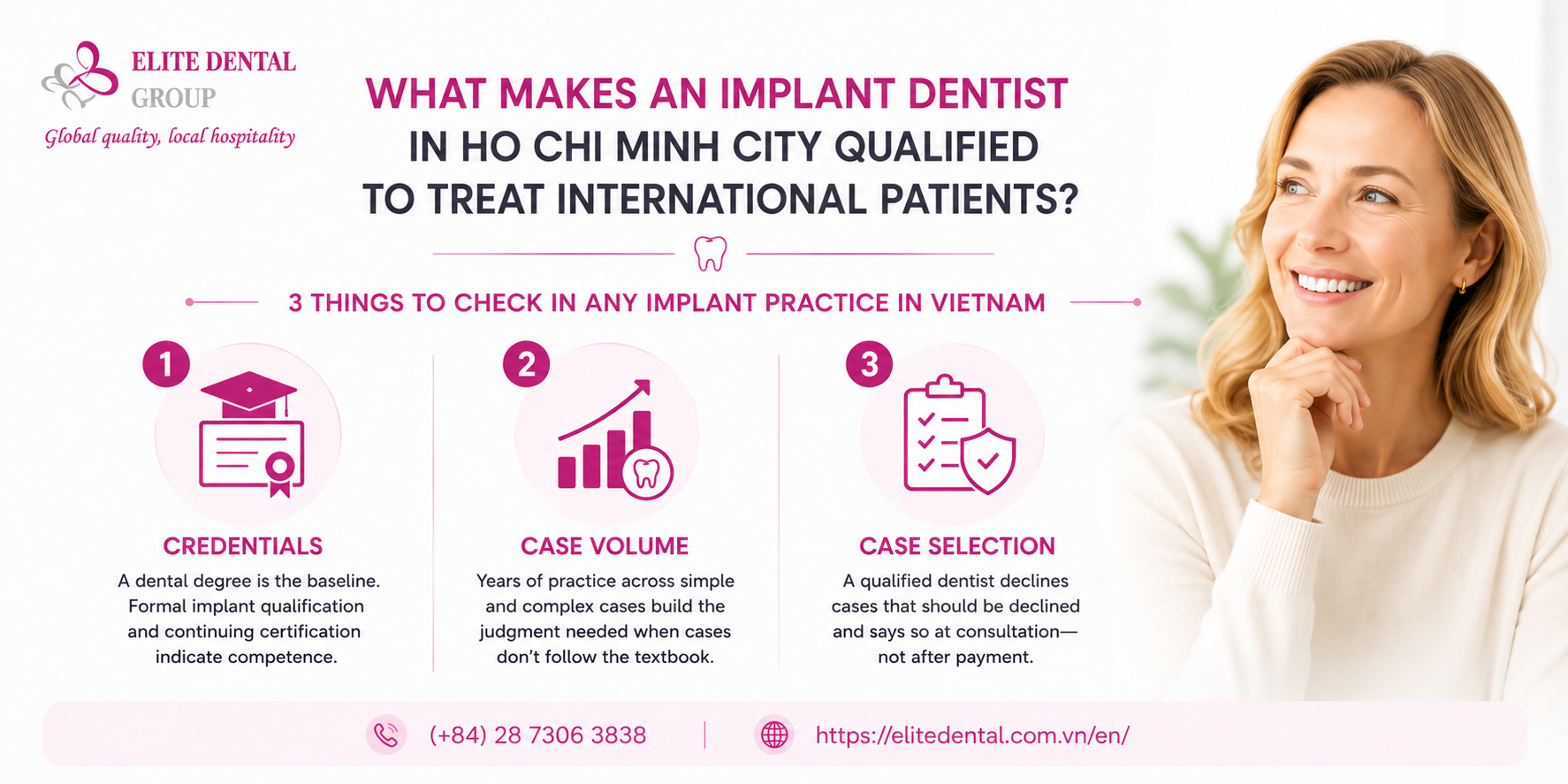 Three things are worth checking in any implant practice
The implant team at Elite Dental Vietnam
Assoc. Prof. Tran Hung Lam, DDS, PhD graduated with distinction from the University of Medicine and Pharmacy, Ho Chi Minh City. He then completed his doctorate in dental surgery in France on a full scholarship. He is Professional Director for Implant Dentistry at Elite Dental Vietnam and serves as ITI Vietnam Chapter President. His research covers full-arch treatment in older patients, including the JDIR case series cited below. One of his cases was selected for a Straumann publication of clinical cases by Asia-Pacific implant dentists.
Dr. Pham Hung Duc Anh trained at the University of Medicine and Pharmacy, Ho Chi Minh City, and holds continuing certification in implant placement. He has more than five years placing and restoring implants across age groups.
Dr. Tran Chau Bao Phuc completed the Master Clinician in Implant Dentistry program at the gIDE Institute and Loma Linda University in the US. He followed this with advanced courses in zygomatic implants, vertical bone augmentation, and soft-tissue reconstruction around implants.
Elite Dental’s advanced training centre, THL Academy, is a Center of Excellence by Straumann, officially recognised by the Straumann Group, and one of only three Straumann Centers of Dental Education in Southeast Asia.
4. What does implant treatment at Elite Dental Vietnam involve?
Treatment follows a planned clinical sequence rather than a fixed calendar. It opens with imaging: a panoramic 2D X-ray as the initial imaging study, and a 3D CBCT as part of the planning workflow. The CBCT assesses bone volume and density, and maps the relationship to the inferior alveolar nerve and maxillary sinus.
Blood work follows, checking clotting and, where relevant, blood glucose. Surgery is performed under local or general anesthesia in a closed surgical suite with a dedicated sterile scrub area, following a strict aseptic protocol. The Wand STA computer-controlled anesthesia and PRF/PRP may be used where indicated. Placement itself is quick; digital planning tools including dCarer Navigation, an intraoral scanner, and the PIC System support accuracy in planning and impression-taking.
After osseointegration, the final restoration is fitted. Where bone volume is insufficient, grafting or a sinus lift is added to the plan before placement.
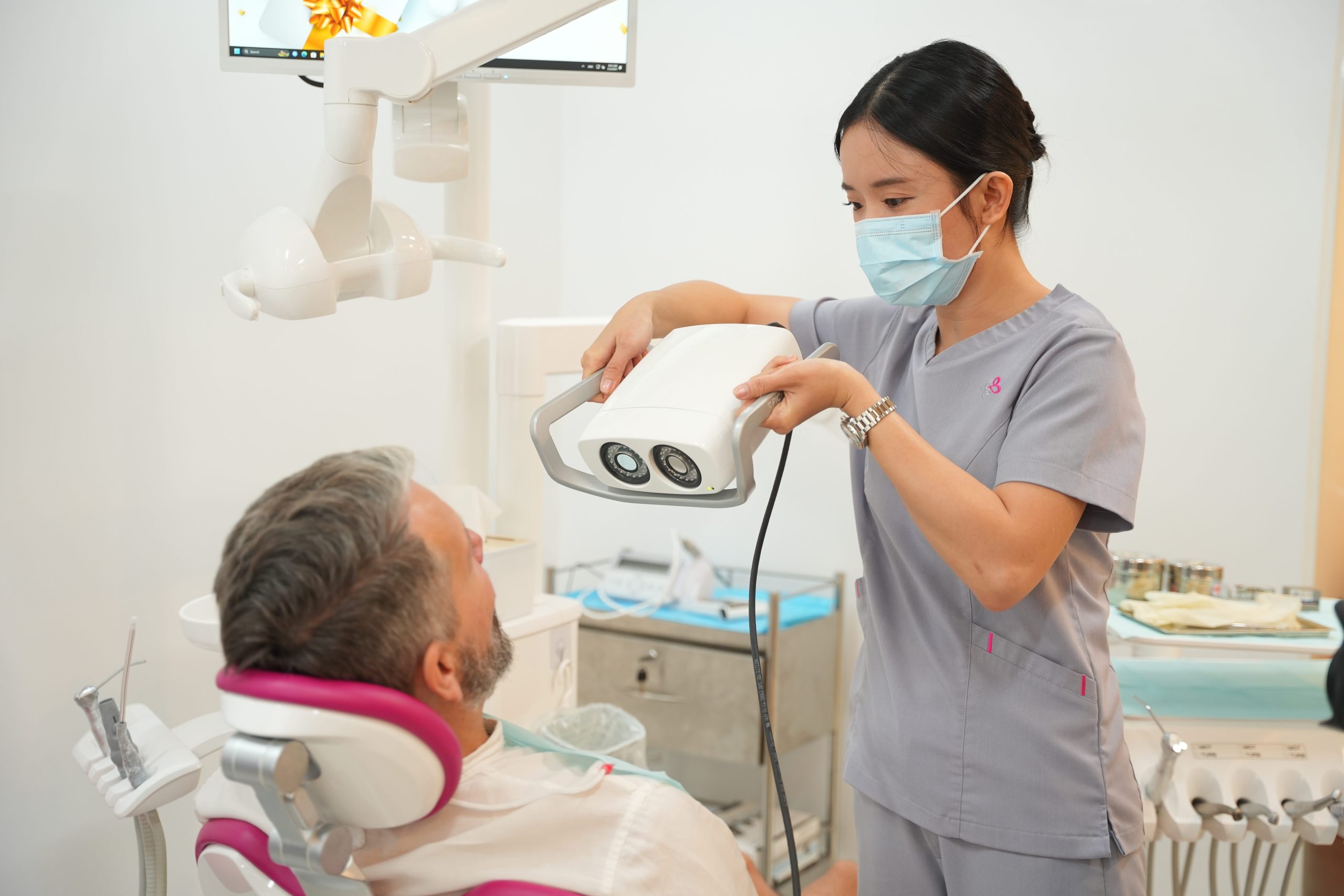 Elite Dental uses state-of-the-art facilities to ensure precise diagnoses for you
For international patients: plan on two trips with a 4–6 month gap between them. The exact length and schedule depend on the patient’s clinical condition and treatment plan, confirmed at the initial consultation. Recovery time depends on case complexity; treatment is well tolerated by most patients, and post-operative discomfort is typically managed with standard analgesia.
Elite Dental Vietnam maintains comprehensive implant documentation (manufacturer details and surgical records maintained for each component) and supplies the warranty terms provided by each implant manufacturer. Because the systems used are distributed globally, maintenance or repair can generally be handled by a dentist in your home country without flying back to Vietnam.
5. What should I consider before deciding on a dental implant?
An implant is a long-term restoration, so the factors that support a good long-term result are worth discussing at consultation rather than afterwards. The main one is peri-implant health. Peri-implantitis, inflammation of the tissue and bone around an implant, can develop years after placement, and it is a common reason an established implant needs further attention.
Several factors are known to influence how an implant performs over time:
- A history of periodontal disease. Patients previously treated for periodontitis can be implant candidates, and the published evidence supports treating them. They do warrant closer monitoring afterwards.
- Smoking is associated with higher rates of peri-implant complications. Reducing or stopping it is discussed as part of planning.
- Systemic conditions and medication. Uncontrolled diabetes and certain medications affect healing, which is why blood work and a medical history review come before surgery.
- Maintenance and recall. Implants do not decay, but the tissue around them needs professional cleaning and periodic review, broadly on the same schedule as your natural teeth.
Not every implant integrates. A small proportion do not, most often in the first months after placement, and long-term survival data from systematic review is listed in the References below. At consultation, the implant dentist at Elite Dental Vietnam reviews your medical history and your CBCT, and tells you which of these factors apply to your case before you commit to treatment.
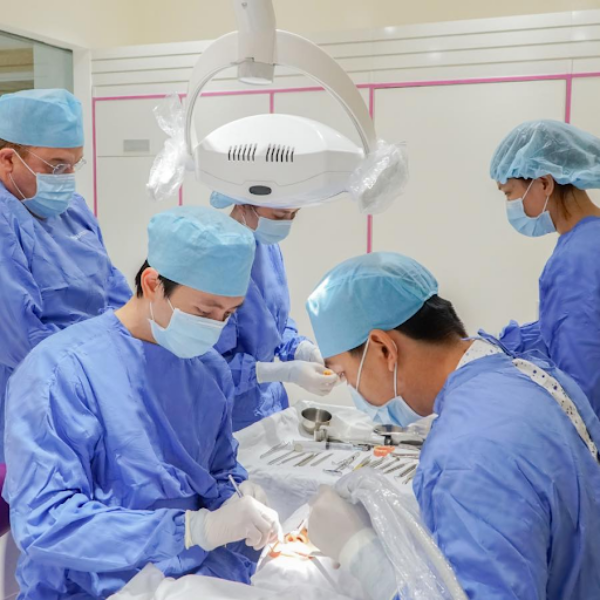
Quality standards at Elite Dental Vietnam
Elite Dental Vietnam holds AACI (American Accreditation Commission International) accreditation with a score of 95.33/100 — the first AACI-accredited dental system in Vietnam (issued September 2025). AACI evaluates sterilization, material traceability, and patient safety.
For Implant treatment, this means the surgical suite, instrument sterilization cycle, and per-component record-keeping are audited against an external American standard rather than declared internally. Elite Dental Vietnam operates under a quality management system assessed against AACI standards; AACI assesses the quality-management and safety system, not the clinical outcome of an individual case.
Contact Elite Dental Vietnam at (+84) 28 7306 3838 for a consultation on dental Implant treatment.
Conclusion
What separates implant pricing in Ho Chi Minh City from pricing in higher-cost markets is the cost base of the practice, not the implants themselves. That makes the useful question a different one: not how cheap, but what is verifiable. Look for a named, credentialed implant dentist and a globally distributed implant system with documentation you can take home. Look also for imaging-led planning, third-party accreditation of the safety systems you cannot inspect yourself, and a frank conversation about the factors that affect your own case. In 2026, Elite Dental Vietnam publishes its Implant pricing in full and names the dentist who will treat you. It holds AACI accreditation at 95.33/100 as the first AACI-accredited dental system in Vietnam. Contact Elite Dental Vietnam at (+84) 28 7306 3838 to arrange a consultation.
FAQ
Can I have dental implants in Vietnam if I already have bone loss?
Yes, in most cases. Long-term tooth loss commonly leads to bone resorption, and this is anticipated rather than disqualifying. After CBCT review, the treatment plan may include bone grafting or a sinus lift to rebuild volume at the site before placement. The plan is confirmed with you at consultation.
How long do I need to stay in Ho Chi Minh City?
Plan two trips with a 4–6 month gap between them: one for placement, one for the final restoration. The exact length and schedule depend on your clinical condition and treatment plan, confirmed at the initial consultation. The patient care team at Elite Dental Vietnam can help you align appointments with your travel dates.
Will my implant be serviceable after I return to Australia or the US?
Yes, in most cases. Elite Dental Vietnam uses implant systems distributed worldwide: Straumann, Neodent, Hahn, MegaGen, and Dentium. Your documentation records the manufacturer details for each component, so a dentist in your home country can identify and service the implant. Warranty terms are those supplied by each implant manufacturer.
Is implant surgery comfortable?
Implant surgery is well tolerated by most patients. Anesthesia is administered locally or generally depending on the case, and The Wand STA computer-controlled delivery may be used to make administration more comfortable. Post-operative discomfort is typically managed with standard analgesia. Recovery time depends on case complexity.
Do the dentists at Elite Dental Vietnam speak English?
Yes. The implant dentists at Elite Dental Vietnam consult in English, supported by trained interpreters where a patient prefers another language. This matters more than it sounds: consent, medical history, and post-operative instructions all depend on the clinical conversation being understood accurately by both sides.
Can I combine treatment with travel in Vietnam?
Yes. Many international patients schedule the consultation and surgery at the start of a trip, then travel within Vietnam during the initial healing days before flying home. Discuss your itinerary at consultation so that follow-up appointments and any activity restrictions can be planned around it.
References
- American Dental Association. Oral Health Topics: Implants. https://www.ada.org/resources/ada-library/oral-health-topics/implants
- Howe M-S, Keys W, Richards D. Long-term (10-year) dental implant survival: A systematic review and sensitivity meta-analysis. Journal of Dentistry, 2019. PMID 31082452. https://pubmed.ncbi.nlm.nih.gov/31082452/
- Esposito M, Grusovin MG, Maghaireh H, Worthington HV. Interventions for replacing missing teeth: different times for loading dental implants. Cochrane Database of Systematic Reviews, 2013. CD003878. https://www.cochranelibrary.com/cdsr/doi/10.1002/14651858.CD003878.pub5/full
- Tran-Hung Lam, Dard Michel. Immediate placement and loading of full edentulous arches in 20 periodontally compromised patients — in-line clinical case series with 3 years follow-up. J Dent Implant Res. 2021;40(3):59-65. doi:10.54527/jdir.2021.40.3.59
Related posts:
> Single-Tooth Implant
> Front Dental Implant
> Full Mouth Dental Implants