

Table of content
- Key Takeaways
- 1. Which Route Applies to Your Passport?
- 2. Do Dental Trips Fit Within the Permitted Stay?
- 3. How to Apply for the Vietnam E-Visa
- 4. Single Entry or Multiple Entry?
- 5. Implants, Two Trips and Your Visa
- 6. Timing Your Application
- 7. Entry Points: Match Your Airport to Your E-Visa
- 8. Passport Checks
- 9. What to Carry
- 10. If Your Plans Change
- 11. Common Mistakes to Avoid
- 12. Official Sources and Your Own Government’s Advice
- Frequently Asked Questions
- Next Steps
- References
A visa is the least romantic part of planning a dental trip, and yet it is the one piece that can stop a journey at the airport. If you have already spent weeks weighing quotes, clinics and flights, it is natural to want this part to be simple. The good news is that, for most dental travellers, it can be: a short online application, a modest government fee and a printout in your bag.
Which route applies depends on your passport. According to Vietnam’s official tourism guide, citizens of the United Kingdom and a number of other countries can enter visa-free for up to 45 days, while Australian, New Zealand, US and Canadian passport holders are not on that list and need an e-visa, which is valid for up to 90 days. The e-visa is applied for on the official government portal, evisa.gov.vn, at a published fee of US$25 for a single entry or US$50 for multiple entries, with a processing time of 3 to 5 working days. Your passport must be valid for at least six months beyond your date of entry.
This guide walks through those rules in the order you will meet them: who needs what, how to apply, how the two-trip structure of implant treatment affects your visa, which airport to use, what to carry and which mistakes to avoid. It is written for dental travellers coming to Ho Chi Minh City, and it points you to the official sources throughout, because rules change and only the official pages are final.
None of this is difficult, but it does reward doing things in the right order. Most visa problems for travellers are not caused by complicated rules. They come from small mismatches: a passport with too little validity, an application made on the wrong website, an airport that does not match the e-visa. The sections below are built to help you avoid each of them, one at a time.
Key Takeaways
Your passport decides your route. UK passport holders can use the 45-day visa exemption, while Australian, New Zealand, US and Canadian passport holders need an e-visa.
 Preparing travel documents for a dental trip to Vietnam
Apply on the official portal only. The official e-visa website is evisa.gov.vn. Vietnam Tourism warns against third-party agencies charging inflated fees.
Check your passport and your entry point. Your passport needs at least six months’ validity beyond entry and at least two blank pages, and your e-visa lists an approved port of entry that should match your arrival airport.
Plan one e-visa per trip for implants. An e-visa is valid for up to 90 days, so it cannot cover two trips that are four to six months apart.
Leave a margin. Processing takes 3 to 5 working days, and the fee is not refunded if an application is refused.
1. Which Route Applies to Your Passport?
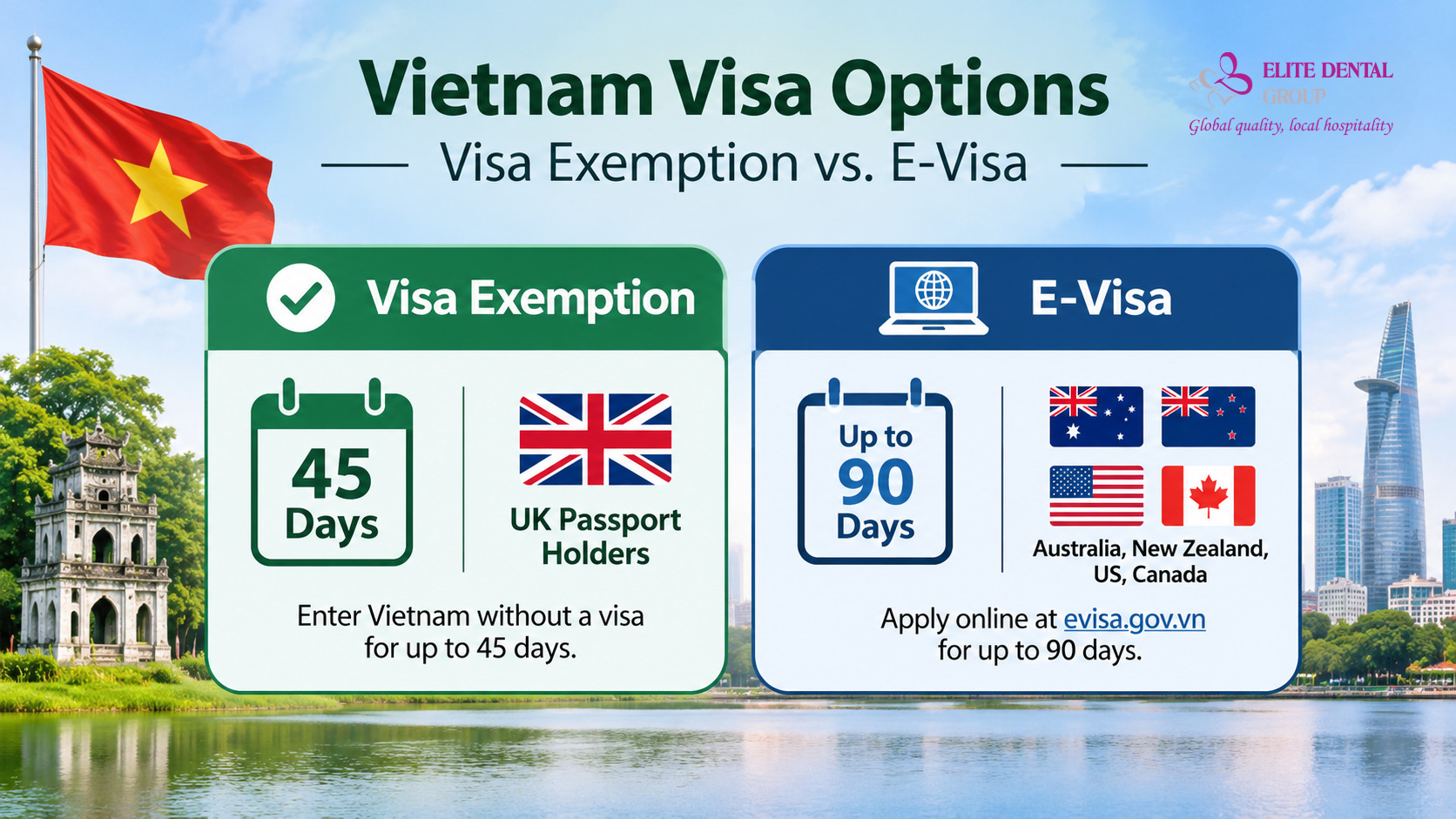
Vietnam’s official tourism guide lists three main ways in: visa exemption, the e-visa, and a special exemption for Phu Quoc Island. For a dental trip to Ho Chi Minh City, the first two are the ones that matter. Visa exemption means that citizens of listed countries can enter without applying for a visa in advance, for a fixed number of days. The e-visa is an electronic visa that you apply for online before you travel, and Vietnam issues e-visas to citizens of all countries and territories.
The table below summarises the position for the passports most common among Elite Dental’s international patients. It is a summary only, so confirm it against the official pages before you book.
| Your passport | Typical route | Permitted stay | Notes |
|---|---|---|---|
| United Kingdom | Visa exemption | Up to 45 days from the date of entry | Listed in the official 45-day group valid through 14 March 2028 under Resolution 44/NQ-CP |
| Australia | E-visa | Up to 90 days | Not on the official 45-day exemption list |
| New Zealand | E-visa | Up to 90 days | Not on the official 45-day exemption list |
| United States | E-visa | Up to 90 days | Not on the official 45-day exemption list |
| Canada | E-visa | Up to 90 days | Not on the official 45-day exemption list |
| Other passports | Check the official exemption list, otherwise e-visa | Varies | Vietnam issues e-visas to citizens of all countries and territories |
The 45-day exemption comes with conditions, including a passport valid for at least six months on entry and a round-trip ticket or proof of onward travel. If you want to stay longer than 45 days, you need to apply for an e-visa before you arrive. Exemption periods are set by government resolutions, which is why the dates in the table matter and why it is worth checking the official page close to your travel date.
Vietnam visa exemption and e-visa options for international travellers
2. Do Dental Trips Fit Within the Permitted Stay?
In almost every case, yes, and by a wide margin. Veneers and crowns can usually be completed in one stay of about 5 to 10 days. Implants need healing time, so single implants and full-arch treatment usually need two trips: about 5 to 7 days on the first and about 3 to 5 days on the second. Even with buffer days for rest, these stays sit comfortably inside a 45-day or 90-day allowance.

International dental patient discussing treatment planning at a dental clinic in Vietnam
That said, two practical points are worth raising early. If you are unsure how your purpose of travel is classed under your visa or exemption, ask the Vietnam Immigration Department or your nearest Vietnamese embassy or consulate before you book. And if your treatment plan might need longer than your permitted stay, raise it with your coordinator and the immigration authorities in advance rather than on arrival.
3. How to Apply for the Vietnam E-Visa
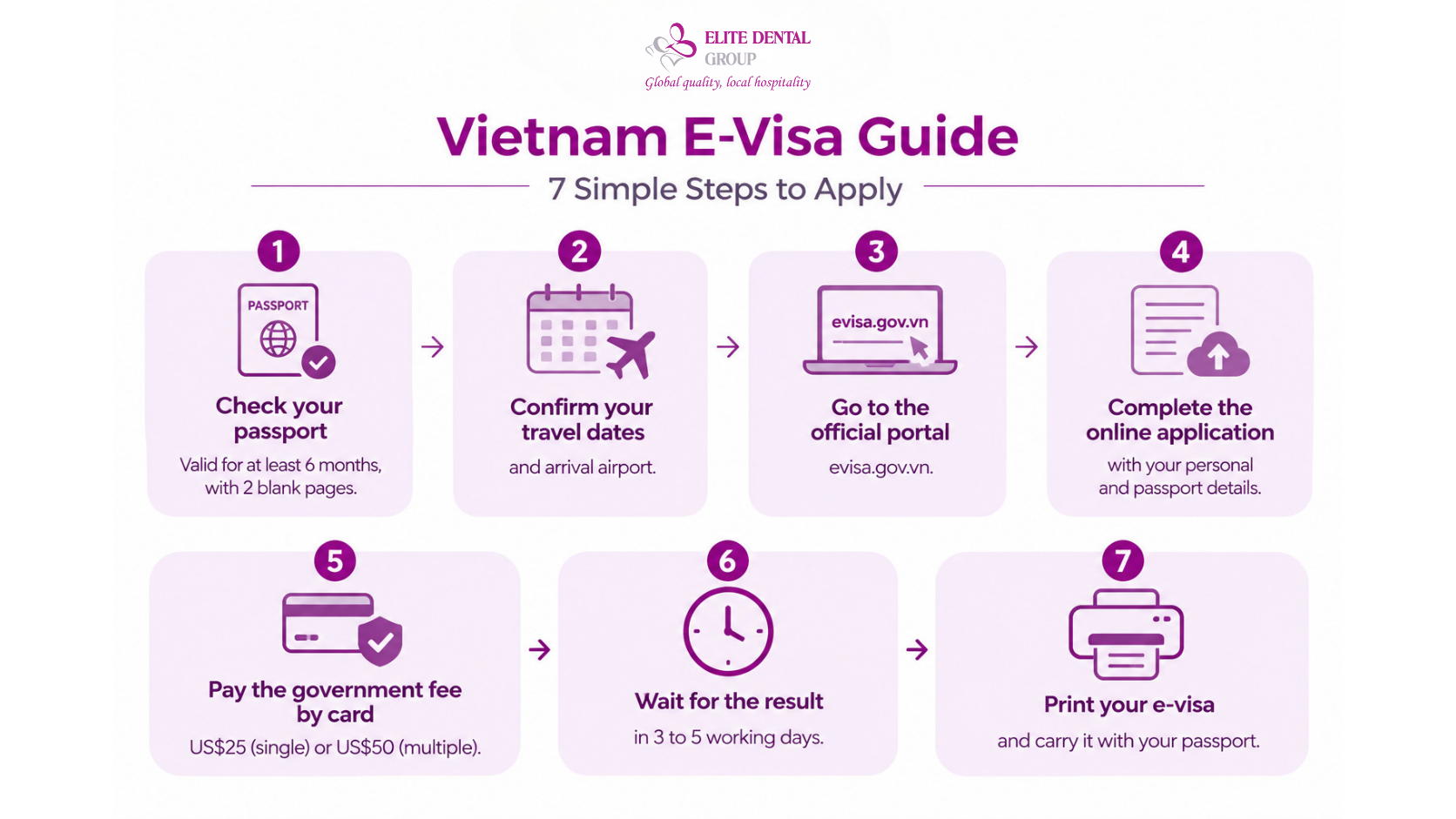
The e-visa is a straightforward online process when you use the official site. Here is the sequence most travellers follow:
- Check your passport. It must be valid for at least six months beyond your date of entry, with at least two blank pages for entry and exit stamps.
- Confirm your travel dates and which airport you will arrive at. For Ho Chi Minh City, that is Tan Son Nhat International Airport.
- Go to the official portal, evisa.gov.vn. Type the address yourself rather than following an advertisement, because look-alike sites exist.
- Complete the online application with your personal and passport details, your intended entry date and your port of entry, and upload the documents the portal requests.
- Pay the government fee by card on the portal. The published fee is US$25 for a single entry or US$50 for multiple entries, both valid for up to 90 days. The immigration department notes that the fee is not refunded if an application is refused.
- Wait for the result. Processing takes 3 to 5 working days, according to Vietnam Tourism. You receive a code by email that you use to check the result and download your approval.
- Print your e-visa and carry it with your passport.
Steps to apply for a Vietnam e-visa through the official immigration portal
It is worth slowing down at step 4. Names and passport numbers must match your passport exactly, and a small typo is the most common reason an application needs correcting. Take a few minutes to check every field before you pay.
The official portal is run by the Vietnam Immigration Department. Vietnam Tourism’s own guide advises applying only on the official government portal and avoiding third-party agencies that charge inflated fees.
4. Single Entry or Multiple Entry?
For most dental travellers a single-entry e-visa is enough: you enter once, have your treatment and leave. A multiple-entry e-visa, at US$50, only makes sense if you plan to leave and re-enter within its validity, for example for a short side trip to a neighbouring country, which also calls for checking that country’s own entry rules. If you are unsure which to choose, think about whether your itinerary actually includes a second entry within the 90 days.
5. Implants, Two Trips and Your Visa
This is the part that is easy to miss. An e-visa is valid for up to 90 days, while the two trips for implant treatment are typically about four to six months apart, with healing at home in between. A single e-visa therefore cannot span both trips, and you should plan to apply for a separate e-visa for the second trip if your passport requires one. Passport holders who can use a 45-day exemption simply enter again under the exemption, provided the conditions are still met.
It helps to see how this fits together on a calendar. The example below is illustrative, for a patient who needs an e-visa:
| Stage | What to do |
|---|---|
| A few weeks before trip 1 | Check your passport, then apply for your first e-visa on the official portal |
| Trip 1 (about 5 to 7 days) | Enter with your first e-visa, have your treatment and fly home |
| Healing at home (about 4 to 6 months) | Plan the date of trip 2 with your team and keep your passport validity in view |
| A few weeks before trip 2 | Apply for a new e-visa for the second trip |
| Trip 2 (about 3 to 5 days) | Enter with your second e-visa for your review and final restoration |
It is sensible to put both visa applications in your planning calendar when you agree the date of your second trip with your team, so that nothing is left to the last minute. Also check that your passport will still have six months’ validity at the time of the second trip, not only the first.
6. Timing Your Application
Processing takes 3 to 5 working days, so applying a few weeks before departure leaves a comfortable margin for questions or corrections. Many travellers apply once their treatment dates and flights are firm, so that the entry date on the e-visa matches the plan. If your dates move after you have an approved e-visa, check the portal’s guidance for what that means for your application rather than assuming it carries over.
7. Entry Points: Match Your Airport to Your E-Visa
Vietnam has 83 approved border gates for e-visa holders, including Tan Son Nhat International Airport in Ho Chi Minh City. Your e-visa approval specifies the approved port of entry, and Vietnam Tourism advises making sure your flight or land route matches the exact checkpoint listed. If you plan to arrive in Hanoi or Da Nang and travel on to Ho Chi Minh City, enter the port you will actually use. A quick comparison of your flight booking and your e-visa approval, done once before you travel, is enough to catch a mismatch.
8. Passport Checks
Three checks save most arrival-day problems. First, your passport must be valid for at least six months from your date of entry. Second, it needs at least two blank pages. Third, the name and number on your e-visa must match your passport exactly. Airlines can refuse boarding if your passport validity is short, so check this before you book flights rather than after.
9. What to Carry
Having the right papers in one place makes arrival calm. Pack:
- Your passport, with the validity and blank pages above.
- A printed copy of your approved e-visa, if you need one.
- A return or onward ticket.
- Your hotel and airport pickup details. Elite Dental’s English-speaking coordinator arranges airport pickup and hotel assistance, provided at no charge for eligible cases, so ask what confirmation they can send you.
- Your travel and specialist insurance details.
- Contact details for your treating team and your own dentist.
Keep digital copies of the same documents on your phone and in cloud storage, in case a paper copy is lost.
10. If Your Plans Change
Plans sometimes move: a flight is rebooked, a treatment date shifts, or a plan turns out to need a few more days. If your dates change before you travel, check the official portal for what that means for an approved e-visa, and let your coordinator know so that your appointments and airport pickup can be adjusted. If your treatment might need longer than your permitted stay, talk to the immigration authorities early. It is far easier to ask the question before you travel than at the border.
11. Common Mistakes to Avoid
- Using an unofficial site. Third-party agencies can charge several times the official fee. Start from evisa.gov.vn.
- Letting your passport run short. Check the six-month rule before booking anything.
- Mismatched entry points. Make sure your arrival airport is the port named on your e-visa.
- Forgetting the second trip. For implants, plan the second visa as carefully as the first.
- Assuming rules never change. Exemption periods and fees are set by government resolutions and can be updated, so check the official pages close to your travel date.
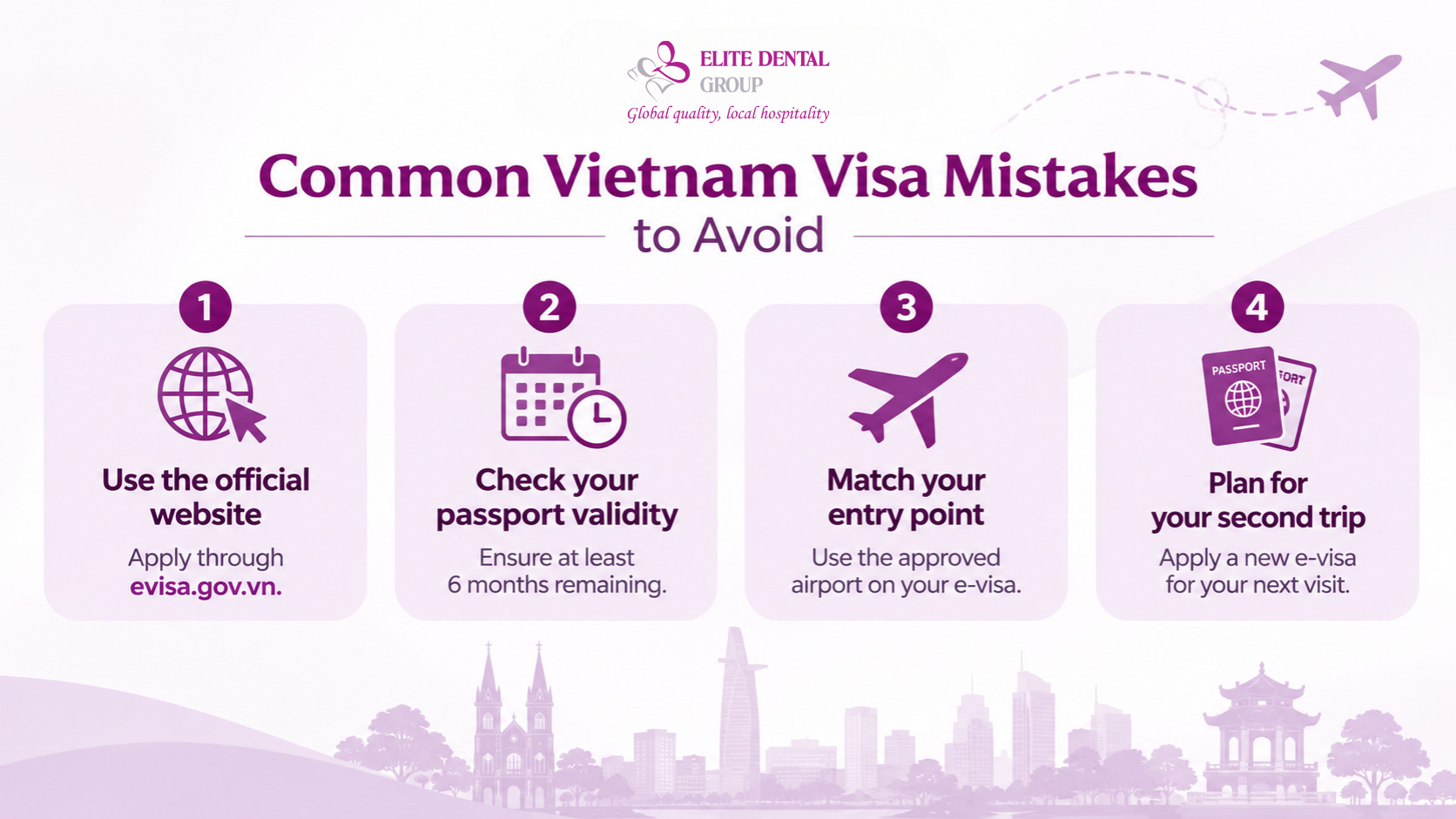
– Checklist of common Vietnam visa mistakes for international travellers
12. Official Sources and Your Own Government’s Advice
Bookmark these before you travel:
- Vietnam e-visa official portal
- Vietnam Tourism: visa requirements
- Vietnam Tourism: official guide to e-visas
- Smartraveller (Australia)
- SafeTravel (New Zealand)
- UK Foreign Office travel advice
Frequently Asked Questions
Do Australians need a visa for Vietnam? Yes. Australia is not on Vietnam’s official 45-day exemption list, so Australian passport holders need an e-visa, which is valid for up to 90 days. Apply on the official portal, evisa.gov.vn.
Do New Zealanders need a visa for Vietnam? Yes. New Zealand is not on the official exemption list either, so apply for an e-visa on the official portal and check the current fee.
Do UK passport holders need a visa for Vietnam? Not for stays of up to 45 days. The UK is in the official 45-day exemption group that runs through 14 March 2028. For a longer stay, apply for an e-visa before you arrive.
Do US and Canadian passport holders need a visa? Yes. Neither is on the official 45-day exemption list, so both need an e-visa, valid for up to 90 days.
How much does the Vietnam e-visa cost? Vietnam Tourism lists US$25 for a single entry and US$50 for multiple entries, each valid for up to 90 days. Check the portal for the current fee.
How long does the e-visa take? Vietnam Tourism gives 3 to 5 working days. Apply a few weeks before departure to leave a margin.
Do I need two e-visas for a two-trip implant plan? Usually, yes. An e-visa is valid for up to 90 days, and the two trips are typically four to six months apart, so plan a separate e-visa for the second trip unless your passport is exempt.
Which airport should I use for Ho Chi Minh City? Tan Son Nhat International Airport is one of the approved e-visa airports. Make sure the port of entry on your e-visa matches your arrival.
Is the e-visa fee refundable? The immigration department notes that the fee is not refunded if an application is refused, so check your details carefully before you pay.
Can Elite Dental apply for my visa? Elite Dental’s coordinator can help with practical arrangements such as airport pickup and hotel assistance, but you should apply for your visa yourself on the official government portal.
Next Steps
Paperwork can feel like the part of a journey that stands between you and the thing you actually want, but it is also the part that, once done, lets you stop worrying. Take an evening to check your passport, open the official portal and put the dates in your calendar, and you will have turned an unknown into a tick on a list. From there, the rest of the trip comes into focus. Ssee what a real first trip looks like in Michael Turner’s two-trip journey, and when you are ready, send us your X-ray so your coordinator can draft a treatment timeline before you book flights. If you would like to talk it through first, call (+84) 28 7306 3838. The paperwork is only a doorway. What waits on the other side is the care, and the smile, you came for.
References
- Vietnam National Authority of Tourism. Vietnam visa requirements (updated 2026). https://vietnam.travel/plan-your-trip/visa-requirements/
- Vietnam National Authority of Tourism. An official guide to e-visas for Vietnam. https://vietnam.travel/plan-your-trip/official-vietnam-evisa-application/
- Vietnam Immigration Department. National portal on immigration, electronic visa. https://evisa.gov.vn
- Government of Vietnam. Resolution 44/NQ-CP (45-day visa exemption, 15 March 2025 to 14 March 2028) and Resolution 229/NQ-CP (45-day tourism exemption, 15 August 2025 to 14 August 2028), as listed in the Vietnam Tourism visa guide.
- Elite Dental Vietnam. How many trips does All-on-4 in Vietnam need? https://elitedental.com.vn/en/how-many-trips-does-all-on-4-in-vietnam-need-a-real-two-trip-case.html
Please note: This article is intended for general information only and is not legal, immigration or medical advice. Visa and entry rules are set by the Vietnamese government and may change, so always confirm the current requirements on the official sources above before you travel.