

Table of content
- Contents
- Key Takeaways
- 1. When All-on-4 Implants Are Indicated
- 2. Advantages of All-on-4 Dental Implants
- 3. All-on-4 Costs: Australia vs. Vietnam
- 4. Treatment Schedule: Two Trips
- 5, Quality and Safety: What Accreditation Covers
- 6. Warranty and Aftercare: What Happens After You Return Home
- 7. All-on-4 at Elite Dental Vietnam
- 8. The Standard All-on-4 Implant Procedure
- Conclusion
- Frequently Asked Questions
- References
All-on-4 is a fixed, full-arch restoration for patients who have lost most or all of the teeth in one jaw, using fewer implants than replacing each tooth individually. Because full-arch treatment is a significant investment, many Australian patients compare more than just domestic and overseas prices. They also compare treatment protocols, clinical standards and long-term support.
This article explains how All-on-4 works, how costs differ between Australia and Vietnam, what the two-trip treatment schedule involves, and how to evaluate quality, aftercare and warranty before you decide.
Key Takeaways
All-on-4 is a fixed restoration for an entire arch. The procedure is typically more streamlined than replacing teeth one by one, and it suits patients who want a stable, long-term alternative to removable dentures.
Cost is the main reason many Australian patients consider treatment overseas. Australian clinic cost guides for 2026 typically place All-on-4 at roughly A$20,000 to A$35,000 per arch. Elite Dental Vietnam’s 2026 price list ranges from 210,000,000 VND to 260,000,000 VND per arch (about US$8,100 to US$10,000), depending on the treatment package. The difference can be substantial even before travel costs are factored in.
Treatment usually requires two trips. The first trip covers the main treatment, and the second completes it after about four to six months. This structure lets patients plan work commitments, leave and travel costs well in advance.
A fair comparison looks beyond the quoted price. Check what each quote includes, which materials are used and what travel will cost. Two quotes with the same total can cover very different things.
Documentation determines whether your warranty is usable once you are home. Warranty terms should be set out in writing so that you can rely on them later. Ask the clinic for these documents before you book flights, not after treatment is finished.
1. When All-on-4 Implants Are Indicated
The All-on-4 technique was developed by Dr. Paulo Maló in the late 1990s and first published in 2003. It is indicated in the following cases of full-arch tooth loss.
Complete tooth loss in the upper arch, lower arch or both. All-on-4 is an effective solution for restoring chewing function and aesthetics when all teeth have been lost. Compared with removable dentures, a fixed prosthesis on four implants provides firmer, more stable chewing force over the long term.
Multiple consecutive missing teeth that cannot be restored individually. When six or more teeth are missing, placing individual implants is costly and complex. All-on-4 restores the full arch with only four implants, saving cost and shortening treatment time.
Severe periodontitis requiring full-mouth extraction. When teeth are loose and severely infected due to periodontitis and cannot be saved, dentists typically recommend extracting all teeth. All-on-4 is then used to restore a new set of teeth and limit jawbone loss.
Patients who are not candidates for multiple implants. Older adults, or patients with weak jawbone who do not qualify for a larger number of implants, can still opt for All-on-4. The method uses only four implants, reducing invasiveness and shortening treatment time while still ensuring stability for the entire arch.
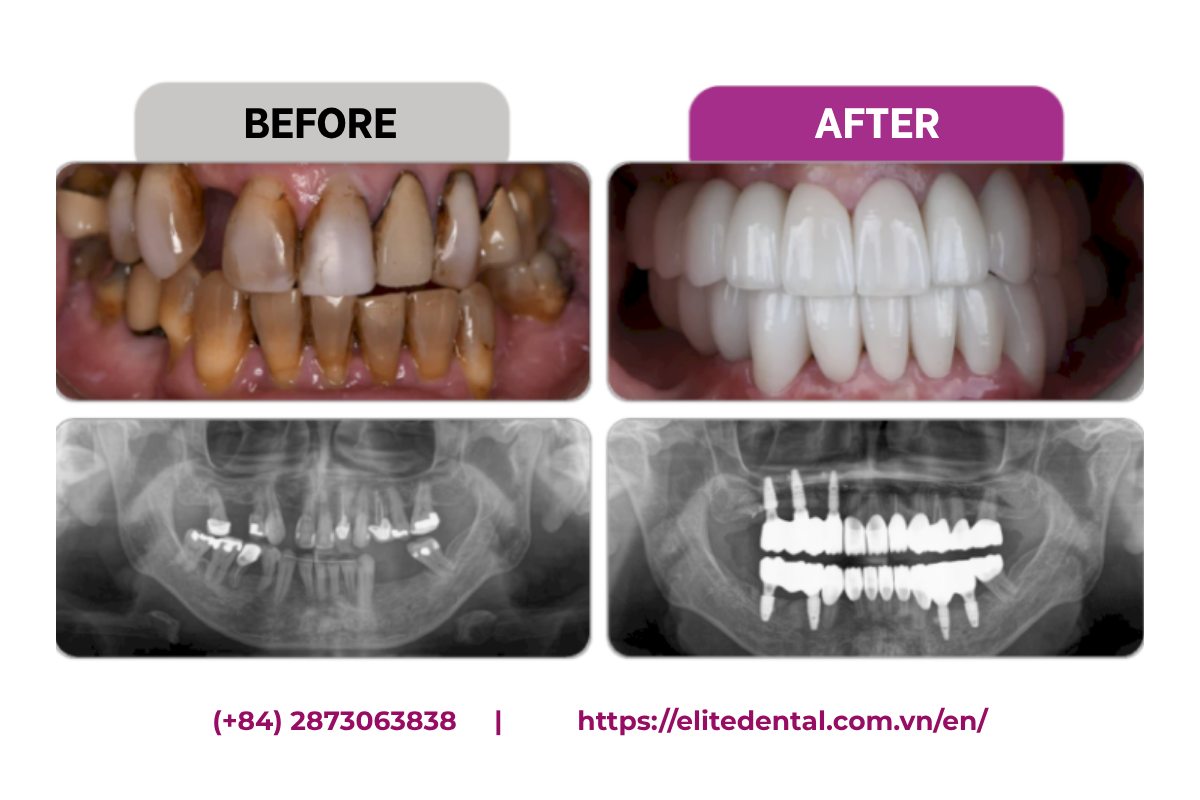
The All-on-4 technique, following the Maló protocol, is indicated for patients with complete tooth loss or severe periodontitis.
2. Advantages of All-on-4 Dental Implants
All-on-4 is a modern full-arch restoration solution, highly regarded by many specialists for optimizing function, aesthetics and cost compared with traditional implant techniques.
Restores strong chewing ability. Four implants anchored in the jawbone create a solid foundation that supports the entire arch. Patients can eat comfortably, without the looseness associated with removable dentures.
Saves cost by reducing the number of implants. With only four implants per arch instead of the eight to ten used in traditional techniques, overall cost is significantly reduced while the entire arch is still restored.
Limits complex surgery and shortens treatment time. By tilting the two rear implants up to 45 degrees, All-on-4 makes use of available bone and limits or avoids the need for bone grafting in many cases. This reduces invasiveness and shortens recovery time.
Prevents bone loss and improves facial aesthetics. Implants replace tooth roots, helping preserve jawbone density and limit the bone loss that follows tooth loss. The face is better supported, improving aesthetics and confidence in social interaction.
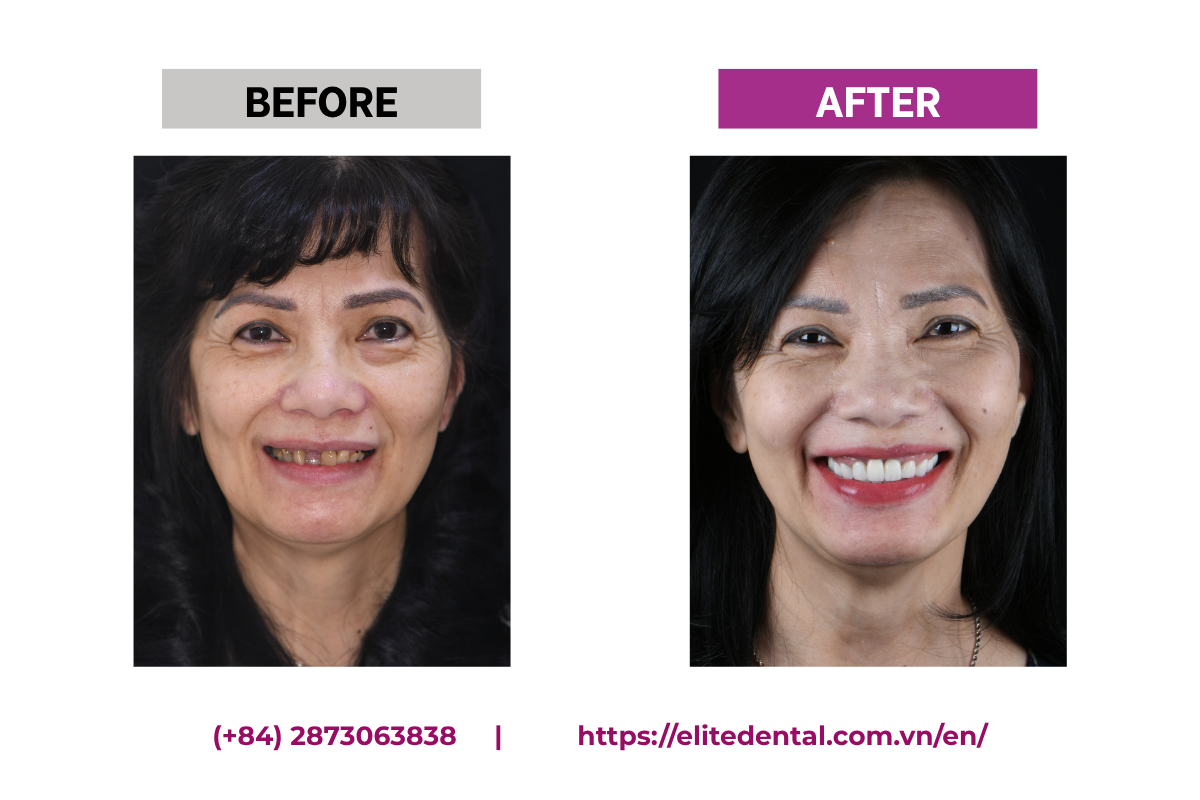 All-on-4 optimizes chewing function, aesthetics and cost by reducing the number of implants, limiting bone grafting and limiting bone loss.
3. All-on-4 Costs: Australia vs. Vietnam
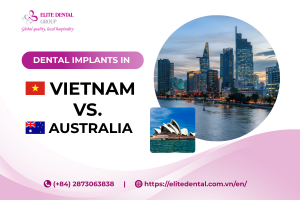
Australian clinic cost guides published for 2026 typically place All-on-4 at roughly A$20,000 to A$35,000 per arch. Some guides give lower figures and others higher, depending on location, implant system and, above all, the material of the final bridge.
Prices in Vietnam are generally lower, and the gap can be significant. Compared with the midpoint of the Australian range, Vietnamese prices are roughly 45% to 55% lower per arch, before travel costs, depending on the type of implant.
How to Compare Quotes Fairly
Two quotes with the same total can include very different things. To compare on a like-for-like basis, check the following four factors:
- Implant system. Each implant brand has its own price level. Straumann, Neodent/Hahn and the major Korean systems are all widely used but sit in different price segments, so confirm which system the quote applies to.
- Material of the final bridge. Material directly affects total cost. According to published Australian cost guides, acrylic and zirconia bridges can differ by several thousand Australian dollars per arch.
- Scope of the quote. Some clinics bundle everything, while others charge separately for items such as extractions, anaesthesia or sedation, imaging, temporary bridges and review appointments. Ask specifically whether each item is included.
- Travel costs. Overseas treatment requires two return airfares and roughly 8 to 12 days of accommodation across the two trips. Add these costs based on your actual airfare and accommodation prices, then compare the total against the cost of treatment at home for a complete picture.
4. Treatment Schedule: Two Trips
All-on-4 overseas typically follows a two-trip structure, which suits a pre-planned journey.
Trip 1 (approx. 5 to 7 days). A 3D CBCT scan is taken to determine bone volume and nerve position. Four implants are placed, and a fixed temporary bridge is fitted in the same appointment, so the patient does not leave without teeth.
Healing at home (approx. 4 to 6 months). The implants integrate with the bone, a process known as osseointegration.
Trip 2 (approx. 3 to 5 days). Once healing is confirmed, the final CAD/CAM bridge is fitted and adjusted.
5, Quality and Safety: What Accreditation Covers
Cost is only one part of the decision for a procedure this significant, so it is also worth looking at how a clinic’s quality is independently assessed.
AACI (American Accreditation Commission International) is an independent U.S. healthcare accreditation body with a dedicated set of standards for dental facilities. The latest edition, Version 2.1, comprises 52 standards across three domains: governance, clinical practice and infrastructure. The standards are built on ISO 9001:2015, WHO recommendations and U.S. CMS/Medicare requirements.
A facility must go through standardization of its processes, evidence review, a preliminary assessment and a final assessment before it is scored. Typical areas include instrument sterilization control, patient identification, emergency response procedures and radiation safety during X-ray imaging, which is particularly important for a treatment planned from 3D scans. Records, clinical imaging and equipment management are also within the scope of assessment.
When a clinic mentions accreditation, look for the name of the accrediting body, a verifiable score, the year of issue, and whether the certificate covers the specific branch where you will be treated.
6. Warranty and Aftercare: What Happens After You Return Home
For many patients, the biggest question is what happens once they are back in Australia. A warranty is only useful if it can be applied remotely, and that depends on documentation.
Ask any clinic to provide the following in writing:
- The implant brand, model and lot number
- The manufacturer’s warranty terms and the clinic’s own warranty conditions
- A named contact person for follow-up, and how follow-up is conducted remotely
- The records that a dentist in Australia would need to reference your treatment
Straumann, Neodent/Hahn and the major Korean systems are internationally distributed brands, so a dentist back home can usually identify the system and source compatible components when the documentation is clear.
Who Will Treat You
Full-arch treatment requires specialized surgical and prosthodontic experience. Before you travel, ask for the name of the dentist who will treat you, their training and their experience with full-arch cases, ideally supported by published results or recognized credentials. Reputable clinics will provide this information in writing before patients book flights.
7. All-on-4 at Elite Dental Vietnam
Elite Dental Vietnam is a premium international dental system in Ho Chi Minh City, built on U.S.-standard quality, evidence-based dentistry, internationally trained doctors and patient-centered care.
2026 price list. Prices depend on the implant system chosen and include implant placement surgery and a final CAD/CAM titanium-framework bridge with porcelain or zirconia teeth [6].
| Implant type | Elite Dental 2026 (per arch) | USD equivalent | AUD equivalent |
| Korean systems | From 210,000,000₫ | From US$8,100 | From A$12,200 |
| Hahn/Neodent (Swiss design, made in Brazil) | Up to 240,000,000₫ | Up to US$9,700 | Up to A$14,600 |
| Straumann (Switzerland) | Up to 260,000,000₫ | Up to US$10,000 | Up to A$15,000 |
Figures are indicative, based on an approximate exchange rate of US1≈A1.50.
Elite Dental is the first dental clinic in Vietnam to achieve AACI accreditation, with a score of 95.33/100 under Version 2.1 for dental facilities [6]. The same quality standards framework is applied at all three branches in Ho Chi Minh City (Huynh Tinh Cua, Tu Xuong and Metropole), covering clinical practice, governance and infrastructure.
With an orientation toward evidence-based dentistry and the philosophy of “minimal intervention, maximum preservation,” Elite Dental combines scientific clinical practice with modern technology to support diagnosis and treatment. The team includes more than 30 specialist doctors trained internationally in France, Italy, the U.S. and Japan, and complex implant treatments are led by Assoc. Prof. Dr. Tran Hung Lam, DDS, PhD, Chief Medical Officer of Elite Dental. The treating dentist’s name and professional background are provided in writing before the patient travels.
On materials, Elite Dental is a recognized Straumann Center of Dental Education and uses documented, traceable implant brands, with manufacturer documentation available on request. Every treatment plan is itemized and agreed in writing before the patient departs.
Beyond clinical standards, Elite Dental emphasizes dedication and patient support, with a process coordinated throughout, from consultation and treatment planning to post-treatment follow-up. Implant patients receive the Implant Passport, a documented and portable warranty, along with a named contact for follow-up. For international patients, this support extends throughout the treatment journey, so that patients are fully informed and feel reassured before, during and after treatment.
For a personalized All-on-4 treatment plan, please call (+84) 28 7306 3838.
8. The Standard All-on-4 Implant Procedure
Elite Dental’s procedure follows six steps, each controlled according to international medical protocols to ensure accurate implant positioning and long-term restoration success.
Step 1 – Examination and 3D CBCT scan. The dentist performs a general oral examination and takes a 3D Cone Beam CT scan to assess jawbone density and locate nerves and sinuses, in order to determine implant feasibility.
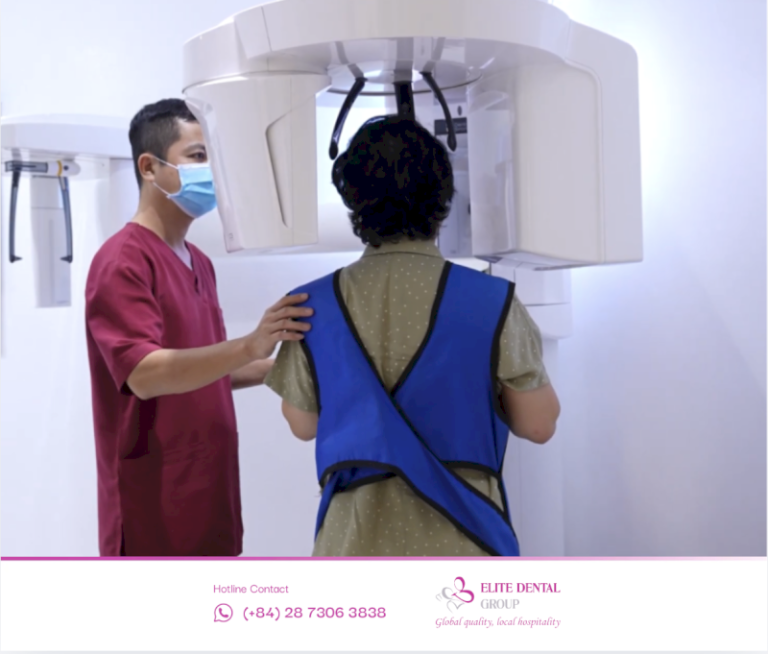
The 6-step implant process at Elite Dental begins with a general examination and a 3D CBCT scan to accurately assess jawbone density.
Step 2 – Personalized treatment planning. Based on CBCT data, the dentist develops a detailed plan covering implant position, angulation and the type of implant suited to each patient. Where there is periodontitis, damaged teeth or weak bone, the dentist will carry out pre-treatment, such as extractions, treatment of infection or bone grafting, before placing the implants.
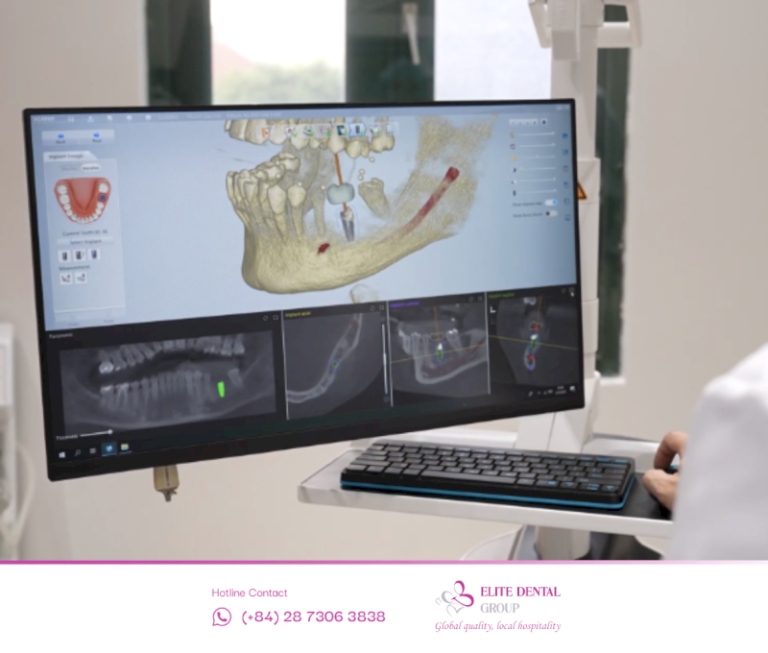
Personalized planning, management of underlying conditions, then placement of four implants under 7-SOP sterile conditions using a surgical guide.
Step 3 – Placement of four implants. The dentist places four implants in the jawbone according to the plan, using positioning devices and surgical guides, including a static guide and the DCarer dynamic navigation system. The entire surgery takes place in a 7-SOP sterile environment that meets AACI standards.
Step 4 – Temporary teeth and osseointegration. After surgery, the patient is fitted with temporary teeth to maintain aesthetics and basic chewing function. The implants need 3 to 6 months to integrate stably with the jawbone, depending on each person’s healing rate.
Step 5 – Fitting the final fixed bridge. Once the implants are stable, the dentist takes a digital impression using a 3D Trios scanner and the PIC stereophotogrammetry system, fabricates the final bridge using CAD/CAM technology, and fixes it onto the four implants.
The finished porcelain bridge is fixed onto four implants using PIC impression technology and modern CAD/CAM fabrication.
Step 6 – Follow-up and regular care. After the restoration is complete, patients return for regular check-ups to examine the implants and bridge and to maintain proper oral hygiene.
Conclusion
All-on-4 is a case where comparing options overseas can make a real difference, because it is a high-value procedure and its two-trip structure suits a planned journey. Price is only part of the picture. Equally important is whether a clinic can document the implant brand, name the treating dentist and offer a warranty process that remains valid after the patient returns home. Ask for all three in writing from any clinic you are considering.
Frequently Asked Questions
How much does All-on-4 cost per arch in Vietnam compared with Australia?
Australian clinic cost guides for 2026 typically place All-on-4 at roughly A$20,000 to A$35,000 per arch. At Elite Dental, prices range from about US$8,100 to US$10,000 (approximately A$12,200 to A$15,000) per arch, depending on the implant type.
What other costs should I factor in besides treatment?
Overseas treatment requires two return airfares and roughly 8 to 12 days of accommodation across the two trips. Add these costs based on your actual airfare and accommodation prices, then compare the total with the cost of treatment at home. Also ask what the quote includes, since items such as extractions, anaesthesia or sedation, imaging and review appointments are sometimes charged separately.
How many trips does All-on-4 require?
Usually two. The first trip, about 5 to 7 days, covers the main treatment, and the second, about 3 to 5 days, completes it, roughly 4 to 6 months apart. This structure lets you plan work, leave and travel costs well in advance.
How can I compare quotes between clinics fairly?
Compare them on the same basis: the implant system used, the material of the final prosthesis, the scope of the quote and travel costs. Two quotes with the same total can include very different things, so request an itemized quote in writing.
How can I verify the quality of a clinic overseas?
Look for verifiable information: the name of the independent accrediting body, the score or certificate, the year of issue, and whether the certificate covers the specific branch where you will be treated. You should also request the treating dentist’s name, training and experience in writing before booking flights.
References
- Maló P, Rangert B, Nobre M. “All-on-Four” immediate-function concept with Brånemark System® implants for completely edentulous mandibles: a retrospective clinical study. Clin Implant Dent Relat Res. 2003;5(Suppl 1):2-9.
- Maló P, Rangert B, Nobre M. “All-on-4” immediate-function concept with Brånemark System® implants for completely edentulous maxillae: a 1-year retrospective clinical study. Clin Implant Dent Relat Res. 2005;7(Suppl 1):S88-S94.
- New Life in Aus. Dental implant cost in Australia. https://newlifeinaus.com.au/dental-implant-cost-australia/
- American Accreditation Commission International (AACI). Accreditation Standards for Dental Facilities, Version 2.1. [https://aacihealthcare.com/patient-safety-goals-2020-2022/]
- International Organization for Standardization. ISO 9001:2015, Quality management systems: Requirements. Geneva: ISO; 2015.
- Elite Dental Vietnam. 2026 All-on-4 price list and AACI accreditation information. [https://elitedental.com.vn/en/pricelist/dental-implant-pricelist]
Please note: This article is intended for general information only and is not a substitute for professional medical advice. Every patient’s oral health is different, so the most suitable treatment can only be determined after an in-person consultation and a personalized assessment by a qualified dentist.