


Table of content
- Short answer
- 📌 5 Things to Know About Impacted Wisdom Teeth
- Why Wisdom Teeth Become Impacted
- Symptoms and When to Seek Evaluation
- How the Procedure Works at Elite Dental Vietnam
- Cost of Wisdom Tooth Extraction at Elite Dental Vietnam
- Why Choose Elite Dental Vietnam for Impacted Wisdom Teeth
- What to Ask During Your Consultation
- Frequently Asked Questions
- Conclusion
Short answer
An impacted wisdom tooth is not always dangerous, but it should be assessed when there is pain, infection, swelling, decay, gum-pocket formation, cyst risk, or pressure on the neighboring molar. Treatment complexity depends on tooth position, root shape, nerve or sinus proximity, and whether bone removal or tooth sectioning is needed.
📌 5 Things to Know About Impacted Wisdom Teeth
- An impacted wisdom tooth is one that fails to fully erupt because of insufficient jaw space — common in adults, with prevalence varying widely by population.
- Four angle patterns are recognized: mesioangular (often the most common pattern), distoangular, horizontal, and vertical — each carrying a different surgical complexity.
- Symptoms commonly include intermittent pain at the back of the jaw, gum swelling around a partially erupted crown (pericoronitis), bad breath, and decay on the adjacent second molar.
- Not every impacted wisdom tooth requires removal. Fully impacted, asymptomatic teeth without pathology may be managed with periodic clinical and radiographic monitoring at intervals recommended by the dentist.
- Elite Dental Vietnam uses 3D Cone Beam CT planning, ultrasonic bone instruments, computer-controlled anesthesia, and PRF/PRP biologics where clinically indicated for impacted extractions.
📞 Call Elite Dental Vietnam at (+84) 28 7306 3838 to schedule a consultation.
Why Wisdom Teeth Become Impacted
Most adults will encounter a wisdom tooth issue at some point in their life, and the underlying reason is mechanical rather than mysterious. Compared to earlier human populations, modern jaw size is generally smaller relative to tooth size, often leaving insufficient length in the arch for the last molar to come through cleanly. The tooth ends up tilted, partially buried, or fully trapped in bone.
The angle of the tooth germ during childhood also matters. If the developing crown is already pointing forward at age 9 to 12, it usually erupts in that direction at age 17 to 25. The tooth then slides into the side of the second molar instead of growing straight up. This is the most common pattern and explains why mesioangular impactions (forward-tilted) account for nearly half of all cases.
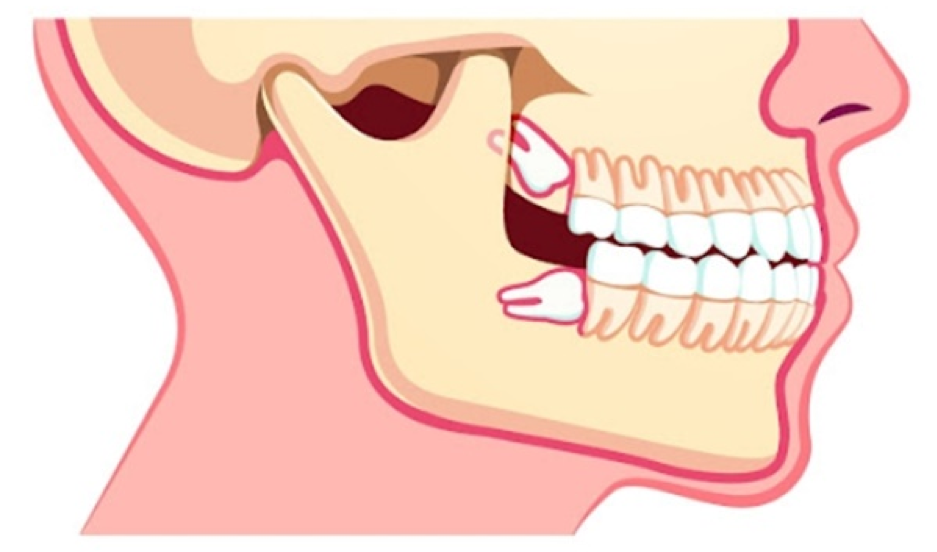
Wisdom teeth positioned horizontally are oriented at an angle of 45-90 degrees relative to the seventh tooth.
The Four Types of Impacted Wisdom Teeth
Surgeons classify impacted wisdom teeth by angle, because the angle predicts the procedure complexity, the time required, and the post-operative course.
Mesioangular impaction. The most common pattern, reported at around 43% of cases in published reviews (Juodzbalys & Daugela, J Oral Maxillofac Res, 2013). The crown tilts forward, leaning against the second molar. Extraction is usually moderate complexity because access is reasonable once the gum flap is reflected.
Distoangular impaction. The crown tilts backward, away from the second molar and toward the ramus of the mandible. This is one of the more difficult angles because the tooth must be sectioned and removed in pieces to avoid damage to the bone behind it.
Horizontal impaction. The tooth lies on its side, parallel to the gumline. The crown often presses directly against the root of the second molar and can cause external root resorption if left untreated. Surgical sectioning is mandatory.
Vertical impaction. The tooth is upright but blocked by gum or bone. Among the four types, vertical is generally the simplest extraction, especially when the tooth is fully soft-tissue impacted rather than bony impacted.
Depth is described separately as Class A, B, or C — based on how deep the crown sits relative to the second molar and the alveolar bone level. A Class C horizontal impaction sitting close to the inferior alveolar nerve is the highest-risk combination and requires careful imaging before any incision is made.
Symptoms and When to Seek Evaluation
An impacted wisdom tooth may stay fully asymptomatic for years before causing trouble. When it does flare up, the pattern is usually recognizable. Patients describe a deep, aching pressure at the back of the jaw that comes and goes over weeks. The gum behind the second molar may swell and turn red, sometimes with a foul taste from food trapped under the operculum — a condition called pericoronitis. Episodes often coincide with stress, illness, or partial eruption attempts.
Other warning signs include difficulty opening the mouth fully, swelling on the side of the face, persistent bad breath that does not resolve with cleaning, and headaches radiating from the jaw to the temple. Cavities on the back surface of the second molar — visible only on a panoramic radiograph — are an underestimated complication, since the second molar is often impossible to clean once it is partly covered by the wisdom tooth.
Some patients first discover impacted wisdom teeth during a routine check-up or a panoramic 2D X-ray, with no symptoms at all. This is exactly why a baseline panoramic image between ages 17 and 25 is recommended, even for patients who feel fine.
A horizontal impaction lies sideways against the second molar, which is why decay often starts on the molar behind it.
📞 Suspect an impacted wisdom tooth? Contact Elite Dental Vietnam — hotline (+84) 28 7306 3838 — to book a panoramic and 3D imaging consultation.
When Extraction Is Necessary vs. When to Monitor
Removal is recommended when the tooth has caused recurrent pericoronitis (more than one episode), when there is decay or root resorption on the adjacent second molar, when a follicular cyst has formed around the crown, or when the tooth interferes with planned orthodontic treatment. Pain that returns repeatedly is itself a strong indication, even when imaging looks clean.
Monitoring may be appropriate when the tooth is fully bony impacted, asymptomatic, deep enough that it does not communicate with the oral cavity, and shows no cyst or resorption. In those cases, periodic clinical and radiographic monitoring at intervals recommended by the dentist is enough to catch quiet changes early.
The decision is rarely binary. Many adult patients sit in a middle zone: one quiet quadrant, one tooth flaring up periodically, one with mild decay starting on the second molar. A surgeon will weigh patient age, medical history, and the cumulative damage risk over the next 5 to 10 years before recommending extraction or watchful waiting.
How the Procedure Works at Elite Dental Vietnam
Wisdom tooth extraction at Elite Dental Vietnam typically begins with a panoramic 2D X-ray as the initial imaging study. For complex cases — when the tooth root lies close to the inferior alveolar nerve or the maxillary sinus — a 3D Cone Beam CT scan is then ordered. It allows detailed evaluation and helps ensure surgical safety. Imaging is reviewed before the procedure is scheduled.
Anesthesia may be delivered with The Wand STA system when clinically appropriate. This computer-controlled injection approach regulates flow rate and pressure and may support a more comfortable experience than a manual syringe in selected cases.
When clinically indicated, bone work may be performed with ultrasonic bone instruments rather than a conventional rotary bur. Ultrasonic bone instruments are designed to cut mineralized tissue selectively and may help reduce soft-tissue trauma when used appropriately. After the tooth is sectioned and removed, the socket is irrigated; PRF/PRP (platelet-rich fibrin or plasma) may be placed in selected cases to support clot stability and soft-tissue healing.
Closure is done with resorbable sutures, which may reduce the need for a separate suture removal visit. Most patients walk out within 60 to 90 minutes of arrival for a single tooth, or 90 to 120 minutes for two teeth on the same side.
The combination of panoramic and 3D imaging, selective bone work, computer-controlled anesthesia, and PRF/PRP biologics where clinically indicated reflects a minimally invasive surgical workflow aligned with international oral-surgery principles.
Recovery After Extraction
Most patients return to non-strenuous activity within 3 to 5 days after a standard surgical extraction. Complex cases involving horizontal impaction, deep bony impaction, or proximity to the inferior alveolar nerve may require 7 to 10 days for full functional recovery, though mild swelling can persist for up to two weeks.
Post-operative care has a few non-negotiable rules. Apply a cold compress to the cheek for the first 24 hours (20 minutes on, 20 minutes off) to limit swelling. Eat a soft diet for 5 to 7 days — yogurt, eggs, mashed vegetables, blended soup. Brush gently the morning after surgery while avoiding the surgical site, and rinse with warm salt water from day 2 onward. Do not smoke for at least 72 hours, ideally for 1 to 2 weeks; nicotine constricts the small blood vessels at the socket edge and is the leading cause of dry socket. Avoid alcohol and aggressive mouth rinsing in the first 24 hours so the clot can stabilize. See more: what to eat after wisdom teeth removal.
Pain medication should be taken strictly as prescribed or advised by the dentist, especially for patients with stomach, kidney, liver, bleeding, pregnancy, allergy, or medication-interaction concerns. Antibiotics are prescribed when indicated by infection signs, not routinely. PRF/PRP may be used in selected cases to support clot stability and soft-tissue healing. Recovery still varies by surgical complexity, inflammation level, and individual healing response.
Some warning signs warrant a same-day call back to the clinic. These include fever above 38.5°C, throbbing pain that worsens after day 3, a foul taste with no visible clot in the socket, persistent numbness of the lower lip or chin beyond 48 hours, or swelling that spreads downward toward the neck rather than resolving.
Cost of Wisdom Tooth Extraction at Elite Dental Vietnam
Wisdom tooth extraction at Elite Dental Vietnam is priced by complexity rather than by tooth count. A simple erupted extraction costs 1,000,000–2,000,000 VND (around $40–$80 USD). A surgical extraction of an impacted tooth — where bone removal or sectioning is needed — ranges from 3,000,000–6,000,000 VND ($115–$230 USD). Final pricing depends on the position of the tooth, the difficulty of access, the imaging required, and the approved treatment plan.
English-language coordination is provided across all three clinics: Tu Xuong, Huynh Tinh Cua, and Metropole (Thu Thiem). The Elite Dental Vietnam team supports appointment scheduling, post-operative follow-up, and consultation on accommodation and transit for expat residents in Ho Chi Minh City. A typical surgical visit is 2 to 3 days on the ground; complex bilateral cases may need a second visit 1 to 2 weeks later for follow-up imaging.
Why Choose Elite Dental Vietnam for Impacted Wisdom Teeth
Surgery is the discipline where a clinic’s protocols matter most. With orthodontics or veneers, a small misjudgment can be revised; with bone removal close to a major nerve, the standards set at the start of the procedure tend to define the patient’s experience and outcome. Elite Dental Vietnam anchors those standards on AACI accreditation — the first AACI-accredited dental system in Vietnam (95.33/100) — with the surgical record documented from the initial CBCT to the final post-operative review.
Surgical care is delivered by clinicians experienced in complex oral surgery, including specialized training for inferior alveolar nerve proximity and maxillary sinus navigation. The team handles all four impaction angles (mesioangular, distoangular, horizontal, vertical) and depth classes A through C, including the multi-rooted and deeply impacted cases that may require referral in less specialized settings.
Each technology in the surgical workflow is matched to a specific clinical purpose. Panoramic 2D X-ray provides the initial overview of dentition. For complex cases, 3D Cone Beam CT imaging maps the relationship between the wisdom tooth, the inferior alveolar nerve, and the maxillary sinus before any incision is made. This lets the surgical plan account for actual anatomy rather than population averages. Ultrasonic bone instruments are designed to cut mineralized tissue selectively and may help reduce soft-tissue trauma when used appropriately. The Wand STA can deliver anesthesia under computer control for a smoother, gentler injection during longer surgical visits.
Pre-operative planning, intraoperative precision, and biological support after surgery are three independent variables. Elite Dental Vietnam controls all three — a standard patients should reasonably expect from a structured surgical protocol.
 |  |
Meet Dr. Vo The Dzu & Dr. Tran Ngoc Nhu Y of Elite Dental – Over 14 years of experience in safe and effective wisdom teeth extraction. | |
What to Ask During Your Consultation
Use the consultation to connect the general guidance in this article to your own diagnosis, budget, timeline, and treatment pathway. Useful questions include:
For international or expat patients, also ask whether records can be reviewed before arrival and how much time should be reserved in Ho Chi Minh City for examination, treatment, and follow-up.
- How many recovery days should I reserve before work, travel, or sport?
- What makes this extraction simple, moderate, or complex?
- Do I need CBCT, or is panoramic imaging enough for this case?
- Is my wisdom tooth partially impacted, fully impacted, or close to the nerve or sinus?
Frequently Asked Questions
Will an impacted wisdom tooth straighten itself if I wait?
No. Once a wisdom tooth is angled or impacted, the position will not self-correct. The angle may worsen over time as the tooth continues to push against the second molar, and the cumulative pressure can cause root resorption on the neighbor. Watchful waiting is appropriate when the tooth is fully impacted, asymptomatic, and free of pathology on imaging.
Should I have all four wisdom teeth removed in one visit?
Many surgeons will remove two on the same side (upper plus lower) in a single visit to consolidate recovery, then schedule the opposite side 2 to 4 weeks later. Removing all four at once is possible for cooperative patients with low-complexity teeth, but most international patients prefer the two-side staged approach because it preserves a chewing side throughout recovery.
Is the procedure painful with The Wand STA and Piezotome?
The combination of computer-controlled anesthesia and ultrasonic bone work is designed to support patient comfort during the procedure. Most patients report that the injection itself is the part they were most worried about, which is exactly the part the STA system addresses. Post-operative discomfort is real but manageable. PRF/PRP may be used in selected cases to support clot stability and soft-tissue healing, but pain and recovery still vary by surgical complexity, inflammation level, and individual healing response.
Can I fly home 2–3 days after the surgery?
Yes for most simple to moderate cases. Cabin pressure does not affect a properly closed extraction site, and patients regularly fly back to North America, Australia, and Europe within 48 to 72 hours of the procedure. For complex bony impactions or sinus-proximity cases, a longer ground stay of 5 to 7 days is recommended so swelling resolves and any unexpected issues can be addressed locally.
Conclusion
Impacted wisdom teeth are a mechanical problem, not a moral one — modern jaws are simply too small for the last tooth in the arch, and the result is the four angle patterns described above. The right answer for any individual patient depends on imaging, symptoms, and the cumulative damage risk to the second molar over the next 5 to 10 years.
When extraction is the right call, the experience should be planned, well documented, and clinically controlled. At Elite Dental Vietnam, that may include panoramic and 3D imaging before the appointment, computer-controlled anesthesia, selective bone-work tools, and PRF/PRP biologics where indicated. For expat residents in Ho Chi Minh City, pricing depends on diagnosis, technology used, surgical complexity, and follow-up needs.
Your Safety at Elite Dental Vietnam
Elite Dental is the first dental system in Vietnam to receive accreditation from the American Accreditation Commission International (AACI). Under AACI Dental Standards Version 2.1, Elite Dental achieved a score of 95.33 out of 100 and continues to hold this accreditation in 2026. You can read more on our AACI accreditation page.
AACI accreditation serves as an independent third-party validation of the quality standards that Elite Dental has consistently maintained through its rigorous clinical and operational practices over many years. The accreditation is valid for one year and is subject to periodic reassessment and renewal.
The accreditation was awarded on September 8, 2025, and officially announced on October 20, 2025. It applies across all three Elite Dental locations: Huynh Tinh Cua, Tu Xuong and Metropole (Thu Thiem).
Consultation Hotline: (+84) 28 7306 3838
Website: elitedental.com.vn
If you’re weighing extraction or watchful waiting, a 30-minute imaging consultation at Elite Dental Vietnam gives a clear answer — book at (+84) 28 7306 3838.
Elite Dental Vietnam — AACI-accredited | (+84) 28 7306 3838 | elitedental.com.vn/en
Tu Xuong · Huynh Tinh Cua · Metropole (Thu Thiem)
References
- Juodzbalys G, Daugela P. Mandibular third molar impaction: review of the literature and a proposal of classification. J Oral Maxillofac Res. 2013;4(2):e1. https://pubmed.ncbi.nlm.nih.gov/24422029/
- American Association of Oral and Maxillofacial Surgeons. Wisdom Teeth Management. https://www.aaoms.org/
- Pell GJ, Gregory BT. Impacted mandibular third molars: classification and modified technique for removal. Dent Digest. 1933;39:330–338. https://pubmed.ncbi.nlm.nih.gov/12489598/
- World Health Organization. Oral Health Fact Sheet. https://www.who.int/news-room/fact-sheets/detail/oral-health
Disclaimer: The information in this article is for educational purposes only and does not replace an in-person consultation with a qualified dentist. Contact Elite Dental Vietnam for personalized advice.