


Table of content
Short answer
Braces can change facial appearance when they alter tooth position, bite relationship, and soft-tissue support, especially in overbite, underbite, protrusion, or extraction-space cases. Mild crowding usually creates a subtler change. The goal should be a balanced profile and stable bite, not an exaggerated change to the face.
📌 Key Takeaways
- Yes — braces can change facial appearance, but the size of that change depends on the bite problem being corrected, the patient’s skeletal structure, and age.
- Overbite (Class II) correction tends to make the chin look more prominent; underbite (Class III) correction balances a previously protruded lower lip and chin profile.
- Soft tissue follows hard tissue gradually. Lips, cheeks, and chin reposition slowly over treatment as the underlying teeth and jaw shift into a new occlusion.
- Mild crowding cases produce a clearly improved smile but a more subtle change to the visible facial profile.
- Elite Dental Vietnam offers premium orthodontic appliances (metal, ceramic, Invisalign) with tooth-movement simulation technology, supporting clearer treatment planning and a wide range of options for each case.
📞 Call Elite Dental Vietnam at (+84) 28 7306 3838 to schedule a consultation.
Can Braces Really Change Your Face Shape?
Yes, braces can change facial appearance — but the realistic answer is more nuanced than social media suggests. The extent of change depends on three factors: the type of bite problem being corrected, the patient’s underlying skeletal structure, and the patient’s age at the start of treatment.
Patients with significant skeletal malocclusion tend to see the most visible change. Class II patients (the upper jaw and teeth sit forward of the lower) may notice improved profile balance as the bite and dental relationship are corrected. Class III patients (the lower jaw protrudes) may see the lower lip and chin position adjust slightly as the bite balances. Patients with a deep overbite often gain a more proportioned lower face height once the bite opens up.
Patients whose sole problem is mild crowding will see a clear improvement in the smile but a subtle change in the side-profile. The dental change is real; the facial silhouette change is small. Setting that expectation at the consultation is part of an honest plan.
For a closer look at how a recessed jaw and receding chin are diagnosed, see our overview of how a receding chin is diagnosed and treated
What Changes: Jawline, Profile, and Lip Position
Orthodontic treatment affects three facial areas most noticeably: the jawline, the profile (the line from nose to chin), and lip position relative to that profile. The jawline tends to look more defined after treatment of a deep bite or open bite, because the jaw closes into a more balanced vertical relationship — not because the bone itself has changed shape.
Orthodontic treatment affects the lower lip position most reliably. When the upper incisors are retracted, the upper lip retracts with them; when lower incisors are advanced, the lower lip follows. Studies of pre-treatment and post-treatment orthodontic records show this lip-following pattern across patient groups.
There is a useful clinical ratio reported in orthodontic literature (Ricketts, AJO, 1968): for every 1 mm the upper incisors are retracted, the upper lip retracts approximately 0.6 to 0.7 mm. For the lower lip, the ratio is closer to 0.6 to 0.8 mm per 1 mm of lower incisor retraction. Individual response varies; this means a patient whose upper incisors are pulled back 4 mm during treatment may see the upper lip flatten by approximately 2.5 to 3 mm — a visible but proportionate change.
The chin position also shifts predictably. In Class II correction, allowing the mandible to posture forward moves the soft-tissue chin point (pogonion) forward as well, which is why post-treatment photos often show a stronger profile. In Class III correction, the inverse happens, and the lower-third of the face appears less prominent.
For adolescents whose facial bones are still developing, growth modification appliances can guide jaw growth in addition to moving teeth — producing skeletal-level changes that are not achievable in fully grown adults.
Face Changes by Malocclusion Type
Each malocclusion produces a different soft tissue change because the underlying skeletal and dental correction is different. The table below summarizes the realistic outcome by bite type.
| Malocclusion | Treatment focus | Typical facial change |
|---|---|---|
| Class II (overbite/overjet) | Retract upper incisors, allow mandible forward | Chin appears more prominent; upper lip flattens 1.5–3 mm; profile becomes more balanced |
| Class III (underbite) | Move lower jaw backward (or upper forward in growing patients) | Lower lip and chin retract; profile becomes less concave |
| Deep bite | Open the vertical dimension | Lower face height increases slightly; smile shows less gum |
| Open bite | Close the front vertical gap | Lips meet at rest; facial proportions look less long |
| Crowding only (Class I) | Align teeth within existing arch | Smile noticeably wider; profile change is subtle |
| Asymmetric jaw | Unilateral mechanics, sometimes ortho-surgical | Midline corrects; jawline looks more even between left and right |
Expected facial change by malocclusion type. Outcomes vary based on age, skeletal pattern, and treatment plan.
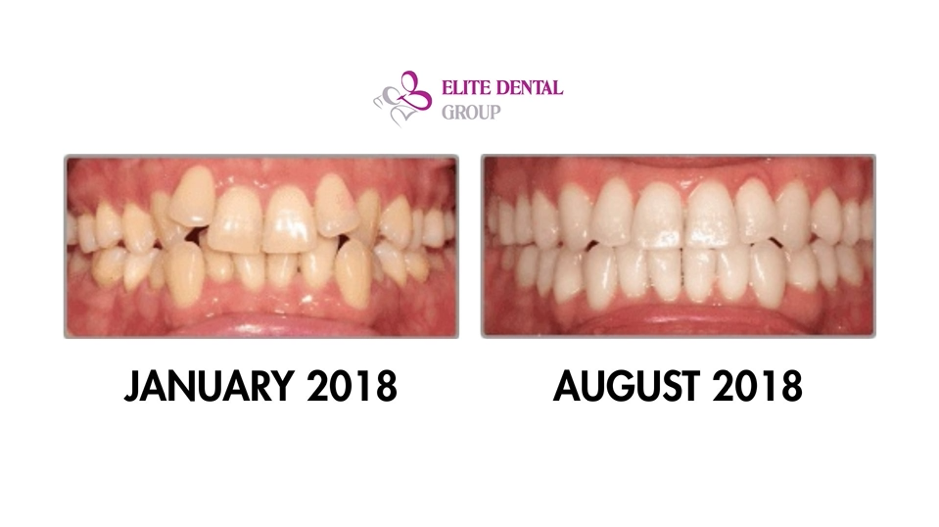
For instance, Ms. N.N., with a severe case of misaligned teeth, achieved a markedly improved result through Invisalign treatment—without the need for tooth extraction.
Which Bracket System Affects Face Shape Most
All orthodontic systems — metal braces, ceramic braces, and Invisalign — can produce facial change because they all move teeth using biomechanical force. The bracket system is not what determines whether a face will change; the treatment plan and the amount of tooth movement are what matter. A patient with severe Class II treated with metal braces and a patient treated with Invisalign — both can achieve comparable lip retraction if the total tooth movement is the same.
Premium orthodontic appliances at Elite Dental Vietnam — metal, ceramic, and Invisalign — provide a wide range of options. Tooth-movement simulation technology enables precise planning, allowing the clinical team to project tooth-movement goals and expected smile changes before treatment begins.
Multi-system proficiency is part of the standard at Elite Dental Vietnam. The orthodontic team is trained across traditional metal brackets, ceramic (tooth-colored) brackets, and Invisalign clear aligners — and the recommendation is matched to the case rather than to whatever the clinic happens to stock.
For mild to moderate crowding or spacing, Invisalign can produce results comparable to fixed appliances; for severe skeletal discrepancies that require large rotational or translational tooth movement, fixed appliances usually offer more precise force control. See our deeper comparison in the Invisalign vs braces guide.
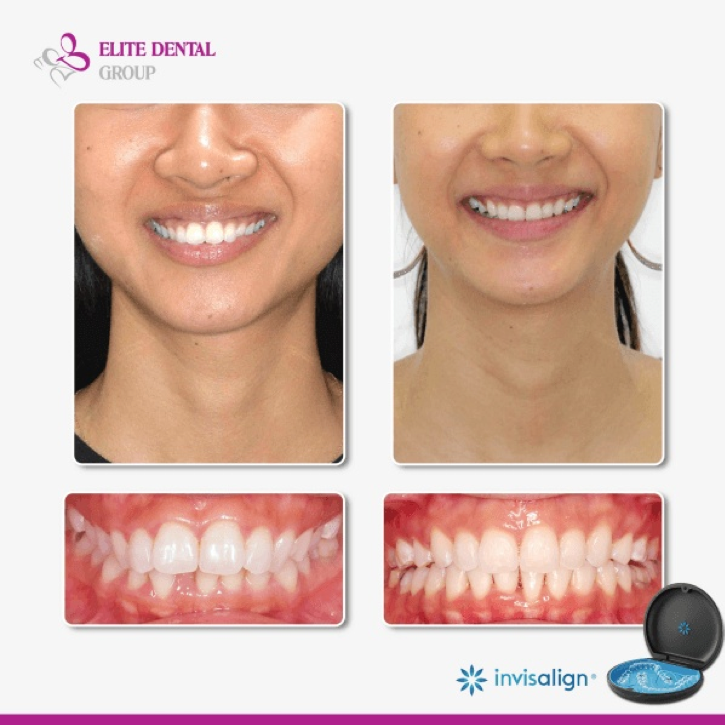
Clear aligners (Invisalign) can help reposition the jaw and teeth, enhancing facial symmetry.
Side Effects and Unwanted Facial Changes
Some patients report facial changes they did not anticipate. The most commonly cited concern is lip flattening after premolar extraction. When the front teeth are pulled back to close extraction spaces, the lips lose some of their anterior support and can flatten. In a minority of patients with already retrusive lips, this change is visible and unwelcome.
Orthodontists at Elite Dental Vietnam evaluate facial proportions using the E-line (Ricketts esthetic line) — a reference line drawn from the tip of the nose to the soft-tissue chin point — before recommending extraction. If the lower lip already sits behind the E-line at the start of treatment, non-extraction mechanics or interproximal reduction (IPR) may be preferred to preserve lip projection.
Temporary cheek hollowing during active treatment is common because brackets and aligners take up space inside the mouth; this resolves within weeks of debonding. Mild gum recession can occur if oral hygiene lapses during fixed appliance treatment. This is one reason regular clinical monitoring during follow-up visits is helpful, because early signs of recession can be flagged and managed before they become permanent.
Long-term, the most important determinant of facial stability after orthodontic treatment is retainer compliance. Teeth tend to drift back toward their original position for years after the brackets come off, and that drift can also affect the soft-tissue silhouette. A clear retainer worn nightly is a small commitment that protects a multi-year investment.
📞 Wondering if treatment will affect your profile? Contact Elite Dental Vietnam — hotline (+84) 28 7306 3838 — to book an orthodontic consultation.
Why Choose Elite Dental Vietnam for Orthodontic Treatment
Orthodontics is an 18-to-30-month relationship, not a procedure. Choosing the right clinic is less about which bracket system is on the shelf and more about whether the diagnostic depth at month zero matches the treatment commitment that follows. Elite Dental Vietnam approaches every adult orthodontic case from a bone–muscle–tooth diagnostic frame. The recommendation is built on which underlying factor is driving the malocclusion, rather than on what is easiest to bond.
The orthodontic team is led by Dr. Do Quynh Nhu, DDS — Orthodontic Specialist — and includes clinicians with training in facial structure, jaw relationships, and growth and development. Multidisciplinary collaboration with surgical and prosthodontic colleagues optimizes both chewing function and facial aesthetics. Personalized treatment planning is tailored to each individual face. The orientation is facial aesthetics–oriented — not just teeth alignment.
Each orthodontic case begins with a comprehensive diagnosis evaluating bite relationship, jaw position, facial balance, and tooth movement goals. The team then creates an individualized treatment plan and recommends an appropriate appliance — metal braces, ceramic braces, or Invisalign — based on the case profile. The objective is not just straighter teeth but better harmony between the teeth, jaws, and facial profile.
The orientation across diagnosis, planning, mechanics, and follow-through is toward facial aesthetics in addition to dental alignment. The teeth are the means; the face is the patient.
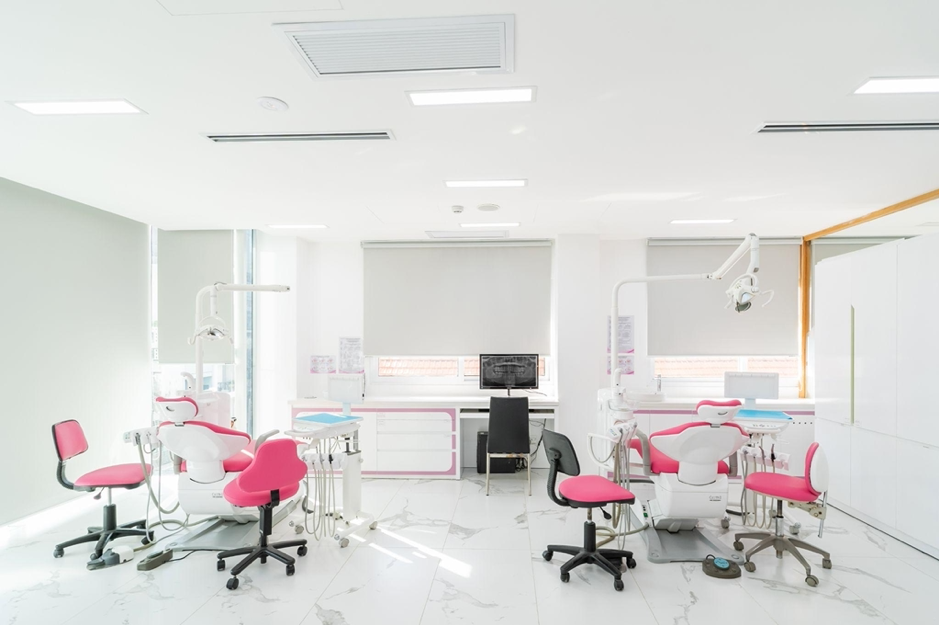
Modern orthodontic clinic equipped with advanced tools, where braces help improve bite alignment and enhance facial harmony.
What to Ask During Your Consultation
Use the consultation to connect the general guidance in this article to your own diagnosis, budget, timeline, and treatment pathway. Useful questions include:
For international or expat patients, also ask whether records can be reviewed before arrival and how much time should be reserved in Ho Chi Minh City for examination, treatment, and follow-up.
- How will the plan protect facial balance instead of merely straightening teeth?
- Which appliance system most closely matches the movement needed?
- Is my case dental, skeletal, or mixed?
- Which part of my face is likely to change: lips, chin, smile width, lower-face height, or jawline?
Frequently Asked Questions
Will braces make my jawline look sharper?
Braces can make the jawline look more defined when treatment corrects a deep bite or an underbite that previously caused the jaw to sit in a suboptimal position. The jawbone itself does not change shape from orthodontic treatment in adults — what changes is the relationship between the upper and lower jaw at rest, which alters the soft-tissue silhouette. In growing adolescents, growth modification appliances can additionally guide skeletal change.
Do braces change the shape of your nose?
Braces do not directly change the nose. However, when the upper front teeth are significantly retracted, the nasolabial angle (the angle between the nose and the upper lip) can appear slightly different. This happens because lip support at the base of the nose has shifted. This is a soft tissue effect, not a change to the nasal cartilage or bone.
Can Invisalign change face shape the same way metal braces can?
For mild to moderate cases, Invisalign and metal braces can produce comparable facial change because both move teeth using biomechanical force. For severe skeletal discrepancies that require large bodily tooth movement or strong rotational control, fixed appliances usually deliver more predictable mechanics. The orthodontist’s recommendation should be based on the case complexity, not on the patient’s preference for one system.
How long before I notice a facial change?
Subtle profile changes are usually visible at month 6 to 9 of active treatment. The full facial outcome is most accurately judged at 3 to 6 months after debonding, once the soft tissues have fully adapted to the new tooth position and any post-treatment swelling has resolved. Comparison with pre-treatment records makes the change measurable rather than impressionistic.
Conclusion
Braces can change facial appearance, but the change is proportionate to the underlying problem. Class II and Class III patients see the most visible profile difference; mild crowding patients see a much better smile and a subtle profile shift. Soft tissue follows hard tissue at predictable ratios — roughly 0.6 to 0.7 mm of lip retraction for every 1 mm of incisor retraction. A good plan accounts for those ratios before the first bracket is bonded.
For expat patients in Ho Chi Minh City, the right choice is an orthodontist who plans facial proportions in addition to tooth alignment. That is the difference between a straight smile and a straight smile that fits the face. At Elite Dental Vietnam, that means a comprehensive diagnosis, tooth-movement simulation, an individualized treatment plan, and a recommendation that fits the case across the available range of premium orthodontic appliances.
Your Safety at Elite Dental Vietnam
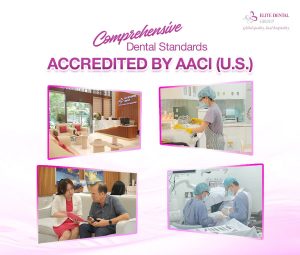
Elite Dental is the first dental system in Vietnam to receive accreditation from the American Accreditation Commission International (AACI). Under AACI Dental Standards Version 2.1, Elite Dental achieved a score of 95.33 out of 100 and continues to hold this accreditation in 2026.
AACI accreditation serves as an independent third-party validation of the quality standards that Elite Dental has consistently maintained through its rigorous clinical and operational practices over many years. The accreditation is valid for one year and is subject to periodic reassessment and renewal.
The accreditation was awarded on September 8, 2025, and officially announced on October 20, 2025. It applies across all three Elite Dental locations: Huynh Tinh Cua, Tu Xuong and Metropole (Thu Thiem).
Consultation Hotline: (+84) 28 7306 3838
Website: elitedental.com.vn
Curious how your specific bite would respond to treatment? Book an orthodontic consultation at Elite Dental Vietnam — (+84) 28 7306 3838 — and review the projected outcome before committing.
Elite Dental Vietnam — AACI-accredited | (+84) 28 7306 3838 | elitedental.com.vn/en
Tu Xuong · Huynh Tinh Cua · Metropole (Thu Thiem)
References
- Proffit WR, Fields HW, Sarver DM. Contemporary Orthodontics. 6th ed. Elsevier; 2019. https://www.elsevier.com/books/contemporary-orthodontics/proffit/978-0-323-54387-3
- American Association of Orthodontists. Benefits of Orthodontic Treatment. https://www.aaoinfo.org/
- Ricketts RM. Esthetics, environment, and the law of lip relation. Am J Orthod. 1968;54(4):272–289. https://pubmed.ncbi.nlm.nih.gov/5238879/
- World Health Organization. Oral Health Fact Sheet. https://www.who.int/news-room/fact-sheets/detail/oral-health
Disclaimer: The information in this article is for educational purposes only and does not replace an in-person consultation with a qualified dentist. Contact Elite Dental Vietnam for personalized advice.