


Table of content
- Short answer
- 📌 5 Things to Know About Jaw Asymmetry
- What Is Jaw Asymmetry?
- Causes of Jaw Asymmetry
- Self-Assessment: How to Check for Jaw Asymmetry
- Severity Scale and Treatment Approach
- Orthodontic Treatment for Asymmetrical Jaw
- Why Choose Elite Dental Vietnam for Asymmetrical Jaw
- What to Ask During Your Consultation
- Frequently Asked Questions
- Conclusion
- Your Safety at Elite Dental Vietnam
- References
Short answer
An asymmetrical jaw can come from a dental midline shift, bite imbalance, muscle habits, growth pattern, TMJ changes, or a true skeletal difference. Braces may improve dental asymmetry and bite-related imbalance. In significant skeletal cases, orthodontic treatment alone has limits, and an in-person specialist evaluation is needed to advise the right path. Diagnosis should measure facial symmetry, occlusion, jaw position, and functional symptoms.
📌 5 Things to Know About Jaw Asymmetry
1. Jaw asymmetry exists on a spectrum — virtually no human face is perfectly symmetrical, and deviations greater than 3 mm from the facial midline are usually the ones that are clinically significant.
2. The first decision in any case is whether the asymmetry is dental (the teeth are misaligned but the jaw bones are balanced) or skeletal (the bones themselves differ between sides). Orthodontics can correct the first. The second involves bone-level differences that orthodontics alone cannot reposition and that need in-person specialist evaluation.
3. Causes range from genetics and asymmetric growth during adolescence to trauma, temporomandibular disorders, condylar hyperplasia, and one-sided chewing or sleeping habits.
4. Severity is graded by chin deviation. Under 3 mm is mild and may need nothing more than monitoring. From 3 to 6 mm is moderate and is usually treated with orthodontics. Over 6 mm is severe, with limits to what orthodontics alone can achieve that an in-person evaluation will clarify.
5. Elite Dental Vietnam provides the diagnostic workup and orthodontic treatment in-house. When a case extends beyond what orthodontics can address, the orthodontist explains the realistic options during the consultation so the next step is clear.
| 📞 Call Elite Dental Vietnam at (+84) 28 7306 3838 to schedule a consultation. |
|---|
What Is Jaw Asymmetry?
Jaw asymmetry describes a condition in which the left and right sides of the jaw differ noticeably in size, shape, or position. Mild asymmetry is a normal variation of human facial structure — virtually no face is perfectly symmetrical, and minor differences of 1 to 2 mm between sides are present in almost everyone. The clinical question is whether the asymmetry is large enough to affect bite function, cause chronic jaw pain, or influence quality of life — and, if so, what kind of asymmetry it is.

A person with a deviated jaw may have difficulty eating and can also suffer from uncomfortable joint pain, affecting their quality of life.
This article focuses on skeletal jaw asymmetry, which involves bone-level differences between the two sides of the mandible or maxilla. That is distinct from soft-tissue asymmetry caused by muscle imbalance or fat distribution, and from functional asymmetry where the jaw appears uneven only during movement because of a displaced joint. The treatment paths are very different: a true skeletal discrepancy will not respond to soft-tissue treatments, and a functional shift may resolve with joint therapy alone, without the need for orthodontic treatment.
Studies in the orthodontic and clinical literature define clinically significant jaw asymmetry as a deviation greater than 3 mm of the chin from the facial midline. By that definition, it is present in roughly 12 to 15 percent of the general population. Mild asymmetry exists in nearly everyone. Patients usually notice the deviation in photographs, particularly in selfies and group photos where the camera angle accentuates one side; the psychological impact can be meaningful, especially in adolescents and young adults.
Causes of Jaw Asymmetry
Jaw asymmetry has multiple potential causes, and in many patients more than one factor is at play. Genetic factors and developmental growth patterns are the most common explanation. The mandible and maxilla grow at genetically determined rates, and asymmetric growth is common during the pubertal growth spurt between ages 10 and 16. If one condyle (the rounded end of the lower jaw that articulates with the skull base) grows faster or longer than the other, the jaw deviates to one side.
Temporomandibular disorders (TMD) can cause functional asymmetry when the jaw joint on one side becomes inflamed, displaced, or mechanically restricted. If left untreated for a long period, chronic TMD can lead to adaptive bone remodeling that turns the asymmetry from functional into structural. Trauma to the jaw during the growth years — from sports injuries, falls, or accidents — can disrupt the growth center in the condyle, leading to asymmetric development that becomes obvious only later.
Habitual behaviors contribute to asymmetry more than most patients realize. Chronic chewing on one side causes the muscles on the dominant side to enlarge while the opposite side weakens, creating visible facial asymmetry even without underlying skeletal differences. Long-term sleeping on one side can compress facial structures and influence growth patterns during adolescence. These habitual factors are typically addressed during orthodontic treatment through patient education and behavioral modification.

People who have a habit of sleeping on one side are prone to jaw deviation.
In adolescents, condylar hyperplasia deserves particular attention because it represents active, ongoing asymmetric growth. The condition is diagnosed with a bone scan that measures metabolic activity in the condyles. If one condyle shows significantly higher activity than the other, it is still actively growing and is causing progressive asymmetry. In those cases, any correction alone may relapse as the condyle continues to grow asymmetrically — addressing the growth center is part of the long-term plan.
Self-Assessment: How to Check for Jaw Asymmetry
A simple self-assessment can help identify possible jaw asymmetry before consulting a specialist. Stand in front of a well-lit mirror with your face relaxed and mouth gently closed. Imagine a vertical line down the center of your face from forehead through nose to chin — does your chin sit centered on this line, or deviate to one side? Look at the jaw angles below each ear — is one side wider, lower, or more prominent than the other? Open your mouth slowly and watch your chin: does the lower jaw shift to one side during opening?
These observations provide useful preliminary information but cannot replace professional diagnosis. At Elite Dental Vietnam, diagnostic imaging is the standard initial study, measuring the skeletal and dental relationships across the face. For complex cases or when 3D detail is required, Cone Beam CT imaging is added to map the spatial relationships in three dimensions.
Diagnostic imaging from a frontal view is particularly valuable for asymmetry assessment. It shows the relative widths of the maxilla and mandible, the position of the dental midlines relative to the facial midline, and any tilt of the occlusal plane. Combined with side-view imaging, the orthodontist can quantify the asymmetry in millimeters and degrees rather than estimating it visually.
Diagnostic imaging generates specific measurements that quantify the asymmetry objectively. The most important are menton deviation (how far the chin point sits from the facial midline, in millimeters) and ramus height difference (the vertical discrepancy between left and right jaw branches). Others are gonial angle difference (the angular discrepancy at the jaw corner on each side) and occlusal plane tilt. These numbers guide both diagnosis and treatment planning — a menton deviation greater than 4 mm with significant occlusal tilt typically indicates that orthodontics alone will not achieve a complete result and an in-person specialist evaluation is advised.
| 📞 Considering jaw asymmetry assessment? Contact Elite Dental Vietnam — hotline (+84) 28 7306 3838 — to schedule a consultation. |
|---|
Severity Scale and Treatment Approach
Severity grading follows the chin deviation measured on the diagnostic imaging study. The table below summarizes the typical approach at each severity level.
| Severity | Characteristics | Functional Impact | Treatment Approach |
|---|---|---|---|
| Mild (<3 mm chin deviation) | Barely noticeable to others; may be self-perceived | No bite issues; normal function | Monitoring; orthodontics if the bite is affected |
| Moderate (3–6 mm deviation) | Visible asymmetry in photographs; noticeable to others | Uneven bite; possible TMJ symptoms; jaw clicking | Orthodontics, with orthodontic camouflage as an option |
| Severe (>6 mm deviation) | Significant facial imbalance; clearly visible | Speech, chewing, and possibly breathing affected | Complex case; orthodontics alone has limits, and an in-person specialist evaluation is advised |
At Elite Dental Vietnam, the orthodontic team provides the full diagnostic workup and the orthodontic treatment phases in-house. For severe cases that extend beyond what orthodontics can correct, the orthodontist explains the limits clearly and advises the appropriate next step after an in-person evaluation.
Orthodontic Treatment for Asymmetrical Jaw
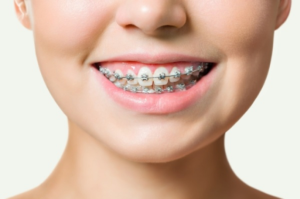
For mild asymmetry, orthodontics alone is often sufficient. The treatment focuses on correcting any dental midline shift, balancing the bite between the two sides, and using elastic mechanics to encourage the soft tissues to settle into a more even resting posture. Treatment time is typically 12 to 30 months depending on the starting position. Most patients with deviation under 3 mm are happy with the orthodontic-only result. See how braces change your face shape?
The Elite Dental Vietnam Orthodontic Approach
What sets Elite Dental Vietnam apart is the treatment plan you receive. The orthodontic team has effectively treated many cases that initially appeared to need surgery — through in-depth orthodontic planning, the right timing, and the right method. After a complete diagnostic workup with intraoral, extraoral, and X-ray imaging, the orthodontist will:
- Analyze the relationships between teeth, jawbone, and occlusion using cephalometric tracing.
- Assess the degree of malocclusion and the overall oral health.
- Develop a treatment plan tailored to your case for long-term effectiveness and safety.
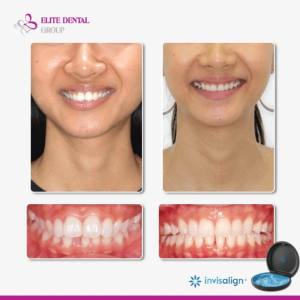
For patients who would prefer a more discreet appearance during treatment, Elite Dental Vietnam offers Invisalign clear aligners alongside traditional metal and ceramic braces. The choice is calibrated to the diagnosis and the planned movements rather than to any one-size-fits-all preference.
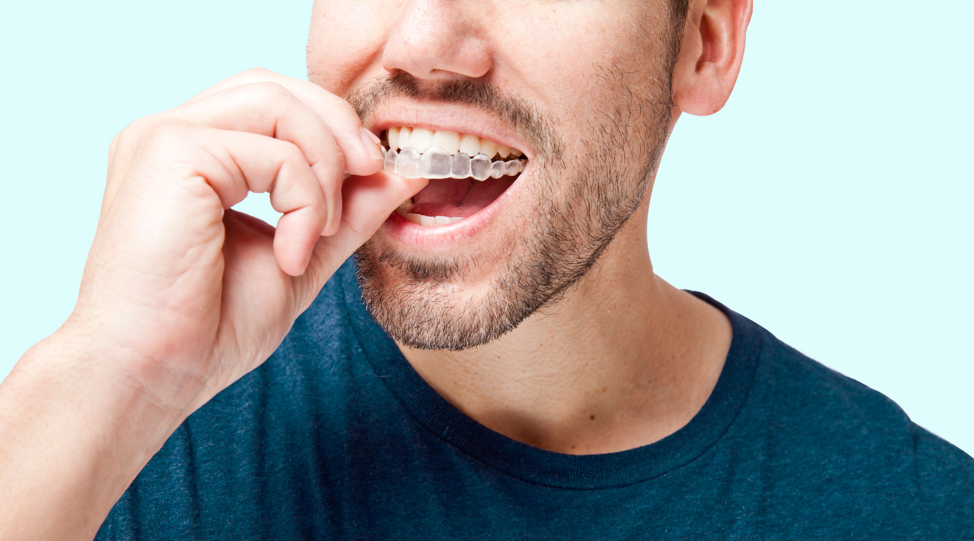
Orthodontic treatment is the optimal solution for cases of jaw deviation caused by crooked or crowded teeth.
Why Choose Elite Dental Vietnam for Asymmetrical Jaw
Asymmetrical jaw correction is a diagnostic decision, not just a bracket choice. Choosing the right clinic is less about which appliance is available and more about whether the assessment at intake correctly distinguishes dental asymmetry, functional shift, and true skeletal difference — because each pathway requires a different treatment plan.
The orthodontic team is led by Dr. Do Quynh Nhu, DDS — Orthodontic Specialist — and includes clinicians with training in skeletal-dental relationships, functional occlusion, and complex case planning. For severe skeletal cases that extend beyond orthodontic correction, the team explains the limits clearly and advises the appropriate next step after an in-person evaluation.
Each asymmetrical jaw case begins with a comprehensive assessment evaluating dental midline, occlusal shift, facial midline, and skeletal pattern. The team then creates an individualized treatment plan using diagnostic imaging, tooth-movement simulation, and personalized planning — all delivered under AACI accreditation (95.33/100).
The orientation across intake, diagnosis, treatment planning, and follow-through is toward functional and aesthetic balance. The teeth and bite are the means; long-term jaw function and facial symmetry are the outcome.
What to Ask During Your Consultation
Use the consultation to connect the general guidance in this article to your own diagnosis, budget, timeline, and treatment pathway. Useful questions include:
For international or expat patients, also ask whether records can be reviewed before arrival and how much time should be reserved in Ho Chi Minh City for examination, treatment, and follow-up.
- How will the team monitor stability after treatment?
- Will treatment change my midline, bite, jawline, or all three?
- Can orthodontics alone improve function and appearance, or are there limits I should understand for my case?
- Is the asymmetry mainly dental, skeletal, muscular, or TMJ-related?
Frequently Asked Questions
Can braces fix jaw asymmetry without surgery?
For mild asymmetry, yes. Braces can level the bite and align dental midlines, which addresses the visible and functional impact of small skeletal differences. For moderate asymmetry, comprehensive orthodontic treatment can produce a satisfying result without surgery for many adult patients. For severe asymmetry — typically over 6 mm of chin deviation — braces alone cannot move the jawbone, and an in-person specialist evaluation is needed to advise the appropriate path.
Does jaw asymmetry get worse with age?
Mild asymmetry in adolescents may stabilize once growth is complete around age 18 to 20. In adults, jaw asymmetry does not typically worsen unless an underlying condition such as a chronic temporomandibular disorder, condylar hyperplasia, or a tumor is actively progressing. Regular monitoring with a specialist can detect progressive changes early so the treatment plan can be adjusted before the asymmetry advances.
How is the right treatment path decided?
The decision is based on the severity measurement, the patient’s functional concerns, and long-term goals. Cases under 3 mm of deviation rarely need more than monitoring or limited orthodontics. Cases over 6 mm have limits that orthodontics alone cannot fully resolve and need in-person specialist evaluation. The 3 to 6 mm range is where the conversation matters most, and the orthodontic team walks each patient through the realistic options so the choice is informed.
What is included in the assessment at Elite Dental Vietnam?
The initial assessment for jaw asymmetry includes a clinical examination, panoramic imaging as the standard initial study, and additional diagnostic imaging from frontal and side views as indicated. For severe cases or when 3D detail is needed, Cone Beam CT imaging is added. The orthodontist explains the severity classification, discusses the realistic treatment options, and provides transparent pricing for the orthodontic phases before any treatment is committed.
Conclusion
Jaw asymmetry is rarely a binary problem. It exists on a spectrum from the 1 to 2 mm differences that nearly every face shows to the 6 mm or greater discrepancies that extend beyond what orthodontics alone can fully resolve. The single most important step is an accurate diagnosis that distinguishes dental from skeletal asymmetry and quantifies the severity in millimeters rather than impressions.
Elite Dental Vietnam provides the diagnostic workup and orthodontic phases in-house under AACI accreditation. For severe skeletal cases that extend beyond what orthodontics can correct, the orthodontist explains the limits and advises the appropriate next step after an in-person evaluation.
If you are wondering whether your jaw asymmetry needs treatment — and, if so, what kind — a consultation at Elite Dental Vietnam will resolve the uncertainty with measured numbers and a clear explanation of the realistic options.
Your Safety at Elite Dental Vietnam
Elite Dental is the first dental system in Vietnam to receive accreditation from the American Accreditation Commission International (AACI). Under AACI Dental Standards Version 2.1, Elite Dental achieved a score of 95.33 out of 100 and continues to hold this accreditation in 2026. You can read more on our AACI accreditation page.
AACI accreditation serves as an independent third-party validation of the quality standards that Elite Dental has consistently maintained through its rigorous clinical and operational practices over many years. The accreditation is valid for one year and is subject to periodic reassessment and renewal.
The accreditation was awarded on September 8, 2025, and officially announced on October 20, 2025. It applies across all three Elite Dental locations: Huynh Tinh Cua, Tu Xuong and Metropole (Thu Thiem).
Consultation Hotline: (+84) 28 7306 3838
Website: elitedental.com.vn
| 📞 If you are weighing whether your jaw asymmetry needs treatment, call Elite Dental Vietnam at (+84) 28 7306 3838 to book a consultation including diagnosis and severity assessment. |
|---|
Elite Dental Vietnam — AACI-accredited | (+84) 28 7306 3838 | elitedental.com.vn/en
Tu Xuong · Huynh Tinh Cua · Metropole (Thu Thiem)
References
1. Proffit WR, White RP, Sarver DM. Contemporary Treatment of Dentofacial Deformity. Mosby; 2003. https://www.elsevier.com/
2. American Association of Orthodontists. Facial Asymmetry and Orthodontics. https://aaoinfo.org/
3. Severt TR, Proffit WR. The prevalence of facial asymmetry in the dentofacial deformities population. Int J Adult Orthodon Orthognath Surg. 1997;12(3):171-176. https://pubmed.ncbi.nlm.nih.gov/9456622/
4. World Health Organization. Oral Health Fact Sheet. https://www.who.int/news-room/fact-sheets/detail/oral-health
Disclaimer: The information in this article is for educational purposes only and does not replace an in-person consultation with a qualified orthodontist. Contact Elite Dental Vietnam for personalized advice.