

Table of content
- 1. Dental Ceramic Materials and Their Role in Restorations
- 2. Porcelain vs. Zirconia: How the Materials Differ
- 3. How Dentists Choose the Material
- 4. Traditional and Digital Restoration Processes
- 5. Coordination Between the Dentist and the Technician
- 6. Ceramic Restorations at Elite Dental
- 7. The CAD/CAM Ceramic Restoration Process at Elite Dental
- 8. What to Ask Your Dentist Before Treatment
- Conclusion
- Frequently Asked Questions
- References
Ceramic restorations help restore tooth form, protect damaged tooth structure and improve aesthetics, depending on the condition of the tooth and the indication for treatment. Depending on clinical needs, the dentist may consider options such as crowns, veneers, inlays, onlays or bridges. Each option has its own indications and calls for careful decisions about the material, the restoration design and how the work is carried out.
To understand ceramic restorations properly, it helps to look at both the properties of the material and the fabrication process. Porcelain and zirconia differ in aesthetics, strength and range of use. In addition, coordination between the dentist and the dental laboratory, together with digital technology such as CAD/CAM, supports the design and fabrication of a restoration that is accurate for each individual case. At Elite Dental, the choice of material and process is set within the context of each patient’s examination, functional assessment and specific treatment goals.
Key Takeaways
- Porcelain and zirconia each have their own properties. Porcelain is often valued for its translucency and its ability to reproduce natural colour, while zirconia stands out for its strength and load-bearing capacity. The choice depends on the position of the tooth, aesthetic requirements and the clinical indication.
- No single ceramic suits every case. The dentist needs to assess the condition of the teeth, the chewing forces and the treatment goals in order to select the material that suits each patient.
- Digital technology supports the restoration process. CAD/CAM digitises the design and fabrication stages, but it does not replace clinical assessment. Whether the impression is taken conventionally or with an intraoral scanner, the restoration still has to be checked for fit and bite before it is placed.
- Digital impressions offer a number of benefits in dental practice. The method makes data collection convenient and can improve the patient’s experience. Accuracy depends on the clinical conditions, the technique used and the system involved.
- At Elite Dental, CAD/CAM technology has been in use since 2018. The digital workflow supports every stage from diagnostic imaging and data capture to fabrication of the restoration, combined with quality control processes aligned with AACI standards.
1. Dental Ceramic Materials and Their Role in Restorations
Dental ceramics are non-metallic materials used to fabricate metal-free restorations. They are widely chosen because they can reproduce the colour of natural teeth and the way natural teeth interact with light, but each type of ceramic has its own properties that need to be weighed. The two most important groups of properties are optical properties and mechanical properties.
Optical properties. These determine how a restoration looks, including colour, translucency and surface gloss. Natural enamel is translucent, especially towards the biting edge, so a restoration that matches the shade guide can still look flat beside real teeth if the material does not have suitable translucency.
Mechanical properties. These determine how a restoration handles chewing forces, including strength, resistance to fracture and wear, and the ability to bond or cement securely to the tooth.
The two groups of properties often have to be balanced against each other: a material that favours translucency is usually not the strongest, and vice versa. Choosing a material is therefore a clinical decision, not simply a matter of preference.
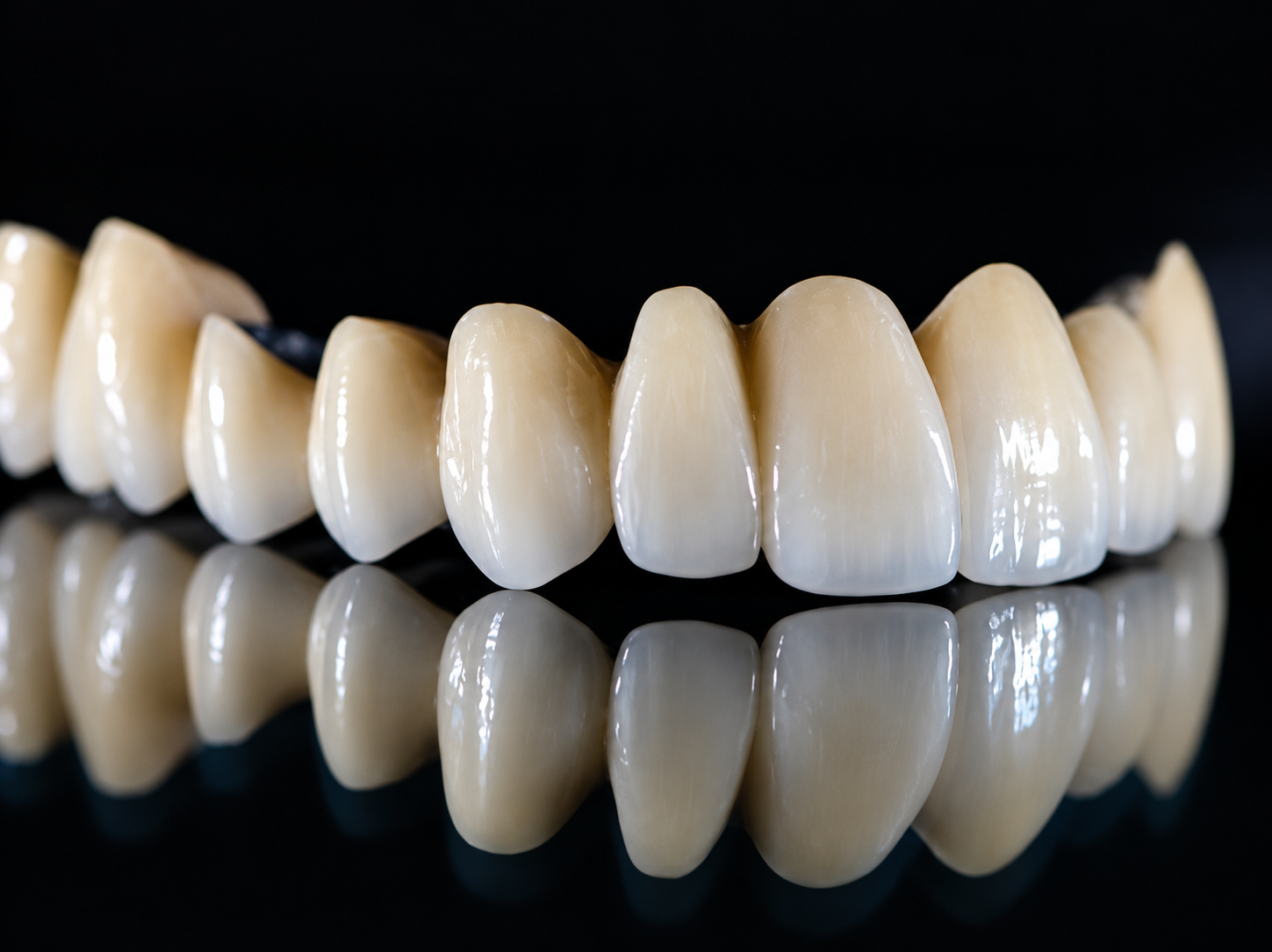
Dental ceramics are selected on the basis of both optical and mechanical properties.
2. Porcelain vs. Zirconia: How the Materials Differ
In everyday conversation both are simply called “ceramic crowns” or “porcelain teeth”, but they are two different groups of materials, differing in structure, the way they interact with light, their load-bearing capacity and how they attach to the tooth. There is also a third group, resin-matrix ceramics, which are hybrid materials containing ceramic particles in a resin matrix and are used selectively according to the dentist’s indication. They are therefore not part of the comparison below.
Composition and structure. Porcelain belongs to the glass-matrix ceramics, which include traditional feldspathic porcelain and glass-ceramics reinforced with crystals, such as lithium disilicate. Zirconia (zirconium dioxide) is a polycrystalline ceramic, made up of very tightly packed crystals with no glass phase [1]. By professional classification, therefore, zirconia is a ceramic but not a porcelain.
Aesthetics. Light enters natural enamel, scatters and is reflected back out, giving the tooth colour its depth. Glass-matrix ceramics generally have the optical properties closest to natural enamel, which is why they are often considered for front teeth, where aesthetics is a priority. Early zirconia was fairly opaque and was usually used as an inner framework, covered with a layer of veneering porcelain on the outside to achieve a natural appearance. Newer generations of zirconia are more translucent and suitable for monolithic (single-material) restorations, but translucency still varies between generations and products, and there is generally a trade-off between translucency and strength [3].
Masking the underlying tooth colour. Because of its relative opacity, zirconia can be useful when a darkened underlying tooth or core needs to be masked. With glass-matrix ceramics, the colour of the underlying tooth and the thickness of the material have a greater influence on the final colour, so the dentist needs to take this into account from the planning stage.
Strength and load-bearing capacity. Zirconia stands out for the strength of the material. With glass-matrix ceramics, strength varies with the formulation and thickness, and feldspathic porcelain is generally lower than reinforced glass-ceramics such as lithium disilicate. It is worth noting that all ceramic materials are brittle and can fracture under unsuitable loading [4]. With zirconia, chipping of the veneering porcelain was a recognised technical complication, and this is one of the reasons monolithic zirconia restorations were developed; a 2024 review suggests that monolithic zirconia has some clinical advantages over veneered zirconia [3][4]. Even so, the final result still depends on the design, thickness, bonding or cementation, and each person’s bite forces.
How it attaches to the tooth. Glass-matrix ceramics are usually adhesively bonded to the tooth, so enough enamel and dentine must remain for bonding, and the ceramic surface is treated with its own protocol before bonding. Zirconia has its own surface treatment and cementation protocol, which differs from that of glass-matrix ceramics. For both groups, the outcome depends on carrying out the correct protocol for the specific material [5].
Amount of tooth reduction and design. Each material and each product has a different minimum thickness. Veneers and other thin restorations usually use glass-matrix ceramics because they can be bonded to enamel, while full-coverage crowns can use either group depending on the position and condition of the tooth. The preparation design is decided by the dentist, balancing the requirements of the material against the goal of preserving as much natural tooth as possible.
| Criterion | Porcelain (glass-matrix ceramic) | Zirconia (polycrystalline ceramic) |
| Structure | Contains a glass phase; includes feldspathic porcelain and reinforced glass-ceramics such as lithium disilicate | Tightly packed crystals, no glass phase |
| Aesthetics | Generally closest to natural enamel, with natural translucency | Varies by generation; newer types are more translucent, but translucency and strength usually need to be balanced |
| Masking underlying colour | Depends heavily on the underlying tooth colour and the material thickness | Relative opacity can help with masking |
| Strength | Varies with formulation and thickness | High material strength; the result still depends on design, thickness and bite forces |
| Bonding | Usually adhesively bonded; needs enough enamel and dentine | Own surface treatment and cementation protocol |
| Commonly considered for | Veneers, inlays/onlays, front-tooth crowns where aesthetics is a priority | Teeth under heavy chewing loads, extensive damage, or where the underlying colour needs masking |
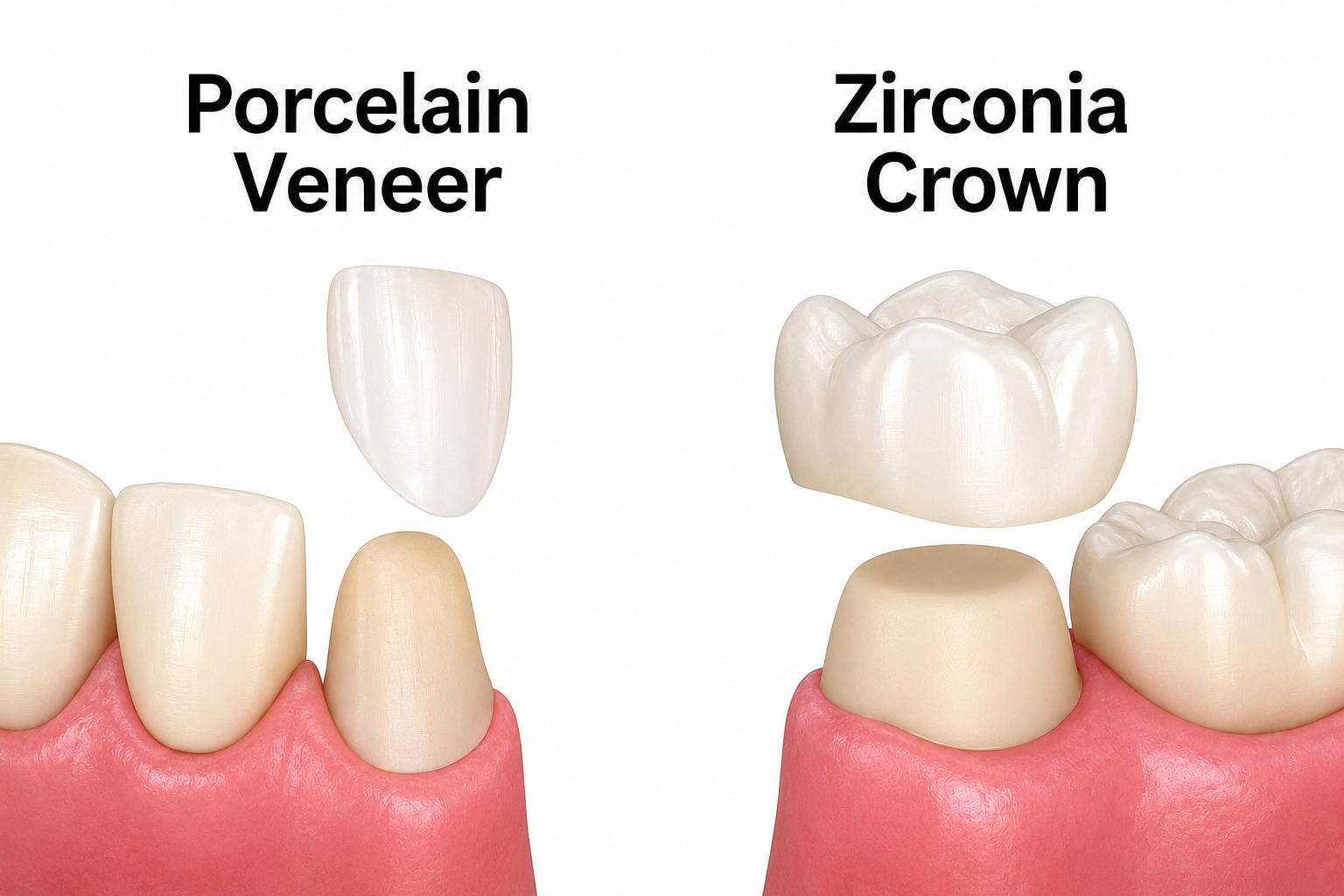
Porcelain and zirconia differ in structure, aesthetics, strength and bonding, and each suits different indications
At Elite Dental, we believe in maximum preservation with minimal intervention. We take the time to listen to your wishes, understand your dental condition, and recommend treatment options based on scientific evidence — not just short-term results.
If your expectations differ from what we consider clinically appropriate, we’ll explain why and work with you to find an alternative that best supports your long-term oral health. For more complex cases, our specialist dentists may come together to discuss the case and determine the most suitable materials and treatment approach.
Our goal is to help you maintain healthy teeth and achieve a smile that feels natural, looks harmonious with your facial features, and stands the test of time.
3. How Dentists Choose the Material
The choice of material is made after examination, based on several factors considered together.
Tooth position and bite forces. Back teeth carry heavier chewing loads than front teeth, so the strength requirements of the material differ between the two areas.
Remaining tooth structure. The amount of healthy enamel and dentine affects the preparation design and how reliable bonding or cementation will be.
Underlying tooth colour. A darkened tooth or one with a core may need a material or thickness that masks the colour.
Biting habits. Grinding or clenching increases the load on every type of restoration and needs to be taken into account when choosing the material.
Aesthetic expectations. The neighbouring teeth, the smile line and the patient’s priorities influence the colour, translucency and shape of the restoration.
4. Traditional and Digital Restoration Processes
In the traditional process, the dentist takes an impression of the teeth with impression material, a plaster model is poured from the impression, and the restoration is fabricated on that model. In the digital CAD/CAM process, an intraoral scanner records the teeth and soft tissue as a 3D model in place of a physical impression. This model is loaded into software for design (CAD: Computer-Aided Design), and the design data is then sent to a machine that mills the restoration from a block of material (CAM: Computer-Aided Manufacturing).
In terms of performance, systematic reviews comparing digital and conventional impressions report that the marginal fit of the restoration is comparable between the two methods, and that patients generally find scanning more comfortable [7]. Another review of single ceramic crowns reported better marginal and internal fit in the digital impression group [8]. Results still differ between studies, but digital impressions are generally regarded as meeting the standard of care [9]. Conventional impressions remain the preference of many dentists in certain situations, for example when a full arch needs to be recorded or when the margin of the restoration lies below the gum line [10].
Whichever process is used, the direct check in the mouth, covering fit, contact with neighbouring teeth, bite and aesthetics, remains the deciding step before the restoration is placed. Digital technology allows better control of the data, but it does not replace the dentist’s clinical judgement.
5. Coordination Between the Dentist and the Technician
Depending on each clinic’s model, the design and fabrication steps may be carried out by the dentist, a technician or both. What they have in common is that information about the teeth, the bite, colour and aesthetic expectations needs to be communicated clearly so that the material and design can perform as intended. A 2025 evidence-based guideline on all-ceramic restorations on implants recommends that material selection be coordinated between the dentist and the technician, particularly given that there are many generations of zirconia with different compositions [6].
6. Ceramic Restorations at Elite Dental
Elite Dental is a premium international dental group operating to US standards, with treatment plans built on scientific evidence and the principle of maximum preservation of natural teeth with minimal intervention. What stands out in ceramic restorations at Elite Dental is that digital technology is used as a routine part of treatment, not limited to special cases. CAD/CAM ceramic restorations have been offered at Elite Dental since 2018 and form part of the everyday digital workflow [11].
Elite Dental’s digital system has three connected components, so that each patient’s data can be used throughout, from diagnosis to fabrication.
| Equipment | Role in the process |
| 3D Cone Beam CT (CBCT) | Diagnostic imaging, providing the initial data |
| 3Shape Trios 3D intraoral scanner | Digital impressions |
| Cerec CAD/CAM system | Design and fabrication of the restoration from a monolithic ceramic block |
Because the data is controlled on a 3D model, the dentist has an additional basis for calculating how much tooth reduction is needed, in line with the principle of preservation that Elite Dental follows. This process can be applied to full ceramic crowns, inlays, onlays, overlays and veneers, depending on the clinical indication. For veneers, the process also includes digital smile design, so that patients can visualise the planned shape before treatment. The ceramic and the treatment option suited to each tooth are decided by the treating dentist after examination.
In terms of quality standards, Elite Dental is the first dental group in Vietnam to achieve AACI (American Accreditation Commission International) accreditation, with a score of 95.33/100 under Version 2.1 of the standards for dental facilities. The accreditation was awarded on 8 September 2025, officially announced on 20 October 2025, and applies to all three branches: Huynh Tinh Cua, Tu Xuong and Metropole (Thu Thiem). For advice on the restoration option that suits you, please call our hotline on (+84) 28 7306 3838.
7. The CAD/CAM Ceramic Restoration Process at Elite Dental
The CAD/CAM ceramic restoration process at Elite Dental has four steps, digitised continuously from impression to finishing.
Step 1 – Digital impression. The dentist uses the Trios intraoral scanner to record the teeth and soft tissue as a 3D model, in place of a physical impression tray. This step is the foundation that determines how well the restoration fits later on, and it is usually less uncomfortable than taking an impression with material.
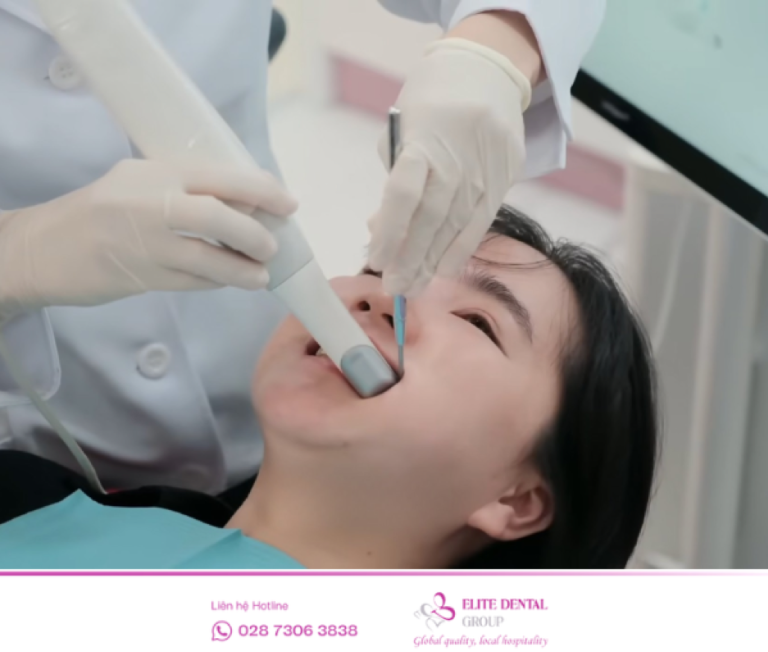 A digital impression with an intraoral scanner replaces the physical impression tray
Step 2 – Design (CAD). The 3D model is loaded into the design software, where the shape, size and bite of the restoration are built to suit each patient.
Step 3 – Fabrication (CAM). The design data is sent to the Cerec system, which mills the restoration from a monolithic ceramic block, giving a uniform structure.
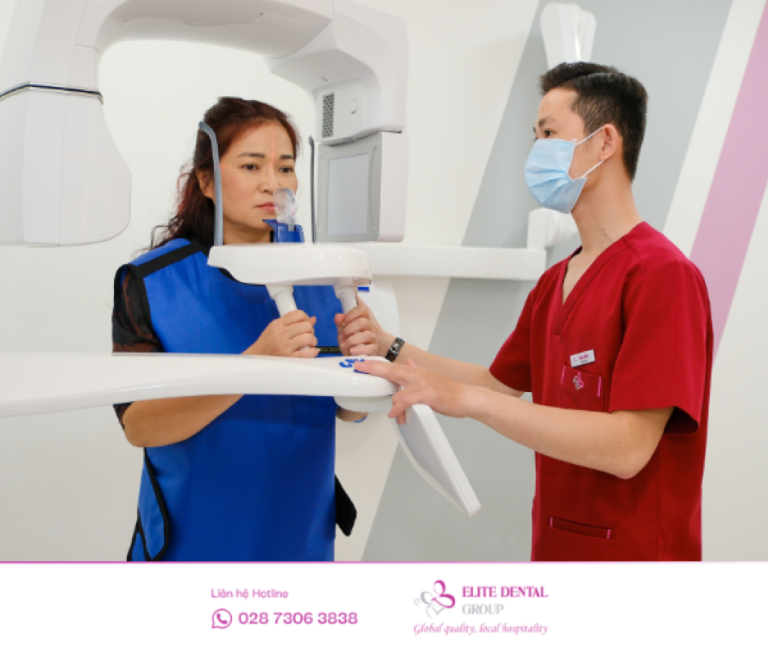
Digital imaging helps our dentists assess the patient’s teeth and jaw structure to support accurate diagnosis and treatment planning
Step 4 – Try-in, finishing and placement. The restoration is tried in the mouth, the bite is adjusted, the aesthetics are finished, and the restoration is then fixed onto the tooth. How much treatment time is saved through digitisation can vary with the indication and the specifics of each case.
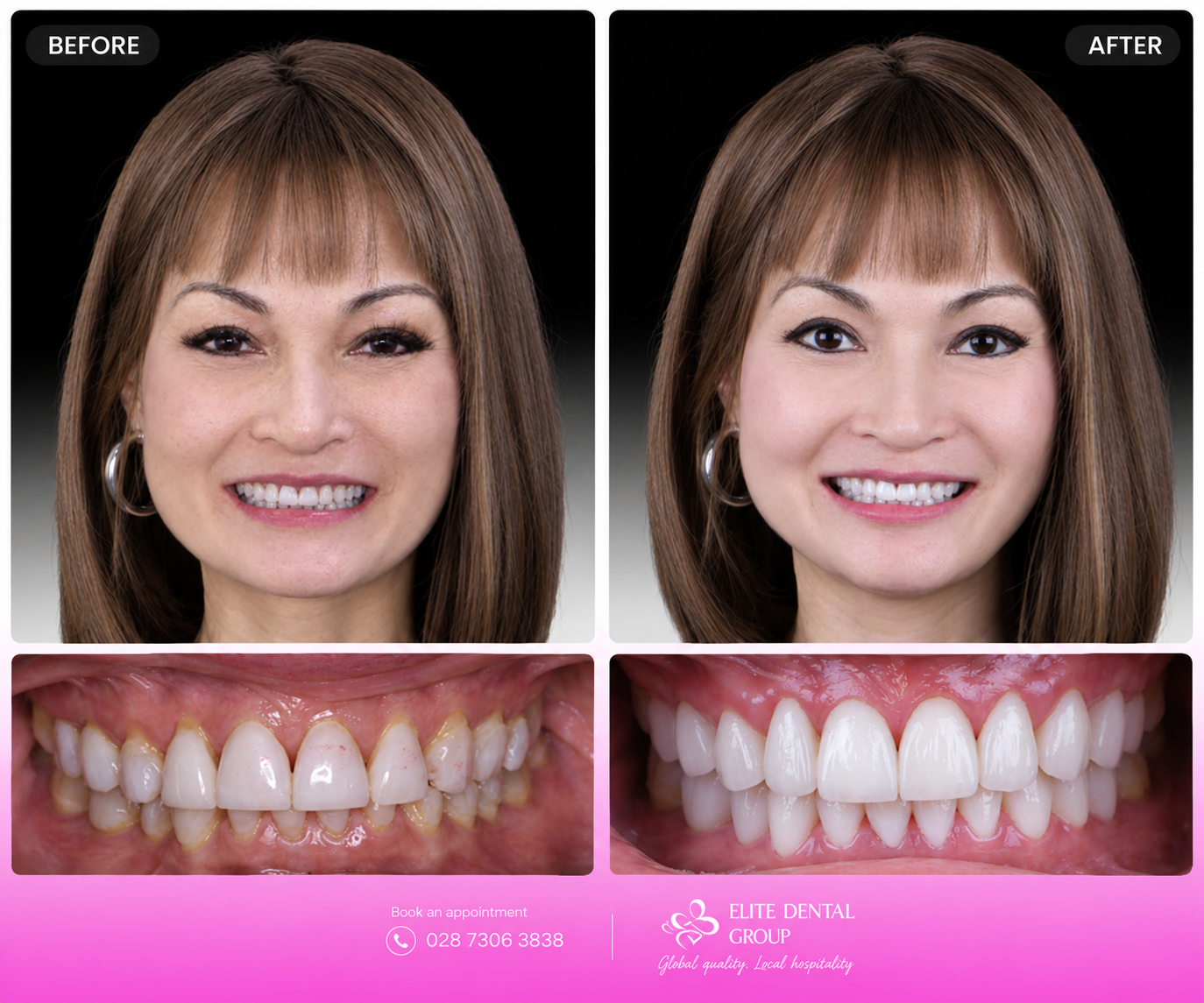
A beautiful smile, renewed with confidence — natural, harmonious, and uniquely yours
8. What to Ask Your Dentist Before Treatment
Before agreeing to a restoration plan, patients can ask the dentist about three groups of issues. The first is the material: which ceramic is recommended for this tooth and why, what alternatives were considered, and how much natural tooth will need to be removed with that material and design. The second is the process: how the restoration will be impressed and fabricated, how the colour and shape will be planned and checked before placement, and what happens if the fit or bite needs adjusting. The third is the period after treatment: how to care for the restoration day to day, and the recommended review schedule.
Conclusion
A suitable ceramic restoration is the result of several factors working together: a material that suits each tooth, a controlled impression and fabrication process, and a careful check before placement. Porcelain and zirconia each have their own strengths, and the choice between them should be based on examination, not on the name of the material. The digital process is a tool that supports those steps, while the outcome still depends on the dentist’s diagnosis and expertise. Elite Dental uses the digital process routinely across its whole group, with the aim of balancing oral health, function and aesthetics.
Frequently Asked Questions
How do porcelain and zirconia differ? Porcelain is a glass-matrix ceramic. It generally has natural translucency and is often considered when aesthetics is a priority, such as for veneers and front teeth. Zirconia is a polycrystalline ceramic with no glass phase, stands out for its material strength and can help mask a darkened underlying tooth. The two also differ in how their surfaces are treated and how they are attached to the tooth.
Is zirconia always stronger than porcelain? Zirconia has higher material strength, but material strength does not mean a restoration will not run into complications. The result also depends on the design, thickness, bonding or cementation and bite forces, and every ceramic material can fracture under unsuitable loading. The dentist chooses the material tooth by tooth.
How does a CAD/CAM restoration differ from a traditional one? The difference lies in how the data is created: an intraoral scanner and design software replace the physical impression and plaster model, and the restoration is then milled from a block of material. The try-in, bite adjustment and placement steps remain similar.
Are digital impressions more accurate than conventional impressions? Systematic reviews report comparable or better fit with digital impressions, and patients generally find them more comfortable. Results are not entirely consistent between studies, and the dentist may choose the impression method that suits each situation.
What digital equipment does Elite Dental use for ceramic restorations? The system includes a 3D Cone Beam CT for diagnostic imaging, the Trios 3D intraoral scanner for digital impressions and the Cerec CAD/CAM system for design and fabrication. CAD/CAM has been in routine use at Elite Dental since 2018.
References
- Gracis S, Thompson VP, Ferencz JL, Silva NRFA, Bonfante EA. A new classification system for all-ceramic and ceramic-like restorative materials. Int J Prosthodont. 2015;28(3). https://quintessence-publishing.com/usa/de/journal/the-international-journal-of-prosthodontics/2015/03
- Conrad HJ, Seong WJ, Pesun IJ. Current ceramic materials and systems with clinical recommendations: a systematic review. J Prosthet Dent. 2007;98(5):389-404. https://experts.umn.edu/en/publications/current-ceramic-materials-and-systems-with-clinical-recommendatio/
- A narrative review on polycrystalline ceramics for dental applications and proposed update of a classification system. Materials (MDPI). https://archive-ouverte.unige.ch/unige:180263
- Emerging trends and clinical recommendations for zirconia ceramic crowns: a concise review. Br Dent J. 2024. doi:10.1038/s41415-024-7616-0. https://www.ncbi.nlm.nih.gov/pmc/articles/PMC11245382/
- Clinician’s Guide to Material Selection for All-Ceramics in Modern Digital Dentistry. Materials. 2025;18(10):2235. https://doi.org/10.3390/ma18102235
- German S3 guideline on implant-supported all-ceramic restorations. Int J Implant Dent. 2025;11:53. https://journalimplantdent.springeropen.com/articles/10.1186/s40729-025-00641-7
- Comparative assessment of complete-coverage, fixed tooth-supported prostheses fabricated from digital scans or conventional impressions: a systematic review and meta-analysis. https://www.hal.inserm.fr/inserm-03021968v1
- Accuracy of single-unit ceramic crown fabrication after digital versus conventional impressions: a systematic review and meta-analysis. https://pmc.ncbi.nlm.nih.gov/articles/PMC10262093
- Tsu L. 10-Minute EBD: Digital Scans or Conventional Impressions: Which Results in Better Crowns? J Mich Dent Assoc. 2022;104(3). https://commons.ada.org/journalmichigandentalassociation/vol104/iss3/9
- Digital versus conventional impressions: a comparative study in single-crown fabrication. Rev Med Chir. https://www.revmedchir.ro/index.php/revmedchir/article/view/3290
- Elite Dental. CAD/CAM technology in ceramic restorations: the digital workflow at Elite Dental (Vietnamese). 13 June 2026. elitedental.com.vn
Please note: This article is intended for general information only and is not a substitute for professional dental advice. Every patient’s oral health is different, so the most suitable material and treatment can only be determined after an in-person examination with a qualified dentist.