


Table of content
- Short answer
- 📌 5 Things to Know About Jawbone Resorption
- What Is Jawbone Resorption?
- Bone Loss Timeline After Tooth Extraction
- Effects on Face, Teeth, and Function
- Treatment: Implants, Bone Grafts, and Full-Arch Solutions
- Implant Pricing and International Comparison
- Why Vietnam for Implant Care
- Why Choose Elite Dental Vietnam for Implant Care
- What to Ask During Your Consultation
- Frequently Asked Questions
- Conclusion
- Your Safety at Elite Dental Vietnam
- References
Short answer
Jawbone resorption after tooth loss is progressive. The fastest changes often occur in the first months after extraction, then continue more slowly over time. Long-term bone loss can make Implants, bridges, or dentures more complex. A dentist or Implant specialist should assess bone volume and plan tooth replacement before treatment options narrow.
📌 5 Things to Know About Jawbone Resorption
1. Jawbone resorption begins immediately after a tooth is lost — up to 25 percent of the horizontal bone width is typically lost in the first six months, with continued slower loss every year afterwards.
2. Without treatment, the bone shrinks horizontally and vertically, the adjacent teeth tilt into the gap, and the long-term cost of restoration becomes higher because bone grafting may be needed before an Implant can be placed.
3. Among tooth-replacement options, dental Implants are the closest to a root-like solution because they can transmit chewing force to the jawbone. Suitability still depends on bone volume, gum health, bite force, hygiene, and the patient’s medical condition.
4. When bone volume is already insufficient, modern grafting and sinus lift procedures rebuild the ridge and restore Implant eligibility — but every month of delay after extraction makes the workup more complex.
5. Elite Dental Vietnam plans Implant cases with 3D Cone Beam CT imaging when bone mapping is needed and performs surgery under AACI accreditation (95.33/100). It offers Korean Implants, Hahn (USA) and Neodent (Switzerland, manufactured in Brazil), and Straumann (Switzerland) brands across single-tooth and full-arch cases.
| 📞 Call Elite Dental Vietnam at (+84) 28 7306 3838 to schedule a consultation. |
|---|
What Is Jawbone Resorption?
Jawbone resorption is the gradual loss of bone density and volume in the jaw that occurs after tooth extraction or tooth loss. The jawbone needs constant mechanical stimulation from tooth roots during chewing to maintain its structure. When a tooth is removed, the bone that previously supported it no longer receives this stimulation and begins to shrink — a biological process driven by osteoclast cells breaking down bone tissue faster than osteoblasts can rebuild it.
The process is governed by Wolff’s Law: bone adapts its structure to the loads placed upon it. When a tooth is present, each bite transmits roughly 20 to 30 pounds of force through the root into the surrounding bone, signalling osteoblasts to maintain density. When the tooth is removed, that signal disappears, and the body redirects calcium and minerals to other areas where they are still being used. This is why bone loss after extraction is not a disease — it is a natural physiological response to the absence of function.
The clinical consequence is significant for facial appearance, the stability of remaining teeth, and future dental treatment options — particularly Implant eligibility. Understanding the timeline of bone loss helps patients make informed decisions about replacement strategy and timing.
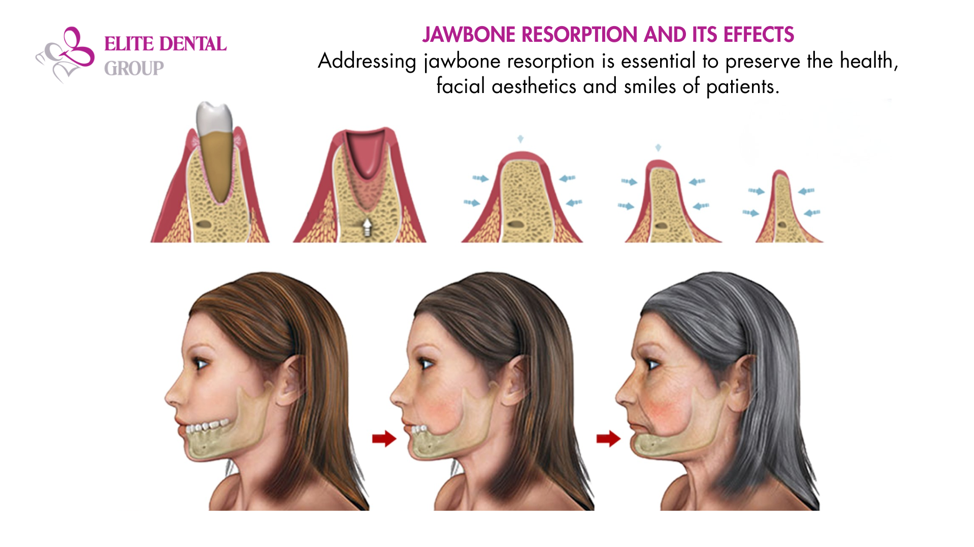
Images of tooth socket resorption over time
Bone Loss Timeline After Tooth Extraction
Bone resorption follows a predictable pattern, although the rate varies by individual factors including age, systemic health, smoking status, and the location of the missing tooth. The anterior mandible (front lower jaw) loses bone more slowly than the posterior regions; the maxilla (upper jaw) loses bone faster than the mandible because the maxillary sinus expands downward into the resorbing ridge.
| Time After Extraction | Bone Changes | Clinical Significance |
|---|---|---|
| 0–3 months | Blood clot organizes; initial bone remodeling begins; socket contracts | Socket healing; ideal window for immediate Implant or socket preservation graft |
| 3–6 months | Up to 25% of horizontal bone width lost; ridge narrowing visible on X-ray | Implant placement still feasible in most cases without grafting |
| 6–12 months | Continued width and vertical height reduction; ridge shape changes | Bone grafting may be needed before Implant; delayed placement more complex |
| 1–3 years | Significant vertical bone loss; alveolar ridge flattens noticeably | Ridge atrophy visible clinically; Implant options narrow |
| 5+ years | Severe atrophy; jaw height may decrease 50–60% from original dimensions | Major bone grafting, block grafts, or zygomatic Implants may be required |
This timeline underscores the value of early intervention. Every month of delay after tooth loss means more bone is permanently lost. The sooner a missing tooth is replaced with an Implant, the more bone is preserved for long-term stability and function.
The posterior mandible resorbs faster than the anterior region because it has thinner cortical plates and is subject to greater chewing forces. The maxilla presents an additional challenge: as bone resorbs, the maxillary sinus expands downward into the alveolar ridge — a process called pneumatization. Upper-jaw bone loss is therefore effectively doubled, with the ridge shrinking from below while the sinus expands from above. After several years without teeth, the available bone for Implant placement in the upper jaw may be less than 3 to 4 mm, requiring a sinus lift procedure before Implant surgery.
The rate of bone loss varies with several patient-specific factors. Smokers lose bone faster than non-smokers because nicotine impairs blood supply to the jaw. Patients with uncontrolled diabetes experience accelerated resorption due to compromised healing. Wearing a removable denture that presses on the ridge accelerates bone loss through mechanical compression — denture wearers lose bone meaningfully faster than patients with no prosthesis at all. Multiple adjacent missing teeth create a larger area of unstimulated bone, leading to faster and more severe resorption than a single missing tooth.
Effects on Face, Teeth, and Function
Bone resorption affects far more than the extraction site — it changes the entire facial structure over time. The lower third of the face shortens as bone height decreases, creating a sunken or prematurely aged appearance. Cheeks lose their bony support and appear hollow. The chin may protrude or rotate upward as the bite collapses, and the distance between the nose and chin visibly decreases. These changes happen gradually over 5 to 10 years, but they are difficult to reverse once established.
Adjacent teeth begin tilting into the gap left by a missing tooth, and the opposing tooth may over-erupt because nothing on the other side restrains it. This creates a cascading problem: the bite becomes uneven, certain teeth wear faster than others, the temporomandibular joint comes under additional stress, and chewing efficiency drops. Over several years, these secondary effects can lead to the loss of additional teeth — which is the cycle that an early Implant restoration is meant to interrupt.
| 📞 Considering bone-loss assessment or an Implant consultation? Contact Elite Dental Vietnam — hotline (+84) 28 7306 3838 — to schedule an evaluation. |
|---|
Treatment: Implants, Bone Grafts, and Full-Arch Solutions
Dental Implants are one of the most evidence-based options for helping limit further jawbone resorption after tooth loss. The titanium Implant fixture integrates with the surrounding bone through a process called osseointegration, after which the Implant transmits chewing forces to the jaw the way a natural root does. Studies in the Implant literature show that Implants maintain bone volume at levels comparable to natural teeth across long follow-up periods.
Osseointegration takes approximately 3 to 6 months depending on bone quality, Implant surface characteristics, and patient health. During this period, the titanium surface bonds directly with the surrounding bone at the molecular level, creating an anchor that can withstand normal bite forces. Modern Implant surfaces are treated with micro-roughening and chemical modification — Straumann’s SLActive surface, for example — to accelerate the process; in favorable cases, stable integration can be achieved in around 6 to 8 weeks.
At Elite Dental Vietnam, Implant planning typically uses 3D Cone Beam CT when detailed bone mapping is needed, especially for cases involving limited bone volume, sinus proximity, full-arch rehabilitation, or navigated Implant placement. The CBCT identifies bone height and width, maps the inferior alveolar nerve and the maxillary sinus, and informs the choice of Implant length, diameter, and position. For complex cases, Navigation DCarer dynamic surgical guidance may be used, with the plan generated from CBCT and intraoral scan data to support more controlled Implant placement. CAD/CAM digital workflows may be used for provisional or final restorations where appropriate. For full-arch rehabilitation, cross-Implant spatial verification may be used to support a passive-fit prosthetic framework.
When bone volume is insufficient for direct Implant placement, bone grafting rebuilds the ridge. Options include guided bone regeneration with synthetic bone substitutes, autogenous grafts taken from the patient’s own body, and sinus lift procedures that add bone to the upper jaw where the maxillary sinus has expanded into the extraction site. Bone grafting at Elite Dental Vietnam costs 10,000,000 to 20,000,000 VND ($380–$770) for localized grafts depending on technique and volume; full-arch grafting is priced separately based on the surgical workup.
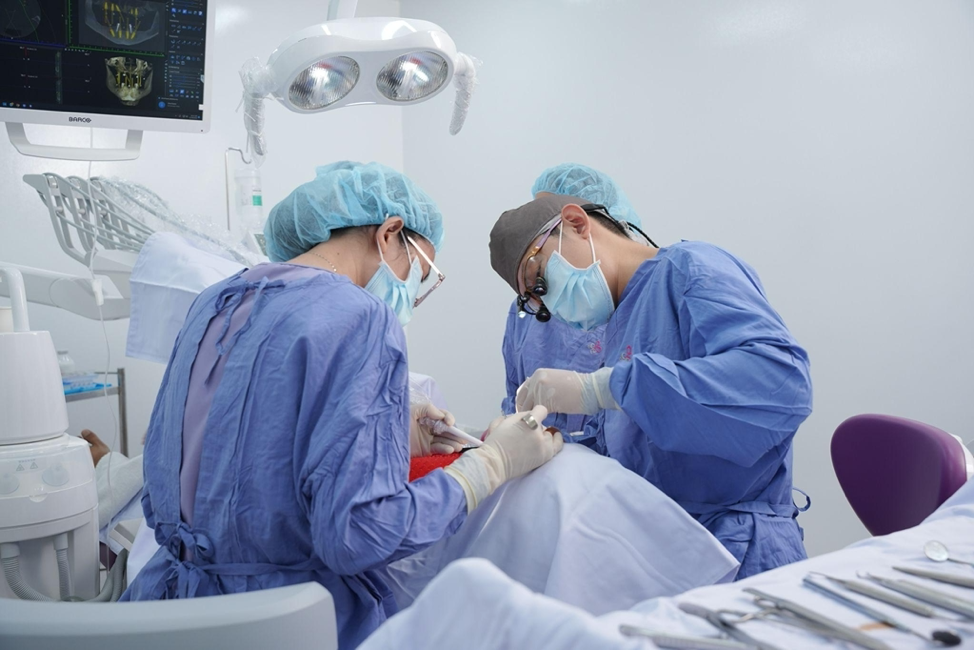
The bone grafting procedure for treating jawbone resorption at Elite Dental adheres to international standards, ensuring high effectiveness.
Implant Pricing and International Comparison
Implant treatment at Elite Dental Vietnam uses three premium brand families: Korean Implants for the entry-level package, Hahn (USA) and Neodent (Switzerland, manufactured in Brazil) for the mid-tier package, and Straumann (Switzerland) for the premium package. Pricing includes the Implant fixture, abutment, and porcelain crown for single-tooth cases.
| Solution | Price (VND) | Price (USD) |
|---|---|---|
| Single Implant + crown (Korean Implants / Hahn-Neodent / Straumann) | 30,000,000–46,000,000 | $1,165–$1,775 |
| All-on-4 (one arch) | 210,000,000–260,000,000 | $8,100–$10,000 |
| All-on-6 (one arch) | 250,000,000–300,000,000 | $9,700–$11,600 |
All Implant pricing includes Implant post, abutment, and zirconia crown.
The international comparison table below shows indicative pricing across major dental destinations. Actual costs depend on case complexity, brand selection, and any grafting or sinus-lift work required.
| Treatment | Vietnam (Elite) | Thailand | S. Korea | Australia | USA |
|---|---|---|---|---|---|
| Single Implant + crown | $1,165–$1,775 | $1,200–$2,500 | $1,500–$3,000 | $4,000–$6,500 | $3,000–$5,000 |
| All-on-4 (one arch) | $8,100–$10,000 | $10,000–$18,000 | $12,000–$22,000 | $20,000–$35,000 | $20,000–$40,000 |
| All-on-6 (one arch) | $9,700–$11,600 | $14,000–$22,000 | $16,000–$28,000 | $25,000–$40,000 | $25,000–$50,000 |
| Bone graft / sinus lift | $380–$770 | $300–$700 | $400–$1,000 | $800–$2,500 | $500–$1,500 |
Indicative price range across markets. Source: Elite Dental Vietnam price list April 2026 vs. publicly available international averages.
Why Vietnam for Implant Care
Vietnam has emerged as a practical destination for expat residents and dental travelers who want Implant care at lower cost than markets such as the USA, Australia, or South Korea. The final plan still depends on case complexity and clinical indication. A typical full-arch program (All-on-4 or All-on-6, including grafting if needed and the final prosthesis) may be lower-priced than comparable Western pricing. The price difference is influenced by lower operating and labor costs in Vietnam, while final quality still depends on diagnosis, materials, clinical execution, sterilization standards, and follow-up.
At Elite Dental Vietnam, Implant care is delivered through a workflow aligned with international Implant-planning principles. These include panoramic 2D imaging for an initial overview, 3D Cone Beam CT when clinically indicated, Navigation DCarer dynamic surgical guidance in selected cases, selective bone-work tools for grafting and sinus-lift procedures where appropriate, computer-controlled anesthesia for comfort when used, and PRF/PRP biologics in selected cases. All are supported by AACI-accredited clinical governance. See why international patients choose full-arch dental Implants in Vietnam
English-language coordination is provided across all three clinics: Tu Xuong, Huynh Tinh Cua, and Metropole (Thu Thiem). The Elite Dental Vietnam team supports appointment scheduling, post-operative follow-up, and consultation on accommodation and transit. A typical Implant program is sequenced over two trips spaced approximately 3 to 6 months apart, with the schedule adjusted to the individual case based on bone quality, healing, and any grafting required.
Why Choose Elite Dental Vietnam for Implant Care
Implant outcomes are set in two places: the diagnostic workup before surgery, and the technical execution at the chair. Elite Dental Vietnam controls both under AACI accreditation — the first AACI-accredited dental system in Vietnam (95.33/100). The clinical record is traceable end-to-end from intake imaging through to the final post-operative review, and the documentation is shareable with the patient’s home-country dentist after the trip.
Surgical care is led by clinicians experienced in complex Implant cases, including full-arch rehabilitation, immediate loading where indicated, and bone grafting in compromised ridges. The clinic’s Implantology section is chaired by a senior clinician who is also Chair of the ITI Vietnam Section, which informs case selection and protocol standards. The team works with the three brand families noted above — Korean Implants for accessible single-tooth cases, Hahn-Neodent for mid-tier and full-arch cases, and Straumann for premium cases — so the brand can be matched to the case rather than to inventory.
Pre-operative planning, intraoperative precision, and post-operative biological support are three independent variables. Elite Dental Vietnam controls all three — a standard patients should reasonably expect from a structured Implant protocol.
What to Ask During Your Consultation
Use the consultation to connect the general guidance in this article to your own diagnosis, budget, timeline, and treatment pathway. Useful questions include:
For international or expat patients, also ask whether records can be reviewed before arrival and how much time should be reserved in Ho Chi Minh City for examination, treatment, and follow-up.
- What happens if I wait another 6-12 months?
- Do I need bone grafting before Implant treatment?
- Is the bone loss local to one tooth, or part of a broader periodontal problem?
- How much bone volume remains in the missing-tooth area?
Frequently Asked Questions
Can bone loss be reversed without Implants?
Bone grafting can rebuild lost bone volume, but without ongoing mechanical stimulation, grafted bone may gradually resorb again over time. Among tooth-replacement options, dental Implants are the closest to a root-like solution because they can transmit chewing force to the jawbone. Suitability still depends on bone volume, gum health, bite force, and the patient’s medical condition.
How fast does bone loss happen after extraction?
The most rapid bone loss occurs in the first 3 to 6 months, with up to 25 percent of horizontal bone width lost in that window. The rate slows after the first year but continues indefinitely without an Implant or other intervention to stimulate the bone.
Does a dental bridge prevent bone loss?
A bridge replaces the visible crown but does not provide root-like stimulation to the underlying bone. Bone resorption may continue beneath a bridge because chewing force is transferred through neighboring teeth rather than through the missing-tooth site. Among available tooth-replacement options, a dental Implant is the closest to a root-like solution because it can transmit chewing force to the jawbone when the patient is a suitable candidate.
How long do Implant-based restorations last?
Implant fixtures themselves have very long survival rates with proper hygiene and regular maintenance. The crown or prosthesis attached to the Implant has a different lifespan and may need refurbishment over the years. Long-term success depends on the diagnostic workup, the surgical execution, and ongoing maintenance — which is why Elite Dental Vietnam treats Implant care as a multi-decade relationship rather than a single procedure.
What does the All-on-4 or All-on-6 program include?
The Elite Dental Vietnam packages cover the Implant placement surgery and the final fixed CAD/CAM prosthesis (titanium or zirconia framework with porcelain teeth). Bone grafting, sinus lifts, sedation, and any provisional restorations are priced separately based on the surgical workup. Pricing is transparent and itemized at the consultation before treatment is committed.
Conclusion
Bone resorption after tooth loss is biological, not optional — and the timeline is short. Within 6 months, up to a quarter of the horizontal bone width can be permanently lost; within 5 years, the available bone may have decreased by half or more. The right time to plan an Implant restoration is before the bone has shrunk to the point where grafting becomes the dominant cost.
Elite Dental Vietnam delivers Implant care through a workflow aligned with international Implant-planning principles: 3D CBCT planning when clinically indicated, Navigation DCarer dynamic surgical guidance in selected cases, selective bone-work tools where appropriate, computer-controlled anesthesia when used, and PRF/PRP biological support in selected cases. This runs under AACI-accredited clinical governance, with Implant systems selected according to the diagnosis and approved treatment plan.
If you have lost a tooth recently or are wondering whether your existing bridge or denture is causing ongoing bone loss, a 30-minute consultation at Elite Dental Vietnam can help. With 3D CBCT when clinically indicated, it will give you a clear picture of where you stand and what the realistic options are.
Your Safety at Elite Dental Vietnam
Elite Dental is the first dental system in Vietnam to receive accreditation from the American Accreditation Commission International (AACI). Under AACI Dental Standards Version 2.1, Elite Dental achieved a score of 95.33 out of 100 and continues to hold this accreditation in 2026. You can read more on our AACI accreditation page.
AACI accreditation serves as an independent third-party validation of the quality standards that Elite Dental has consistently maintained through its rigorous clinical and operational practices over many years. The accreditation is valid for one year and is subject to periodic reassessment and renewal.
The accreditation was awarded on September 8, 2025, and officially announced on October 20, 2025. It applies across all three Elite Dental locations: Huynh Tinh Cua, Tu Xuong and Metropole (Thu Thiem).
Consultation Hotline: (+84) 28 7306 3838
Website: elitedental.com.vn
| 📞 If you would like a 3D CBCT-based bone assessment or an Implant treatment plan, call Elite Dental Vietnam at (+84) 28 7306 3838 to book a consultation. |
|---|
Elite Dental Vietnam — AACI-accredited | (+84) 28 7306 3838 | elitedental.com.vn/en
Tu Xuong · Huynh Tinh Cua · Metropole (Thu Thiem)
References
1. Schropp L, Wenzel A, Kostopoulos L, Karring T. Bone healing following single-tooth extraction: a 12-month prospective study. Int J Periodontics Restorative Dent. 2003;23(4):313-323. https://pubmed.ncbi.nlm.nih.gov/12956475/
2. Atwood DA. Reduction of residual ridges: a major oral disease entity. J Prosthet Dent. 1971;26(3):266-279. https://pubmed.ncbi.nlm.nih.gov/4934740/
3. American Academy of Implant Dentistry. Dental Implants Facts and Figures. https://www.aaid.com/
4. World Health Organization. Oral Health Fact Sheet. https://www.who.int/news-room/fact-sheets/detail/oral-health
Disclaimer: The information in this article is for educational purposes only and does not replace an in-person consultation with a qualified dentist or Implant specialist. Contact Elite Dental Vietnam for personalized advice.